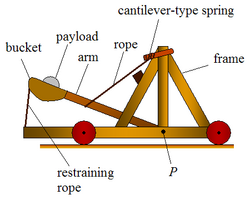
Created page with "thumb|Basic diagram of an [[Onager (weapon)|Onager, a type of catapult]] A '''catapult''' is a ballistic device used to launch a projectile a great distance without the aid of gunpowder or other propellants – particularly various types of ancient and medieval siege engines.<ref>{{cite book|title= The art of the catapult: build Greek ballista, Roman onagers, English trebuchets, and more ancient artillery|last= Gurstelle|..."
[[File:Mang2.png|thumb|Basic diagram of an [[Onager (weapon)|Onager]], a type of catapult]]
A '''catapult''' is a [[ballistics|ballistic]] device used to launch a [[projectile]] a great distance without the aid of [[gunpowder]] or other [[propellant]]s – particularly various types of ancient and medieval [[siege engine]]s.<ref>{{cite book|title= The art of the catapult: build Greek ballista, Roman onagers, English trebuchets, and more ancient artillery|last= Gurstelle|first= William|author-link= William Gurstelle|year= 2004|publisher= Chicago Review Press|location= Chicago|isbn= 978-1-55652-526-1|oclc= 54529037|url-access= registration|url= https://archive.org/details/artofcatapult00will}}</ref> A catapult uses the sudden release of stored [[potential energy]] to propel its payload. Most convert [[Tension (mechanics)|tension]] or [[Torsion (mechanics)|torsion]] energy that was more slowly and manually built up within the device before release, via springs, bows, twisted rope, elastic, or any of numerous other materials and mechanisms.
{{Redirect category shell|1=
In use since ancient times, the catapult has proven to be one of the most persistently effective mechanisms in warfare. In modern times the term can apply to devices ranging from a simple hand-held implement (also called a "[[slingshot]]") to a mechanism for [[Aircraft catapult|launching aircraft from a ship]].
{{R from plural}}
}}
The earliest catapults date to at least the 7th century BC, with King [[Uzziah]], of Judah, recorded as equipping the walls of Jerusalem with machines that shot "great stones".<ref>{{Cite web|title=Bible, King James Version|url=https://quod.lib.umich.edu/cgi/k/kjv/kjv-idx?type=DIV2&byte=1884604|access-date=2022-01-19|website=quod.lib.umich.edu}}</ref> Catapults are mentioned in [[Yajurveda]] under the name "Jyah" in chapter 30, verse 7.<ref>[https://archive.org/stream/yajurveda029670mbp/yajurveda029670mbp_djvu.txt Full text of "The Yajur Veda"]<!--Reference to "Jyah" or catapults not found at this location or elsewhere in this text--></ref> In the 5th century BC the [[mangonel]] appeared in [[ancient China]], a type of [[trebuchet|traction trebuchet]] and catapult.<ref name="Chevedden"/><ref name=Trebuchet/> Early uses were also attributed to [[Ajatashatru]] of [[Magadha]] in his, 5th century BC, war against the [[Licchavi (kingdom)|Licchavi]]s.<ref name="google">{{cite book|title=A History of Ancient and Early Medieval India: From the Stone Age to the 12th Century|author=Singh, U.|date=2008|publisher=Pearson Education|isbn=9788131711200|url=https://books.google.com/books?id=H3lUIIYxWkEC|page=272|access-date=October 5, 2014|url-status=live|archive-url=https://web.archive.org/web/20140703065417/http://books.google.com/books?id=H3lUIIYxWkEC|archive-date=July 3, 2014}}</ref> Greek catapults were invented in the early 4th century BC, being attested by [[Diodorus Siculus]] as part of the equipment of a Greek army in 399 BC, and subsequently used at the [[siege of Motya]] in 397 BC.<ref name="Diod. Sic. 14.42.1">Diod. Sic. 14.42.1.</ref><ref>Campbell, Duncan (2003), Greek and Roman Artillery 399 BC – AD 363, p.3"</ref>
==Etymology==
The word 'catapult' comes from the [[Latin]] 'catapulta', which in turn comes from the [[Greek language|Greek]] {{Lang-grc|καταπέλτης}}<ref>{{cite EB1911|wstitle=Catapult}}</ref> (''katapeltēs''), itself from κατά (''kata''), "downwards"<ref>
{{citation |url=https://www.perseus.tufts.edu/hopper/text?doc=Perseus%3Atext%3A1999.04.0057%3Aentry%3Dkata%2F1 |contribution=κατά |publisher=Tufts |first1=Henry George |last1=Liddell |first2=Robert |last2=Scott |title=A Greek-English Lexicon |type=definition |series=Perseus |url-status=live |archive-url=https://web.archive.org/web/20120513155555/http://www.perseus.tufts.edu/hopper/text?doc=Perseus%3Atext%3A1999.04.0057%3Aentry%3Dkata%2F1 |archive-date=2012-05-13 }}</ref> and πάλλω (''pallō''), "to toss, to hurl".<ref>{{Citation |url=https://www.perseus.tufts.edu/hopper/text?doc=Perseus%3Atext%3A1999.04.0057%3Aentry%3Dpa%2Fllw |contribution=πάλλω |first1=Henry George |last1=Liddell |first2=Robert |last2=Scott |title=A Greek-English Lexicon |publisher=Tufts |series=Perseus |url-status=live |archive-url=https://web.archive.org/web/20131111192039/http://www.perseus.tufts.edu/hopper/text?doc=Perseus%3Atext%3A1999.04.0057%3Aentry%3Dpa%2Fllw |archive-date=2013-11-11 }}.</ref><ref>{{citation |url=http://oxforddictionaries.com/definition/catapult |contribution=catapult |publisher=Oxford |title=Dictionaries |type=definition |url-status=dead |archive-url=https://web.archive.org/web/20120702092148/http://oxforddictionaries.com/definition/catapult |archive-date=2012-07-02 }}</ref> Catapults were invented by the [[ancient Greeks]]<ref>{{cite journal |last=Schellenberg |first=Hans Michael |year=2006 |url=http://s145739614.online.de/fera/ausgabe3/Schellenberg.pdf |title=Diodor von Sizilien 14,42,1 und die Erfindung der Artillerie im Mittelmeerraum |journal=Frankfurter Elektronische Rundschau zur Altertumskunde |volume=3 |pages=14–23 |url-status=live |archive-url=https://web.archive.org/web/20131103073739/http://s145739614.online.de/fera/ausgabe3/Schellenberg.pdf |archive-date=2013-11-03 }}</ref>{{Sfn | Marsden | 1969 | pp = 48–64}} and in [[ancient India]] where they were used by the [[Magadha]]n Emperor [[Ajatashatru]] around the early to mid 5th century BC.<ref>Singh, U. (2008). A History of Ancient and Early Medieval India: From the Stone Age to the 12th Century. Pearson Education. p. 272. {{ISBN|9788131711200}}. Retrieved October 5, 2014.</ref>
== Greek and Roman catapults ==
{{Main article|Greek and Roman artillery}}
[[File:Ancient Mechanical Artillery. Pic 01.jpg|thumb|Ancient mechanical artillery: Catapults (standing), the chain drive of [[Polybolos]] (bottom center), [[Gastraphetes]] (on wall)]]
[[File:Ancient Roman catapult - Discours de la religion des anciens Romains (1581) (14763485952) (enhanced).jpg|thumb|Engraving illustrating a Roman catapult design, 1581]]
[[File:047 Conrad Cichorius, Die Reliefs der Traianssäule, Tafel XLVII (Ausschnitt 02).jpg|thumb|Roman "catapult-nest" in the [[Trajan's Dacian Wars]]]]
The catapult and [[crossbow]] in Greece are closely intertwined. Primitive catapults were essentially "the product of relatively straightforward attempts to increase the range and penetrating power of missiles by strengthening the bow which propelled them".<ref name = "Barton C. Hacker" /> The historian [[Diodorus Siculus]] (fl. 1st century BC), described the invention of a mechanical arrow-firing catapult (''katapeltikon'') by a Greek task force in 399 BC.<ref name="Diod. Sic. 14.42.1"/><ref name = "Duncan Campbell, p.3">
{{Harvnb
| Campbell
| 2003
| p = 3
}}.</ref> The weapon was soon after employed against [[Sicilian Wars#The Second Sicilian War (410 BC–340 BC)|Motya]] (397 BC), a key [[Ancient Carthage|Carthaginian]] stronghold in [[Sicily]].<ref>Diod. Sic. 14.50.4</ref><ref name="Duncan Campbell, p.8">{{Harvnb | Campbell | 2003 | p = 8}}.</ref> Diodorus is assumed to have drawn his description from the highly rated{{Sfn | Marsden | 1969 | pp = 48f}} history of [[Philistus]], a contemporary of the events then. The introduction of crossbows however, can be dated further back: according to the inventor [[Hero of Alexandria]] (fl. 1st century AD), who referred to the now lost works of the 3rd-century BC engineer [[Ctesibius]], this weapon was inspired by an earlier foot-held crossbow, called the ''[[gastraphetes]]'', which could store more energy than the Greek bows. A detailed description of the ''gastraphetes'', or the "belly-bow",<ref name= "Serafina Cuomo">
}}.</ref>{{Page needed | date = December 2013}} along with a watercolor drawing, is found in Heron's technical treatise ''Belopoeica''.<ref name= "Duncan Campbell, p.4">
{{Harvnb
| Campbell
| 2003
| p = 4
}}.</ref><ref>
{{Citation
| first1 = Stanley M
| last1 = Burstein
| first2 = Walter
| last2 = Donlan
| first3 = Sarah B
| last3 = Pomeroy
| first4 = Jennifer Tolbert
| last4 = Roberts
| year = 1999
| title = Ancient Greece: A Political, Social, and Cultural History
A third Greek author, [[Biton (writer)|Biton]] (fl. 2nd century BC), whose reliability has been positively reevaluated by recent scholarship,<ref name = "Duncan Campbell, p.3" />{{Sfn | Lewis | 1999}} described two advanced forms of the ''gastraphetes'', which he credits to [[Zopyrus of Tarentum|Zopyros]], an engineer from [[Taranto|southern Italy]]. Zopyrus has been plausibly equated with a [[Pythagoreanism|Pythagorean]] of that name who seems to have flourished in the late 5th century BC.<ref>{{Citation | url = http://plato.stanford.edu/entries/pythagoreanism/ | first = Peter | last = Kingsley | title = Ancient Philosophy, Mystery and Magic | publisher = Clarendon | place = Oxford | year = 1995 | pages = 150ff}}.</ref>{{Efn | Lewis established a lower date of no later than the mid-4th century.{{Sfn | Lewis | 1999 | p = 160}} So did de Camp.<ref>{{Citation | first = L Sprague | last = de Camp | title = Master Gunner Apollonios | journal = [[Technology and Culture]] | volume = 2 | number = 3 | year = 1961 | pages = 240–4 (241) | doi=10.2307/3101024| jstor = 3101024 | s2cid = 111523345 }}.</ref>}} He probably designed his bow-machines on the occasion of the sieges of [[Cumae]] and [[Milet]] between 421 BC and 401 BC.<ref>Biton 65.1–67.4, 61.12–65.1.</ref><ref name= "Duncan Campbell, p.5">{{Harvnb | Campbell | 2003 | p = 5}}.</ref> The bows of these machines already featured a winched pull back system and could apparently throw two missiles at once.<ref name="Duncan Campbell, p.8" />
[[Philo of Byzantium]] provides probably the most detailed account on the establishment of a theory of belopoietics (''belos'' = "projectile"; ''poietike'' = "(art) of making") circa 200 BC. The central principle to this theory was that "all parts of a catapult, including the weight or length of the projectile, were proportional to the size of the torsion springs". This kind of innovation is indicative of the increasing rate at which geometry and physics were being assimilated into military enterprises.<ref name="Serafina Cuomo" />{{Page needed | date = December 2013}}
From the mid-4th century BC onwards, evidence of the Greek use of arrow-shooting machines becomes more dense and varied: arrow firing machines (''katapaltai'') are briefly mentioned by [[Aeneas Tacticus]] in his treatise on siegecraft written around 350 BC.<ref name="Duncan Campbell, p.8"/> An extant inscription from the [[Athens|Athenian]] arsenal, dated between 338 and 326 BC, lists a number of stored catapults with shooting bolts of varying size and springs of sinews.<ref name = "Eric William Marsden, p.57">{{Harvnb | Marsden | 1969 | p = 57}}.</ref> The later entry is particularly noteworthy as it constitutes the first clear evidence for the switch to [[torsion (mechanics)|torsion]] catapults, which are more powerful than the more-flexible crossbows and which came to dominate Greek and [[Ancient Rome|Roman]] artillery design thereafter.<ref name = "Duncan Campbell, p.8ff">{{Harvnb | Campbell | 2003 | pp = 8ff}}.</ref> This move to torsion springs was likely spurred by the engineers of Philip II of Macedonia.<ref name= "Serafina Cuomo"/>{{Page needed | date = December 2013}} Another Athenian inventory from 330 to 329 BC includes catapult bolts with heads and flights.<ref name = "Eric William Marsden, p.57" /> As the use of catapults became more commonplace, so did the training required to operate them. Many Greek children were instructed in catapult usage, as evidenced by "a 3rd Century B.C. inscription from the island of Ceos in the Cyclades [regulating] catapult shooting competitions for the young".<ref name="Serafina Cuomo"/> Arrow firing machines in action are reported from [[Philip II of Macedon|Philip II]]'s siege of [[Perinth]] ([[Thrace]]) in 340 BC.<ref name="Eric William Marsden, p.60">{{Harvnb | Marsden | 1969 | p = 60}}.</ref> At the same time, Greek fortifications began to feature high towers with shuttered windows in the top, which could have been used to house anti-personnel arrow shooters, as in [[Aigosthena]].<ref>{{Citation | first = Josiah | last = Ober | title = Early Artillery Towers: Messenia, Boiotia, Attica, Megarid | journal = American Journal of Archaeology | volume = 91 | number = 4 | year = 1987 | pages = 569–604 (569) | doi=10.2307/505291| jstor = 505291 | s2cid = 191377778 }}.</ref> Projectiles included both arrows and (later) stones that were sometimes lit on fire.{{clarify|stones lit on fire?|date=October 2022}} [[Onomarchus]] of Phocis first used catapults on the battlefield against [[Philip II of Macedon]].{{Sfn | Ashley | 1998 | pp = 50, 446}} Philip's son, [[Alexander the Great]], was the next commander in recorded history to make such use of catapults on the battlefield{{Sfn | Ashley | 1998 | p = 50}} as well as to use them during sieges.<ref>{{Citation | last1 = Skelton | first1 = Debra | first2 = Pamela | last2 = Dell | url = https://books.google.com/books?id=O8TDQG6jiG4C&pg=PA21 | title = Empire of Alexander the Great | place = New York | publisher = Facts on File | year = 2003 | isbn = 978-0-8160-5564-7 | access-date = January 31, 2013 | pages = 21, 26, 29 | url-status = live | archive-url = https://web.archive.org/web/20171223060540/https://books.google.com/books?id=O8TDQG6jiG4C&pg=PA21 | archive-date = December 23, 2017 }}.</ref>
The Romans started to use catapults as arms for their wars against [[Syracuse, Italy|Syracuse]], Macedon, Sparta and Aetolia (3rd and 2nd centuries BC). The Roman machine known as an [[arcuballista]] was similar to a large crossbow.<ref>{{Citation | contribution = Arcuballista | place = [[France|FR]] | url = http://dagr.univ-tlse2.fr/sdx/dagr/feuilleter.xsp?tome=1&partie=1&numPage=400&filtre=arbal%C3%A8te%20&nomEntree=ARCUBALLISTA | language = fr | title = Dictionnaire des antiquités grecques et romaines | trans-title = Dictionary of Greek and Roman antiquities | publisher = Univ TLSE II | url-status = live | archive-url = https://web.archive.org/web/20081005121645/http://dagr.univ-tlse2.fr/sdx/dagr/feuilleter.xsp?tome=1&partie=1&numPage=400&filtre=arbal%C3%A8te%20&nomEntree=ARCUBALLISTA | archive-date = 2008-10-05 }}.</ref><ref>{{Citation | last = Bachrach | first = Bernard S | url = https://books.google.com/books?id=Is2WQyLMKV4C&pg=PA112 | title = Early Carolingian Warfare: Prelude to Empire | place = Philadelphia | publisher = University of Pennsylvania Press | year = 2001 | isbn = 978-0-8122-3533-3 | access-date = January 31, 2013 | pages = 110–12 | url-status = live | archive-url = https://web.archive.org/web/20171223060540/https://books.google.com/books?id=Is2WQyLMKV4C&pg=PA112 | archive-date = December 23, 2017 }}.</ref><ref>{{Citation | last = Payne-Gallwey | first = Ralph | url = https://books.google.com/books?id=xCDK0twV82MC&pg=PA43 | title = The Crossbow: Its Military and Sporting History, Construction and Use | place = New York | publisher = Skyhorse | year = 2007 | isbn = 978-1-60239-010-2 | access-date = January 31, 2013 | pages = 43–44 | url-status = live | archive-url = https://web.archive.org/web/20171223060540/https://books.google.com/books?id=xCDK0twV82MC&pg=PA43 | archive-date = December 23, 2017 }}.</ref> Later the Romans used [[ballista]] catapults on their warships.
== Other ancient catapults ==
In chronological order:
* 19th century BC, Egypt, walls of the fortress of [[Buhen]] appear to contain platforms for siege weapons.<ref>{{Cite book|last1=Lewis|first1=Leo Richard|title=The Compendium of Weapons, Armor & Castles|last2=Tenney|first2=Charles R.|publisher=Nabu Press|year=2010|isbn=978-1146066846|pages=139}}</ref>
* c.750 BC, Judah, King [[Uzziah]] is documented as having overseen the construction of machines to "shoot great stones".<ref>{{bibleverse-lb|2|Chronicles|26:15|HE}}</ref>
* between 484 and 468 BC, India, [[Ajatashatru]] is recorded in Jaina texts as having used catapults in his campaign against the [[Licchavi (tribe)|Licchavis]].<ref name="google"/>
* between 500 and 300 BC, China, recorded use of [[mangonel]]s.<ref name="Chevedden">Chevedden, Paul E.; et al. (July 1995). "The Trebuchet". Scientific American: 66–71. Original version.</ref><ref name=Trebuchet>[http://www.medievalists.net/2013/01/13/the-trebuchet/ The Trebuchet], Citation:"The trebuchet, invented in China between the fifth and third centuries B.C.E., reached the Mediterranean by the sixth century C.E. "</ref><ref name=PAUL>PAUL E. CHEVEDDEN, [http://www.doaks.org/resources/publications/dumbarton-oaks-papers/dop54/dp54ch4.pdf The Invention of the Counterweight Trebuchet: A Study in Cultural Diffusion] {{webarchive|url=https://web.archive.org/web/20140610032737/http://www.doaks.org/resources/publications/dumbarton-oaks-papers/dop54/dp54ch4.pdf |date=2014-06-10 }}, p.71, p.74, See citation:"The traction trebuchet, invented by the Chinese sometime before the fourth century B.C." in page 74</ref> They were probably used by the [[Mohist]]s as early as the 4th century BC, descriptions of which can be found in the [[Mozi|''Mojing'']] (compiled in the 4th century BC).<ref name=Trebuchet/><ref name=PAUL/> In Chapter 14 of the ''Mojing'', the mangonel is described hurling hollowed out logs filled with burning charcoal at enemy troops.{{sfn|Liang|2006}} The mangonel was carried westward by the [[Pannonian Avars|Avars]] and appeared next in the eastern Mediterranean by the late 6th century AD, where it replaced torsion powered siege engines such as the ballista and onager due to its simpler design and faster rate of fire.{{sfn|Purton|2009|p=366}}<ref name="Chevedden"/>{{sfn|Graff|2016|p=141}} The Byzantines adopted the mangonel possibly as early as 587, the Persians in the early 7th century, and the Arabs in the second half of the 7th century.{{sfn|Graff|2016|p=86}} The [[Franks]] and [[Saxons]] adopted the weapon in the 8th century.{{sfn|Purton|2009|p=367}}
== Medieval catapults ==
[[File:Replica catapult.jpg|right|thumb|Replica of a Petraria Arcatinus]]
[[File:Front of medieval catapult 2 in Mercato San Severino, Italy.JPG|thumb|Petraria Arcatinus catapult in Mercato San Severino, Italy]]
[[File:Catapult 1 Mercato San Severino.jpg|thumb|Catapult 1 Mercato San Severino]]
[[Castle]]s and fortified [[walled cities]] were common during this period and catapults were used as [[siege weapon]]s against them. As well as their use in attempts to breach walls, [[Early thermal weapons|incendiary missiles]], or diseased carcasses or garbage could be catapulted over the walls.
Defensive techniques in the Middle Ages progressed to a point that rendered catapults largely ineffective. The [[Siege of Paris (885–886)|Viking siege of Paris]] (885–6 A.D.) "saw the employment by both sides of virtually every instrument of siege craft known to the classical world, including a variety of catapults", to little effect, resulting in failure.<ref name="Barton C. Hacker">{{Citation | last = Hacker | first = Barton C | jstor = 3102042 | title = Greek Catapults and Catapult Technology: Science, Technology, and War in Ancient World| journal = Technology and Culture | year = 1968 | volume = 9 | issue = 1 | pages = 34–50 | doi = 10.2307/3102042 | s2cid = 112617914 }}.</ref>
The most widely used catapults throughout the Middle Ages were as follows:<ref name="Middle Ages">{{Citation | url = http://www.middle-ages.org.uk/catapults.htm | title = Middle ages | contribution = Catapults | place = United Kingdom | url-status = live | archive-url = https://web.archive.org/web/20100924235615/http://middle-ages.org.uk/catapults.htm | archive-date = 2010-09-24 }}.</ref>
; [[Ballista]]: Ballistae were similar to giant crossbows and were designed to work through torsion. The projectiles were large arrows or darts made from wood with an iron tip. These arrows were then shot "along a flat trajectory" at a target. Ballistae were accurate, but lacked firepower compared with that of a mangonel or trebuchet. Because of their immobility, most ballistae were constructed on site following a siege assessment by the commanding military officer.<ref name = "Middle Ages" />
:
; [[Springald]]: The springald's design resembles that of the ballista, being a crossbow powered by tension. The springald's frame was more compact, allowing for use inside tighter confines, such as the inside of a castle or tower, but compromising its power.<ref name="Middle Ages" />
:
; [[Mangonel]]: This machine was designed to throw heavy projectiles from a "bowl-shaped bucket at the end of its arm". Mangonels were mostly used for “firing various missiles at fortresses, castles, and cities,” with a range of up to {{convert|1,300|ft|abbr=on}}. These missiles included anything from stones to excrement to rotting carcasses. Mangonels were relatively simple to construct, and eventually wheels were added to increase mobility.<ref name = "Middle Ages" />
:
; [[Onager (siege weapon)|Onager]]: Mangonels are also sometimes referred to as Onagers. Onager catapults initially launched projectiles from a sling, which was later changed to a "bowl-shaped bucket". The word ''Onager'' is derived from the Greek word ''onagros'' for "wild ass", referring to the "kicking motion and force"<ref name = "Middle Ages"/> that were recreated in the Mangonel's design. Historical records regarding onagers are scarce. The most detailed account of Mangonel use is from “Eric Marsden's translation of a text written by Ammianus Marcellius in the 4th Century AD” describing its construction and combat usage.<ref name="catapults.info">{{Citation|url=http://www.catapults.info/ |archive-url=https://web.archive.org/web/20020601094938/http://www.catapults.info/ |url-status=dead |archive-date=2002-06-01 |title=Catapults info }}.</ref>
:
; [[Trebuchet]]: [[File:MongolsBesiegingACityInTheMiddleEast13thCentury.jpg|thumb|left|Mongol warriors using trebuchet to besiege a city]] Trebuchets were probably the most powerful catapult employed in the Middle Ages. The most commonly used ammunition were stones, but "darts and sharp wooden poles" could be substituted if necessary. The most effective kind of ammunition though involved fire, such as "firebrands, and deadly [[Greek Fire]]". Trebuchets came in two different designs: Traction, which were powered by people, or Counterpoise, where the people were replaced with "a weight on the short end".<ref name= "Middle Ages"/> The most famous historical account of trebuchet use dates back to the siege of [[Stirling Castle]] in 1304, when the army of Edward I constructed a giant trebuchet known as [[Warwolf]], which then proceeded to "level a section of [castle] wall, successfully concluding the siege".<ref name="catapults.info" />
:
; [[Trebuchet|Couillard]]: A simplified trebuchet, where the trebuchet's single counterweight is split, swinging on either side of a central support post.
:
; Leonardo da Vinci's catapult: [[Leonardo da Vinci]] sought to improve the efficiency and range of earlier designs. His design incorporated a large wooden [[leaf spring]] as an [[:wikt:accumulator|accumulator]] to power the catapult.{{citation needed |date=February 2011}} Both ends of the bow are connected by a rope, similar to the design of a [[bow and arrow]]. The leaf spring was not used to pull the catapult armature directly, rather the rope was wound around a drum. The catapult armature was attached to this drum which would be turned until enough potential energy was stored in the deformation of the spring. The drum would then be disengaged from the winding mechanism, and the catapult arm would snap around.{{citation needed | date = February 2011}} Though no records exist of this design being built during Leonardo's lifetime, contemporary enthusiasts have reconstructed it.{{citation needed|date=February 2011}}
== Modern use ==
=== Military ===
[[File:French grenade catapult.jpg|left|thumb|200px|French troops using a catapult to throw [[hand grenade]]s and other explosives during [[World War I]]]]
The last large scale military use of catapults was during the [[trench warfare]] of [[World War I]]. During the early stages of the war, catapults were used to throw [[hand grenade]]s across [[no man's land]] into enemy trenches. They were eventually replaced by small [[Mortar (weapon)|mortars]].
The SPBG (Silent Projector of Bottles and Grenades) was a soviet proposal anti-tank weapon that launched grenades from a spring loaded shuttle up to {{convert|100|m|abbr=on}}.<ref>{{cite web | url=https://www.tankarchives.ca/2016/08/russian-piat.html | title=Russian PIAT }}</ref>
In the 1840s, the invention of [[vulcanized]] [[natural rubber|rubber]] allowed the making of small hand-held catapults, either improvised from Y-shaped sticks or manufactured for sale; both were popular with children and teenagers. These devices were also known as [[slingshots]] in the United States.
Special variants called [[aircraft catapult]]s are used to launch planes from land bases and sea carriers when the takeoff runway is too short for a powered takeoff or simply impractical to extend.<ref>{{cite book |title=A Dictionary of Aviation |first=David W. |last=Wragg |isbn=9780850451634 |edition=first |publisher=Osprey |year=1973 |page=87}}</ref> Ships also use them to launch torpedoes and deploy bombs against submarines.{{dubious|date=June 2016}} Small catapults, referred to as "traps", are still widely used to launch [[clay target]]s into the air in the sport of [[clay pigeon shooting]].
=== Entertainment ===
In the 1990s and early 2000s, a powerful catapult, a trebuchet, was used by thrill-seekers first on private property and in 2001–2002 at Middlemoor Water Park, Somerset, England, to experience being catapulted through the air for {{convert|100|ft|m|sp=us}}. The practice has been discontinued due to a fatality at the Water Park. There had been an injury when the trebuchet was in use on private property. Injury and death occurred when those two participants failed to land onto the safety net.<ref>{{cite magazine |url=https://www.vanityfair.com/style/2004/02/oxford-university-dangerous-sports-club |title=Scandal: Extreme Oxford Sports |last=Martin |first=Brett |date=August 5, 2013 |magazine=Vanity Fair |access-date=November 13, 2017 |url-status=live |archive-url=https://web.archive.org/web/20170531102033/http://www.vanityfair.com/style/2004/02/oxford-university-dangerous-sports-club |archive-date=May 31, 2017 }}</ref> The operators of the trebuchet were tried, but found not guilty of manslaughter, though the jury noted that the fatality might have been avoided had the operators "imposed stricter safety measures."<ref>{{cite news |url=https://www.theguardian.com/education/2005/oct/31/highereducation.uk4 |title=Inquest told of student catapult death |newspaper=The Guardian |date=October 31, 2005 |access-date=December 8, 2014 |url-status=live |archive-url=https://web.archive.org/web/20150114133709/http://www.theguardian.com/education/2005/oct/31/highereducation.uk4 |archive-date=January 14, 2015 }}</ref><ref>{{cite news |url=http://news.bbc.co.uk/2/hi/uk_news/england/oxfordshire/4401024.stm |title=BBC NEWS UK England Oxfordshire - Safety doubts over catapult death |date=November 2, 2005 |access-date=December 8, 2014 |url-status=live |archive-url=https://web.archive.org/web/20141211151741/http://news.bbc.co.uk/2/hi/uk_news/england/oxfordshire/4401024.stm |archive-date=December 11, 2014 }}</ref> [[Human cannonball]] [[circus]] acts use a catapult launch mechanism, rather than gunpowder, and are risky ventures for the human cannonballs.<ref>{{cite news|url=http://www.straightdope.com/classics/a4_069.html|title=The Straight Dope: How do "human cannonballs" survive?|last=Adams|first=Cecil|date=1991-06-21|website=Straight Dope|publisher=Chicago Reader|access-date=November 13, 2017|url-status=live|archive-url=https://web.archive.org/web/20090106071839/http://www.straightdope.com/classics/a4_069.html|archive-date=January 6, 2009}}</ref>
Early [[launched roller coaster]]s used a catapult system powered by a diesel engine or a dropped weight to acquire their momentum,<ref>{{Cite book|url=https://books.google.com/books?id=OzZHAgAAQBAJ&pg=PA49|title=Coasters 101: An Engineer's Guide to Roller Coaster Design|last=Weisenberger|first=Nick|year=2013|isbn=9781468013559|pages=49–50|publisher=Nick Weisenberger |oclc=927712635|url-status=live|archive-url=https://web.archive.org/web/20171223060540/https://books.google.com/books?id=OzZHAgAAQBAJ&pg=PA49|archive-date=2017-12-23}}</ref> such as [[Shuttle Loop]] installations between 1977 and 1978. The catapult system for roller coasters has been replaced by [[flywheel]]s and later [[linear motor]]s.
''[[Pumpkin chunking]]'' is another widely popularized use, in which people compete to see who can launch a pumpkin the farthest by mechanical means (although the world record is held by a pneumatic air cannon).
=== Other ===
In January 2011, a homemade catapult was discovered that was used to [[Smuggling|smuggle]] [[cannabis (drug)|cannabis]] into the United States from Mexico. The machine was found {{convert|20|ft|abbr=on}} from the border fence with {{convert|4.4|lb}} bales of cannabis ready to launch.<ref>{{Citation | url = http://www.popsci.com/diy/article/2011-01/mexican-authorities-seize-homemade-marijuana-hurling-catapult-border | newspaper = Pop Sci | date = Jan 2011 | title = Mexican authorities seize homemade marijuana hurling catapult at border | url-status = live | archive-url = https://web.archive.org/web/20110130043830/http://www.popsci.com/diy/article/2011-01/mexican-authorities-seize-homemade-marijuana-hurling-catapult-border | archive-date = 2011-01-30 }}.</ref>
== See also ==
{{div col|colwidth=23em}}
* [[Aircraft catapult]]
* [[List of siege engines]]
* [[Mangonel]]
* [[Mass driver]]
* [[National Catapult Contest]]
* [[Sling (weapon)]]
* [[SPBG]]
* [[Trebuchet]]
{{div col end}}
== Notes ==
{{Notelist}}
==References==
{{Reflist|32em}}
==Bibliography==
* {{Citation | last = Ashley | first = James R | url = https://books.google.com/books?id=nTmXOFX-wioC&pg=PA50 | title = The Macedonian Empire: The Era of Warfare Under Philip II and Alexander the Great, 359–323 BC | place = Jefferson, NC | publisher = McFarland & Co | year = 1998 | isbn = 978-0-7864-1918-0 | access-date = January 31, 2013}}.
* {{Citation | first = Duncan | last = Campbell | title = Greek and Roman Artillery 399 BC – AD 363 | publisher = Osprey | place = Oxford | year = 2003 | isbn = 1-84176-634-8}}.
* {{Citation |last=Graff |first=David A. |title=The Eurasian Way of War Military Practice in Seventh-Century China and Byzantium |year=2016 |publisher=Routledge}}.
* {{Citation | first = MJT | last = Lewis | title = When was Biton? |journal = [[Mnemosyne (journal)|Mnemosyne]] | volume = 52 | number = 2 | year = 1999 | pages = 159–68 | doi=10.1163/1568525991528860}}.
* {{Citation |last=Liang|first=Jieming|title=Chinese Siege Warfare: Mechanical Artillery & Siege Weapons of Antiquity – An Illustrated History|year=2006}}.
* {{Citation | first = Eric William | last = Marsden | title = Greek and Roman Artillery: Historical Development | publisher = Clarendon | place = Oxford | year = 1969 | isbn = 978-0-19-814268-3}}.
* {{Citation|last=Purton|first=Peter|year=2009|title=A History of the Early Medieval Siege c.450-1200|publisher=The Boydell Press}}.
* {{Citation | url = http://www.mlahanas.de/Greeks/war/CatapultTypes.htm | contribution = Types | title = Ancient Greek Artillery Technology | publisher = Mlahanas | place = [[Germany|DE]] | url-status = dead | archive-url = https://web.archive.org/web/20160112160714/http://www.mlahanas.de/Greeks/war/CatapultTypes.htm | archive-date = 2016-01-12 }}.
* {{Citation | url = http://www.redstoneprojects.com/trebuchetstore/build_a_catapult.html | title = Trebuchet store | contribution = Catapult Plans and Design | publisher = Red stone projects}}.
* {{Citation | url = http://www.redstoneprojects.com/trebuchetstore/catapultanimation.html | title = Trebuchet store | contribution = Animated Catapults | publisher = Red stone projects}}.
A catapult is a ballistic device used to launch a projectile a great distance without the aid of gunpowder or other propellants – particularly various types of ancient and medieval siege engines.[1] A catapult uses the sudden release of stored potential energy to propel its payload. Most convert tension or torsion energy that was more slowly and manually built up within the device before release, via springs, bows, twisted rope, elastic, or any of numerous other materials and mechanisms.
In use since ancient times, the catapult has proven to be one of the most persistently effective mechanisms in warfare. In modern times the term can apply to devices ranging from a simple hand-held implement (also called a "slingshot") to a mechanism for launching aircraft from a ship.
The earliest catapults date to at least the 7th century BC, with King Uzziah, of Judah, recorded as equipping the walls of Jerusalem with machines that shot "great stones".[2] Catapults are mentioned in Yajurveda under the name "Jyah" in chapter 30, verse 7.[3] In the 5th century BC the mangonel appeared in ancient China, a type of traction trebuchet and catapult.[4][5] Early uses were also attributed to Ajatashatru of Magadha in his, 5th century BC, war against the Licchavis.[6] Greek catapults were invented in the early 4th century BC, being attested by Diodorus Siculus as part of the equipment of a Greek army in 399 BC, and subsequently used at the siege of Motya in 397 BC.[7][8]
The word 'catapult' comes from the Latin 'catapulta', which in turn comes from the GreekAncient Greek: καταπέλτης[9] (katapeltēs), itself from κατά (kata), "downwards"[10] and πάλλω (pallō), "to toss, to hurl".[11][12] Catapults were invented by the ancient Greeks[13][14] and in ancient India where they were used by the Magadhan Emperor Ajatashatru around the early to mid 5th century BC.[15]
Ancient mechanical artillery: Catapults (standing), the chain drive of Polybolos (bottom center), Gastraphetes (on wall)Engraving illustrating a Roman catapult design, 1581Roman "catapult-nest" in the Trajan's Dacian Wars
The catapult and crossbow in Greece are closely intertwined. Primitive catapults were essentially "the product of relatively straightforward attempts to increase the range and penetrating power of missiles by strengthening the bow which propelled them".[16] The historian Diodorus Siculus (fl. 1st century BC), described the invention of a mechanical arrow-firing catapult (katapeltikon) by a Greek task force in 399 BC.[7][17] The weapon was soon after employed against Motya (397 BC), a key Carthaginian stronghold in Sicily.[18][19] Diodorus is assumed to have drawn his description from the highly rated[20] history of Philistus, a contemporary of the events then. The introduction of crossbows however, can be dated further back: according to the inventor Hero of Alexandria (fl. 1st century AD), who referred to the now lost works of the 3rd-century BC engineer Ctesibius, this weapon was inspired by an earlier foot-held crossbow, called the gastraphetes, which could store more energy than the Greek bows. A detailed description of the gastraphetes, or the "belly-bow",[21][page needed] along with a watercolor drawing, is found in Heron's technical treatise Belopoeica.[22][23]
A third Greek author, Biton (fl. 2nd century BC), whose reliability has been positively reevaluated by recent scholarship,[17][24] described two advanced forms of the gastraphetes, which he credits to Zopyros, an engineer from southern Italy. Zopyrus has been plausibly equated with a Pythagorean of that name who seems to have flourished in the late 5th century BC.[25][lower-alpha 1] He probably designed his bow-machines on the occasion of the sieges of Cumae and Milet between 421 BC and 401 BC.[28][29] The bows of these machines already featured a winched pull back system and could apparently throw two missiles at once.[19]
Philo of Byzantium provides probably the most detailed account on the establishment of a theory of belopoietics (belos = "projectile"; poietike = "(art) of making") circa 200 BC. The central principle to this theory was that "all parts of a catapult, including the weight or length of the projectile, were proportional to the size of the torsion springs". This kind of innovation is indicative of the increasing rate at which geometry and physics were being assimilated into military enterprises.[21][page needed]
From the mid-4th century BC onwards, evidence of the Greek use of arrow-shooting machines becomes more dense and varied: arrow firing machines (katapaltai) are briefly mentioned by Aeneas Tacticus in his treatise on siegecraft written around 350 BC.[19] An extant inscription from the Athenian arsenal, dated between 338 and 326 BC, lists a number of stored catapults with shooting bolts of varying size and springs of sinews.[30] The later entry is particularly noteworthy as it constitutes the first clear evidence for the switch to torsion catapults, which are more powerful than the more-flexible crossbows and which came to dominate Greek and Roman artillery design thereafter.[31] This move to torsion springs was likely spurred by the engineers of Philip II of Macedonia.[21][page needed] Another Athenian inventory from 330 to 329 BC includes catapult bolts with heads and flights.[30] As the use of catapults became more commonplace, so did the training required to operate them. Many Greek children were instructed in catapult usage, as evidenced by "a 3rd Century B.C. inscription from the island of Ceos in the Cyclades [regulating] catapult shooting competitions for the young".[21] Arrow firing machines in action are reported from Philip II's siege of Perinth (Thrace) in 340 BC.[32] At the same time, Greek fortifications began to feature high towers with shuttered windows in the top, which could have been used to house anti-personnel arrow shooters, as in Aigosthena.[33] Projectiles included both arrows and (later) stones that were sometimes lit on fire.[clarification needed]Onomarchus of Phocis first used catapults on the battlefield against Philip II of Macedon.[34] Philip's son, Alexander the Great, was the next commander in recorded history to make such use of catapults on the battlefield[35] as well as to use them during sieges.[36]
The Romans started to use catapults as arms for their wars against Syracuse, Macedon, Sparta and Aetolia (3rd and 2nd centuries BC). The Roman machine known as an arcuballista was similar to a large crossbow.[37][38][39] Later the Romans used ballista catapults on their warships.
19th century BC, Egypt, walls of the fortress of Buhen appear to contain platforms for siege weapons.[40]
c.750 BC, Judah, King Uzziah is documented as having overseen the construction of machines to "shoot great stones".[41]
between 484 and 468 BC, India, Ajatashatru is recorded in Jaina texts as having used catapults in his campaign against the Licchavis.[6]
between 500 and 300 BC, China, recorded use of mangonels.[4][5][42] They were probably used by the Mohists as early as the 4th century BC, descriptions of which can be found in the Mojing (compiled in the 4th century BC).[5][42] In Chapter 14 of the Mojing, the mangonel is described hurling hollowed out logs filled with burning charcoal at enemy troops.[43] The mangonel was carried westward by the Avars and appeared next in the eastern Mediterranean by the late 6th century AD, where it replaced torsion powered siege engines such as the ballista and onager due to its simpler design and faster rate of fire.[44][4][45] The Byzantines adopted the mangonel possibly as early as 587, the Persians in the early 7th century, and the Arabs in the second half of the 7th century.[46] The Franks and Saxons adopted the weapon in the 8th century.[47]
Replica of a Petraria ArcatinusPetraria Arcatinus catapult in Mercato San Severino, ItalyCatapult 1 Mercato San Severino
Castles and fortified walled cities were common during this period and catapults were used as siege weapons against them. As well as their use in attempts to breach walls, incendiary missiles, or diseased carcasses or garbage could be catapulted over the walls.
Defensive techniques in the Middle Ages progressed to a point that rendered catapults largely ineffective. The Viking siege of Paris (885–6 A.D.) "saw the employment by both sides of virtually every instrument of siege craft known to the classical world, including a variety of catapults", to little effect, resulting in failure.[16]
The most widely used catapults throughout the Middle Ages were as follows:[48]
Ballistae were similar to giant crossbows and were designed to work through torsion. The projectiles were large arrows or darts made from wood with an iron tip. These arrows were then shot "along a flat trajectory" at a target. Ballistae were accurate, but lacked firepower compared with that of a mangonel or trebuchet. Because of their immobility, most ballistae were constructed on site following a siege assessment by the commanding military officer.[48]
The springald's design resembles that of the ballista, being a crossbow powered by tension. The springald's frame was more compact, allowing for use inside tighter confines, such as the inside of a castle or tower, but compromising its power.[48]
This machine was designed to throw heavy projectiles from a "bowl-shaped bucket at the end of its arm". Mangonels were mostly used for “firing various missiles at fortresses, castles, and cities,” with a range of up to 1,300 ft (400 m). These missiles included anything from stones to excrement to rotting carcasses. Mangonels were relatively simple to construct, and eventually wheels were added to increase mobility.[48]
Mangonels are also sometimes referred to as Onagers. Onager catapults initially launched projectiles from a sling, which was later changed to a "bowl-shaped bucket". The word Onager is derived from the Greek word onagros for "wild ass", referring to the "kicking motion and force"[48] that were recreated in the Mangonel's design. Historical records regarding onagers are scarce. The most detailed account of Mangonel use is from “Eric Marsden's translation of a text written by Ammianus Marcellius in the 4th Century AD” describing its construction and combat usage.[49]
Mongol warriors using trebuchet to besiege a city Trebuchets were probably the most powerful catapult employed in the Middle Ages. The most commonly used ammunition were stones, but "darts and sharp wooden poles" could be substituted if necessary. The most effective kind of ammunition though involved fire, such as "firebrands, and deadly Greek Fire". Trebuchets came in two different designs: Traction, which were powered by people, or Counterpoise, where the people were replaced with "a weight on the short end".[48] The most famous historical account of trebuchet use dates back to the siege of Stirling Castle in 1304, when the army of Edward I constructed a giant trebuchet known as Warwolf, which then proceeded to "level a section of [castle] wall, successfully concluding the siege".[49]
A simplified trebuchet, where the trebuchet's single counterweight is split, swinging on either side of a central support post.
Leonardo da Vinci's catapult
Leonardo da Vinci sought to improve the efficiency and range of earlier designs. His design incorporated a large wooden leaf spring as an accumulator to power the catapult.[citation needed] Both ends of the bow are connected by a rope, similar to the design of a bow and arrow. The leaf spring was not used to pull the catapult armature directly, rather the rope was wound around a drum. The catapult armature was attached to this drum which would be turned until enough potential energy was stored in the deformation of the spring. The drum would then be disengaged from the winding mechanism, and the catapult arm would snap around.[citation needed] Though no records exist of this design being built during Leonardo's lifetime, contemporary enthusiasts have reconstructed it.[citation needed]
The last large scale military use of catapults was during the trench warfare of World War I. During the early stages of the war, catapults were used to throw hand grenades across no man's land into enemy trenches. They were eventually replaced by small mortars.
The SPBG (Silent Projector of Bottles and Grenades) was a soviet proposal anti-tank weapon that launched grenades from a spring loaded shuttle up to 100 m (330 ft).[50]
In the 1840s, the invention of vulcanizedrubber allowed the making of small hand-held catapults, either improvised from Y-shaped sticks or manufactured for sale; both were popular with children and teenagers. These devices were also known as slingshots in the United States.
Special variants called aircraft catapults are used to launch planes from land bases and sea carriers when the takeoff runway is too short for a powered takeoff or simply impractical to extend.[51] Ships also use them to launch torpedoes and deploy bombs against submarines.[dubious – discuss] Small catapults, referred to as "traps", are still widely used to launch clay targets into the air in the sport of clay pigeon shooting.
In the 1990s and early 2000s, a powerful catapult, a trebuchet, was used by thrill-seekers first on private property and in 2001–2002 at Middlemoor Water Park, Somerset, England, to experience being catapulted through the air for 100 feet (30 m). The practice has been discontinued due to a fatality at the Water Park. There had been an injury when the trebuchet was in use on private property. Injury and death occurred when those two participants failed to land onto the safety net.[52] The operators of the trebuchet were tried, but found not guilty of manslaughter, though the jury noted that the fatality might have been avoided had the operators "imposed stricter safety measures."[53][54]Human cannonballcircus acts use a catapult launch mechanism, rather than gunpowder, and are risky ventures for the human cannonballs.[55]
Early launched roller coasters used a catapult system powered by a diesel engine or a dropped weight to acquire their momentum,[56] such as Shuttle Loop installations between 1977 and 1978. The catapult system for roller coasters has been replaced by flywheels and later linear motors.
Pumpkin chunking is another widely popularized use, in which people compete to see who can launch a pumpkin the farthest by mechanical means (although the world record is held by a pneumatic air cannon).
In January 2011, a homemade catapult was discovered that was used to smugglecannabis into the United States from Mexico. The machine was found 20 ft (6.1 m) from the border fence with 4.4 pounds (2.0 kg) bales of cannabis ready to launch.[57]
↑ 4.04.14.2Chevedden, Paul E.; et al. (July 1995). "The Trebuchet". Scientific American: 66–71. Original version.
↑ 5.05.15.2The Trebuchet, Citation:"The trebuchet, invented in China between the fifth and third centuries B.C.E., reached the Mediterranean by the sixth century C.E. "
↑Singh, U. (2008). A History of Ancient and Early Medieval India: From the Stone Age to the 12th Century. Pearson Education. p. 272. ISBN9788131711200. Retrieved October 5, 2014.
↑ 16.016.1Hacker, Barton C (1968), "Greek Catapults and Catapult Technology: Science, Technology, and War in Ancient World", Technology and Culture, 9 (1): 34–50, doi:10.2307/3102042, JSTOR3102042, S2CID112617914.