|
|
| Line 1: |
Line 1: |
| {{Short description|American civil rights activist and leader (1929–1968)}}
| |
| {{Distinguish|Martin Luther}}
| |
| {{Pp-semi|small=yes}}
| |
| {{Redirect-multi|2|Martin Luther King|MLK|other uses|Martin Luther King (disambiguation)|and|MLK (disambiguation)}}
| |
| {{Good article}}
| |
| {{Use American English|date=February 2019}}
| |
| {{Use mdy dates|date=August 2021}}
| |
| {{Infobox officeholder | | {{Infobox officeholder |
| | honorific_prefix = [[The Reverend]] | | | honorific_prefix = [[The Reverend]] [[Doctor (title)|Doctor]] |
| | image = Martin Luther King, Jr..jpg | | | name = Martin Luther King Jr. |
| | caption = King in 1964
| | | image = Martin Luther King, Jr..jpg |
| | alt = Portrait of King | | | alt = Portrait of King |
| | office1 = 1st President of the [[Southern Christian Leadership Conference]] | | | office1 = 1st President of the [[Southern Christian Leadership Conference]] |
| | term_start1 = January 10, 1957 | | | term_start1 = January 10, 1957 |
| | term_end1 = April 4, 1968 | | | term_end1 = April 4, 1968 |
| | predecessor1 = ''Position established'' | | | predecessor1 = ''Position established'' |
| | successor1 = [[Ralph Abernathy]] | | | successor1 = [[Ralph Abernathy]] |
| | birth_name = Michael King Jr. | | | birth_name=Michael King Jr. |
| | birth_date = {{birth date |1929|1|15}} | | | birth_date = {{birth date|1929|1|15}} |
| | birth_place = [[Atlanta, Georgia]], U.S. | | | birth_place = {{nowrap|[[Atlanta]], [[Georgia (U.S. state)|Georgia]], U.S.}} |
| | death_date = {{death date and age|1968|4|4|1929|1|15}} | | | death_date = {{death date and age|1968|4|4|1929|1|15}} |
| | death_place = [[Memphis, Tennessee]], U.S. | | | death_place = {{nowrap|[[Memphis, Tennessee]], U.S.}} |
| | death_cause = [[Assassination of Martin Luther King Jr.|Assassination]] by gunshot | | | death_cause = [[Assassination of Martin Luther King Jr.|Gunshot wound]] |
| | resting_place = [[Martin Luther King Jr. National Historical Park]]
| | | spouse = {{marriage|[[Coretta Scott King|Coretta Scott]]|June 18, 1953}} |
| | spouse = {{marriage|[[Coretta Scott King|Coretta Scott]]|June 18, 1953}} | | | children = [[Yolanda King|Yolanda]]<br />[[Martin Luther King III|Martin]]<br />[[Dexter Scott King|Dexter]]<br />[[Bernice King|Bernice]] |
| | children = {{hlist|[[Yolanda King|Yolanda]]|[[Martin Luther King III|Martin]]|[[Dexter King|Dexter]]|[[Bernice King|Bernice]]}} | | | parents = [[Martin Luther King Sr.]]<br />[[Alberta Williams King]] |
| | parents = {{ubl|[[Martin Luther King Sr.]]|[[Alberta Williams King]]}} | | | relatives = [[Christine King Farris]] (sister)<br />[[A. D. King|Alfred Daniel Williams King]] (brother)<br />[[Alveda King]] (niece) |
| | relatives = {{ubl|[[Christine King Farris]] (sister)|[[A. D. King|Alfred Daniel Williams King]] (brother)|[[Alveda King]] (niece)}} | | | education = [[Morehouse College]] ([[Bachelor of Arts|BA]])<br />[[Crozer Theological Seminary]] ([[Bachelor of Divinity|BDiv]])<br />[[Boston University]] ([[Doctor of Philosophy|PhD]]) |
| | education = {{ubl|[[Morehouse College]] ([[Bachelor of Arts|BA]])|[[Crozer Theological Seminary]] ([[Bachelor of Divinity|BDiv]])|[[Boston University]] ([[Doctor of Philosophy|PhD]])}} | | | occupation = [[Minister (Christianity)|Minister]], [[Activism|activist]] |
| | occupation = {{hlist|[[Baptist]] minister|activist}} | | | known_for = [[Civil Rights Movement]], [[Peace movement]] |
| | known_for = [[Civil rights movement]], [[Peace movement]] | | | awards = [[Nobel Peace Prize]] (1964)<br />[[Presidential Medal of Freedom]] (1977, posthumous)<br />[[Congressional Gold Medal]] (2004, posthumous) |
| | awards = {{ubl|[[Nobel Peace Prize]] (1964)|[[Presidential Medal of Freedom]] (posthumously, 1977)|[[Congressional Gold Medal]] (posthumously, 2004)}} | | | blank1 = Monuments |
| | blank1 = [[Memorials to Martin Luther King Jr.|Memorials]] | | | data1 = [[Martin Luther King Jr. Memorial]] |
| | data1 = [[Martin Luther King Jr. Memorial]] | | | signature = Martin Luther King Jr Signature2.svg |
| | signature = Martin Luther King Jr Signature2.svg | |
| }} | | }} |
| {{Martin Luther King Jr. sidebar}} | | {{nobelprize|Peace}} |
| | '''Martin Luther King, Jr.''' (born '''Michael King, Jr.'''; January 15, 1929 – April 4, 1968)<ref name=timeline>{{cite web |url=http://www.bbc.co.uk/timelines/z86tn39 |title=Did Martin Luther King Achieve His Life's Dream? |last1=Kirk |first1=John A. |date=2016 |website=BBC Online |publisher=British Broadcasting Company, Inc. |access-date=February 29, 2016 |archive-date=March 12, 2016 |archive-url=https://web.archive.org/web/20160312010911/http://www.bbc.co.uk/timelines/z86tn39 |url-status=dead }}</ref> was an [[United States|American]] [[pastor]], [[activist]], [[humanitarianism|humanitarian]], and leader in the [[Civil Rights Movement]]. He was best known for improving [[civil rights]] by using [[Nonviolence|nonviolent]] [[civil disobedience]], based on his [[Christianity|Christian]] beliefs. Because he was both a [[Ph.D.]] and a pastor, King is sometimes called the Reverend Doctor Martin Luther King Jr. (abbreviation: the Rev. Dr. King), or just Dr King.{{efn|In the United States, a person who has any kind of [[Ph.D.]] is called a "doctor." This is not the same as being a [[medical doctor]].}} He is also known by his initials '''MLK'''. He was the pastor of the [[Ebenezer Baptist Church]] in [[Atlanta]], [[Georgia (U.S. state)|Georgia]]. |
|
| |
|
| '''Martin Luther King Jr.''' (born '''Michael King Jr.'''; January 15, 1929 – April 4, 1968) was an American [[Baptist]] minister and activist who became the most visible spokesman and leader in the American [[civil rights movement]] from 1955 until [[Assassination of Martin Luther King Jr.|his assassination]] in 1968. King advanced [[Civil and political rights|civil rights]] through [[nonviolence]] and [[civil disobedience]], inspired by his [[Christianity|Christian]] beliefs and the nonviolent activism of [[Mahatma Gandhi]]. He was the son of early civil rights activist and minister [[Martin Luther King Sr.]]
| | King worked hard to make people understand that not only black people but that all [[Race (sociology)|races]] should always be treated equally to [[white people]]. He gave speeches to encourage [[African Americans]] to [[protest]] without using [[violence]]. |
|
| |
|
| King participated in and led marches for blacks' [[Suffrage|right to vote]], [[desegregation]], [[labor rights]], and other basic civil rights.{{sfn|Jackson|2006|p=53}} King led the 1955 [[Montgomery bus boycott]] and later became the first president of the [[Southern Christian Leadership Conference]] (SCLC). As president of the SCLC, he led the unsuccessful [[Albany Movement]] in [[Albany, Georgia]], and helped organize some of the nonviolent 1963 protests in [[Birmingham, Alabama]]. King helped organize the 1963 [[March on Washington for Jobs and Freedom|March on Washington]], where he delivered his "[[I Have a Dream]]" speech on the steps of the [[Lincoln Memorial]]. | | Led by Dr. King and others, many African Americans used nonviolent, peaceful strategies to fight for their civil rights. These strategies included [[sit-in]]s, [[boycott]]s, and protest marches. Often, they were attacked by white police officers or people who did not want African Americans to have more rights. However, no matter how badly they were attacked, Dr. King and his followers never fought back. |
|
| |
|
| The SCLC put into practice the tactics of [[nonviolent]] protest with some success by strategically choosing the methods and places in which protests were carried out. There were several dramatic stand-offs with segregationist authorities, who sometimes turned violent.{{sfn|Glisson|2006|p=190}} [[Federal Bureau of Investigation]] (FBI) Director [[J. Edgar Hoover]] considered King a radical and made him an object of the FBI's [[COINTELPRO]] from 1963, forward. FBI agents investigated him for possible communist ties, recorded his [[extramarital affairs]] and reported on them to government officials, and, in 1964, mailed King [[FBI–King suicide letter|a threatening anonymous letter]], which he interpreted as an attempt to make him commit suicide.<ref name="autogenerated1" />
| | King also helped to organize the 1963 [[March on Washington for Jobs and Freedom|March on Washington]], where he delivered his "[[I Have a Dream]]" speech. The next year, he won the [[Nobel Peace Prize]]. |
|
| |
|
| On October 14, 1964, King won the [[Nobel Peace Prize]] for combating [[Racism in the United States|racial inequality]] through [[nonviolent resistance]]. In 1965, he helped organize two of the three [[Selma to Montgomery marches]]. In his final years, he expanded his focus to include opposition towards [[Poverty in the United States|poverty]], [[capitalism]], and the [[Vietnam War]].
| | King fought for equal rights from the start of the [[Montgomery Bus Boycott]] in 1955 until [[Assassination of Martin Luther King, Jr.|he was murdered]] by [[James Earl Ray]] in April 1968. |
|
| |
|
| In 1968, King was planning a national occupation of [[Washington, D.C.]], to be called the [[Poor People's Campaign]], when he was [[Assassination of Martin Luther King Jr.|assassinated]] on April 4 in [[Memphis, Tennessee]]. His death was followed by [[King assassination riots|riots in many U.S. cities]]. [[Martin Luther King Jr. assassination conspiracy theories|Allegations]] that [[James Earl Ray]], the man convicted of killing King, had been framed or acted in concert with government agents persisted for decades after the shooting. King was posthumously awarded the [[Presidential Medal of Freedom]] in 1977 and the [[Congressional Gold Medal]] in 2003. [[Martin Luther King Jr. Day]] was established as a holiday in cities and states throughout the United States beginning in 1971; the holiday was enacted at the federal level by legislation signed by President [[Ronald Reagan]] in 1986. [[List of streets named after Martin Luther King Jr.|Hundreds of streets]] in the U.S. have been renamed in his honor, and [[King County, Washington|the most populous county]] in [[Washington (state)|Washington State]] was rededicated for him. The [[Martin Luther King Jr. Memorial]] on the [[National Mall]] in Washington, D.C., was dedicated in 2011.
| | ==Early life== |
| | [[File:1943 Colored Waiting Room Sign.jpg|thumb|left|Sign for the "[[African American|colored]]" waiting room at a bus station in [[Georgia (U.S. state)|Georgia]]]] |
| | Martin Luther King was born at 501 Auburn Avenue in [[Atlanta]], [[Georgia (U.S. state)|Georgia]], on January 15, 1929. <ref>{{Cite web|title=Martin Luther King, Jr., National Historic Site--Atlanta: A National Register of Historic Places Travel Itinerary|url=https://www.nps.gov/nr/travel/atlanta/kin.htm|access-date=2021-04-05|website=www.nps.gov}}</ref>Although the name "Michael" appeared on his [[birth certificate]], his name was later changed to Martin Luther in honor of [[Germany|German]] [[reform]]er [[Martin Luther]].<ref name=nobel>{{cite web |url= http://www.nobelprize.org/nobel_prizes/peace/laureates/1964/king-bio.html |title=Martin Luther King, Jr. – Biography |author=<!--Staff writer(s); no by-line.--> |date=2014 |website=The Official Web Site of the Nobel Prize |publisher=The Nobel Foundation |access-date=February 17, 2016 }}</ref> |
|
| |
|
| ==Early life and education==
| | As King was growing up, everything in Georgia was [[racial segregation|segregated]], 70 years after the [[Confederate States of America|Confederacy]] was defeated and blacks were later separated away from white people. This meant that black and white people were not allowed to go to the same schools, use the same public bathrooms, eat at the same restaurants, drink at the same water fountains, or even go to the same [[hospital]]s. Everything was separate. However, the white hospitals, schools, and other places were usually much better than the places where black people were allowed to go.<ref name=jcrow>{{cite web |url= http://www.encyclopediaofalabama.org/article/h-1248 |title=Segregation (Jim Crow) |last1= Novkov |first1=Julie |date=July 23, 2007 |website= Encyclopedia of Alabama |publisher=Auburn University, The University of Alabama, and Alabama State Department of Education |access-date= February 29, 2016 }}</ref> |
| ===Birth===
| |
| King was born Michael King Jr. on January 15, 1929, in [[Atlanta, Georgia]], the second of three children to [[Michael King Sr.|Michael King]] and [[Alberta Williams King|Alberta King]] ({{nee}} Williams).<ref name="marshall">{{Cite book |last=Ogletree |first=Charles J. |url=https://archive.org/details/alldeliberatespe00ogle/page/138 |title=All Deliberate Speed: Reflections on the First Half Century of Brown v. Board of Education |publisher=W. W. Norton & Co |year=2004 |isbn=0-393-05897-2 |page=[https://archive.org/details/alldeliberatespe00ogle/page/138 138]}}</ref><ref name="bf"/><ref name="bio" /> King's mother named him Michael, which was entered onto the birth certificate by the attending physician.{{sfn|Oates|1983|p=4}} King's older sister is [[Christine King Farris]] and his younger brother was [[A.D. King|Alfred Daniel "A.D." King]].{{sfn|King|1992|p=76}} King's [[maternal]] grandfather Adam Daniel Williams,<ref name="The King Center">{{Cite web |title=Upbringing & Studies |url=http://www.thekingcenter.org/upbringing-studies |url-status=dead |archive-url=https://web.archive.org/web/20130122161058/http://www.thekingcenter.org/upbringing-studies |archive-date=January 22, 2013 |access-date=September 2, 2012 |publisher=The King Center}}</ref> who was a minister in rural [[Georgia (U.S. state)|Georgia]], moved to Atlanta in 1893,<ref name="bio">{{cite web |title=Martin Luther King Jr. |url=https://www.biography.com/activist/martin-luther-king-jr |date=March 9, 2015 |website=Biography |publisher=A&E Television Networks, LLC |access-date=January 22, 2020 |language=en-us}}</ref> and became pastor of the [[Ebenezer Baptist Church (Atlanta, Georgia)|Ebenezer Baptist Church]] in the following year.{{snf|Oates|1983|p=6}} Williams was of [[African-Irish]] descent.<ref>{{cite web|title=King, James Albert|url=http://mlk-kpp01.stanford.edu/index.php/encyclopedia/encyclopedia/enc_king_james_albert_1864_1933/|access-date=June 24, 2014|archive-url=https://web.archive.org/web/20141217012826/http://mlk-kpp01.stanford.edu/index.php/encyclopedia/encyclopedia/enc_king_james_albert_1864_1933/|archive-date=December 17, 2014|url-status=dead}}</ref><ref>{{cite web|last=Nsenga|first=Burton|title=AfricanAncestry.com Reveals Roots of MLK and Marcus Garvey |date=January 13, 2011 |url=https://www.theroot.com/africanancestry-com-reveals-roots-of-mlk-and-marcus-gar-1790862357}}</ref><ref>{{cite book|first=Alondra|last=Nelson |url=https://books.google.com/books?id=W5nhDAAAQBAJ&pg=PA160 |title=The Social Life of DNA |pages=160–61 |date=2016 |isbn=978-0-8070-2718-9}}</ref> Williams married Jennie Celeste Parks, who gave birth to King's mother, Alberta.<ref name="bio"/> King's father was born to [[sharecroppers]], James Albert and Delia King of [[Stockbridge, Georgia]].<ref name="bf">{{cite web |title=Birth & Family |url=http://www.thekingcenter.org/birth-family |website=The King Center |publisher=The Martin Luther King, Jr. Center for Nonviolent Social Change |access-date=January 22, 2020 |archive-url=https://web.archive.org/web/20130122161032/http://www.thekingcenter.org/birth-family |archive-date=January 22, 2013}}</ref><ref name="bio"/> In his adolescent years, King Sr. left his parents' farm and walked to Atlanta where he attained a high school education.{{sfn|Frady|2002|p=11}}{{sfn|Manheimer|2004|p=10}}{{sfn|Fleming|2008|p=2}} King Sr. then enrolled in Morehouse College and studied to enter the ministry.{{sfn|Fleming|2008|p=2}} King Sr. and Alberta began dating in 1920, and married on November 25, 1926.{{sfn|Frady|2002|p=12}}{{sfn|Oates|1983|p=7}} Until Jennie's death in 1941, they lived together on the second floor of her parent's two-story [[Victorian house]], where King was born.{{sfn|Oates|1983|p=4}}{{sfn|Frady|2002|p=12}}{{sfn|Oates|1983|p=7}}{{sfn|Oates|1983|p=13}} | |
|
| |
|
| Shortly after marrying Alberta, King Sr. became assistant pastor of the Ebenezer Baptist Church.{{sfn|Oates|1983|p=7}} Senior pastor Adam Daniel Williams died in the spring of 1931{{sfn|Oates|1983|p=7}} and that fall, King Sr. took the role, where he would in time raise the attendance from six hundred to several thousand.{{sfn|Oates|1983|p=7}}<ref name="bio"/> In 1934, the church sent King Sr. on a multinational trip to [[Rome]], [[Tunisia]], [[Egypt]], [[Jerusalem]], [[Bethlehem]], then [[Berlin]] for the meeting of the [[Baptist World Alliance]] (BWA).<ref name="deneen">{{cite news|first=DeNeen L.|last=Brown|newspaper=The Washington Post|access-date=January 20, 2019|title=The story of how Michael King Jr. became Martin Luther King Jr.|date=January 15, 2019|url=https://www.washingtonpost.com/history/2019/01/15/story-how-michael-king-jr-became-martin-luther-king-jr/}}</ref> The trip also included visits to sites in Germany associated with the [[Reformation]] leader, [[Martin Luther]].<ref name="deneen"/> While there, King Sr. witnessed the rise of [[Nazism]].<ref name="deneen"/> In reaction, the BWA conference issued a resolution that stated, "This Congress deplores and condemns as a violation of the law of God the Heavenly Father, all racial animosity, and every form of oppression or unfair discrimination toward the Jews, toward coloured people, or toward subject races in any part of the world."<ref name="ajc">{{cite news |last1=Nancy Clanton |first1=The Atlanta Journal-Constitution |title=Why Martin Luther King Jr.'s father changed their names |url=https://www.ajc.com/lifestyles/why-martin-luther-king-father-changed-their-names/5ClNJ60MUtgsAZyCB4A4IN/ |access-date=February 3, 2020 |work=The Atlanta Journal-Constitution |date=January 17, 2020 |language=en}}</ref> He returned home in August 1934, and at that time changed his name to Martin Luther King, and his son's to Martin Luther King Jr.<ref name="deneen"/>{{sfn|King|1992|pp=30–31}}{{sfn|Frady|2002|p=12}}{{efn|King Jr's birth certificate was later altered to read "Martin Luther King Jr." on July 23, 1957, when he was 28 years old.<ref name="deneen"/><ref name="ajc"/>{{sfn|King|1992|p=31}}}}
| | At age 6, King first went through [[discrimination]] (being treated worse than a white person because he was black). He was sent to an all-black school, and a white friend was sent to an all-white school.<ref name=timeline/> |
|
| |
|
| ===Early childhood===
| | Once, when he was 14, King won a contest with a speech about [[civil rights]]. When he was going back home on a bus, he was forced to give up his seat and stand for the bus ride so a white person could sit down.<ref name= timeline/> At the time, white people were seen as more important than black people. If a white person wanted a seat, that person could take the seat from any African American.<ref name=jcrow/> King later said having to give up his seat made him "the angriest I've ever been in my life."<ref name=Fleming9>{{cite book|title=Martin Luther King Jr.: A Dream of Hope|page=9 |first=Alice |last= Fleming |year=2008 |publisher=Sterling |isbn= 978-1-4027-4439-6}}</ref> |
| [[File:Martin Luther King's Boyhood Home.jpg|thumb|upright=1.0|King's childhood home in [[Atlanta, Georgia]]]]
| |
| At his childhood home, King and his two siblings would read aloud the [[Bible]] as instructed by their father.{{sfn|Oates|1983|p=5}} After dinners there, King's grandmother Jennie, who he affectionately referred to as "Mama", would tell lively stories from the Bible to her grandchildren.{{sfn|Oates|1983|p=5}} King's father would regularly use [[whipping]]s to discipline his children.{{sfn|Oates|1983|p=8}} At times, King Sr. would also have his children whip each other.{{sfn|Oates|1983|p=8}} King's father later remarked, "[King] was the most peculiar child whenever you whipped him. He'd stand there, and the tears would run down, and he'd never cry."{{sfn|Frady|2002|p=14}} Once when King witnessed his brother A.D. emotionally upset his sister Christine, he took a telephone and knocked out A.D. with it.{{sfn|Oates|1983|p=8}}{{sfn|Manheimer|2004|p=15}} When he and his brother were playing at their home, A.D. slid from a [[banister]] and hit into their grandmother, Jennie, causing her to fall down unresponsive.{{sfn|Oates|1983|pp=8–9}}{{sfn|Manheimer|2004|p=15}} King, believing her dead, blamed himself and attempted [[suicide]] by jumping from a second-story window.{{sfn|Oates|1983|p=9}}{{sfn|Manheimer|2004|p=15}} Upon hearing that his grandmother was alive, King rose and left the ground where he had fallen.{{sfn|Oates|1983|p=9}}
| |
|
| |
|
| King became friends with a white boy whose father owned a business across the street from his family's home.{{sfn|Oates|1983|p=10}} In September 1935, when the boys were about six years old, they started school.{{sfn|Oates|1983|p=10}}<ref>{{cite book |title=Assassination of Martin Luther King Jr. |first=Alan |last=Pierce |url=https://archive.org/details/assassinationofm0000pier |url-access=registration |page=[https://archive.org/details/assassinationofm0000pier/page/14 14] |year=2004 |publisher=Abdo Pub Co |isbn=978-1-59197-727-8 }}</ref> King had to attend a school for black children, Younge Street Elementary School,{{sfn|Oates|1983|p=10}}{{sfn|Manheimer|2004|p=13}} while his close playmate went to a separate school for white children only.{{sfn|Oates|1983|p=10}}{{sfn|Manheimer|2004|p=13}} Soon afterwards, the parents of the white boy stopped allowing King to play with their son, stating to him "we are white, and you are colored".{{sfn|Oates|1983|p=10}}{{sfn|Fleming|2008|p=4}} When King relayed the happenings to his parents, they had a long discussion with him about the history of [[Slavery in the United States|slavery]] and [[Racism in the United States|racism in America]].{{sfn|Oates|1983|p=10}}{{sfn|Manheimer|2004|p=14}} Upon learning of the hatred, violence and oppression that black people had faced in the U.S., King would later state that he was "determined to hate every white person".{{sfn|Oates|1983|p=10}} His parents instructed him that it was his Christian duty to love everyone.{{sfn|Manheimer|2004|p=14}}
| | ===Education=== |
|
| |
|
| King witnessed his father stand up against [[Racial segregation in the United States|segregation]] and various forms of [[Discrimination based on skin color|discrimination]].{{sfn|Frady|2002|p=15}} Once, when stopped by a police officer who referred to King Sr. as "boy", King's father responded sharply that King was a boy but he was a man.{{sfn|Frady|2002|p=15}} When King's father took him into a shoe store in downtown Atlanta, the clerk told them they needed to sit in the back.{{sfn|Manheimer|2004|p=9}} King's father refused, stating "we'll either buy shoes sitting here or we won't buy any shoes at all", before taking King and leaving the store.{{sfn|Manheimer|2004|p=10}} He told King afterward, "I don't care how long I have to live with this system, I will never accept it."{{sfn|Manheimer|2004|p=10}} In 1936, King's father led hundreds of African Americans in a [[civil rights]] march to the [[city hall]] in Atlanta, to protest [[voting rights]] discrimination.{{sfn|Oates|1983|p=8}} King later remarked that King Sr. was "a real father" to him.{{sfn|Oates|1983|p=12}} | | King went to segregnobel He went on to [[Calzone|Morehouse College]] in Georgia, where his father and grandfather had gone.<ref name=nobel/> After graduating from [[college]] in 1948, King decided he was not exactly the type of person to join the [[Baptist|Baptist Church]]. He was not sure what kind of [[career]] he wanted. He thought about being a [[Medical doctor|doctor]] or a [[lawyer]]. He decided not to do either, and joined the Baptist Church.<ref name=auto>{{cite book |last1=King Jr. |first1= Martin Luther |first2=Clayborne |last2=Carson |first3=Peter |last3=Holloran |first4=Ralph |last4=Luker |first5=Penny A. |last5=Russell |title= The papers of Martin Luther King, Jr |publisher= University of California Press |year=1992 |isbn=0-520-07950-7 |page=8}}</ref> |
|
| |
|
| King memorized and sang [[hymns]], and stated verses from the [[Bible]], by the time he was five years old.{{sfn|Oates|1983|p=9}} Over the next year, he began to go to church events with his mother and sing hymns while she played piano.{{sfn|Oates|1983|p=9}} His favorite hymn to sing was ''"I Want to Be More and More Like Jesus"''; he moved attendees with his singing.{{sfn|Oates|1983|p=9}} King later became a member of the junior choir in his church.<ref>{{cite book|title=Martin Luther King Jr.: Young Man with a Dream|first=Dharathula H.|last=Millender|pages=[https://archive.org/details/martinlutherking00mill_0/page/45 45–46]|year=1986|isbn=978-0-02-042010-1|publisher=Aladdin|url=https://archive.org/details/martinlutherking00mill_0/page/45}}</ref> King enjoyed [[opera]], and played the [[piano]].{{sfn|Frady|2002|p=13}} As he grew up, King garnered a large vocabulary from reading dictionaries and consistently used his expanding lexicon.{{sfn|Manheimer|2004|p=15}} He got into physical altercations with boys in his neighborhood, but oftentimes used his knowledge of words to stymie fights.{{sfn|Manheimer|2004|p=15}}{{sfn|Frady|2002|p=13}} King showed a lack of interest in grammar and spelling, a trait that he carried throughout his life.{{sfn|Frady|2002|p=13}} In 1939, King sang as a member of his church choir in [[slave]] costume, for the all-white audience at the Atlanta premiere of the film ''[[Gone with the Wind (film)|Gone with the Wind]]''.<ref name="katznelson">{{cite book| last=Katznelson| first=Ira| page=[https://archive.org/details/whenaffirmativea00katz/page/5 5]| title=When Affirmative Action was White: An Untold History of Racial Inequality in Twentieth-Century America| isbn=0-393-05213-3| year=2005| publisher=WW Norton & Co| url=https://archive.org/details/whenaffirmativea00katz/page/5}}</ref>{{sfn|Oates|1983|p=11}} In September 1940, at the age of 11, King was enrolled at the Atlanta University Laboratory School for the [[seventh grade]].{{sfn|Boyd|1996|p=23}}<ref>{{cite web |title=King enters seventh grade at Atlanta University Laboratory School |url=https://kinginstitute.stanford.edu/encyclopedia/king-enters-seventh-grade-atlanta-university-laboratory-school |website=The Martin Luther King, Jr., Research and Education Institute |publisher=Stanford University |access-date=September 17, 2020 |language=en |date=June 12, 2017}}</ref> While there, King took violin and piano lessons, and showed keen interest in his history and English classes.{{sfn|Boyd|1996|p=23}} | | King went to a [[seminary]] in [[Pennsylvania]] to become a pastor. While studying there, King learned about the non-violent methods used by [[Mahatma Gandhi]] against the [[British Empire]] in [[British India|India]]. King was convinced that these non-violent methods would help the civil rights movement.<ref name=nobelpres/> |
|
| |
|
| On May 18, 1941, when King had sneaked away from studying at home to watch a parade, King was informed that something had happened to his maternal grandmother.{{sfn|Oates|1983|p=12}} Upon returning home, he found out that she had suffered a [[heart attack]] and died while being transported to a [[hospital]].{{sfn|Oates|1983|p=13}} He took the death very hard and believed that his deception of going to see the parade may have been responsible for [[God]] taking her.{{sfn|Oates|1983|p=13}} King jumped out of a second-story window at his home, but again survived an attempt to kill himself.{{sfn|Oates|1983|p=13}}{{sfn|Frady|2002|p=14}}{{sfn|Manheimer|2004|p=15}} His father instructed him in his bedroom that King should not blame himself for her death, and that she had been called home to God as part of God's plan that could not be changed.{{sfn|Oates|1983|p=13}}{{sfn|Manheimer|2004|p=16}} King struggled with this, and could not fully believe that his parents knew where his grandmother had gone.{{sfn|Oates|1983|p=13}} Shortly thereafter, King's father decided to move the family to a two-story brick home on a hill that overlooked downtown Atlanta.{{sfn|Oates|1983|p=13}}
| | Finally, in 1955, King earned a [[Ph.D.]] from [[Boston University]]'s School of [[Theology]].<ref name=timeline/> |
| [[File:Booker T. Washington High School in Atlanta.jpg|alt=|thumb|The high school that King attended was named after African-American educator [[Booker T. Washington]].]]
| |
|
| |
|
| ===Adolescence===
| |
| In his adolescent years, he initially felt resentment against whites due to the "racial humiliation" that he, his family, and his neighbors often had to endure in the segregated South.<ref>{{cite news|last=Blake|first=John|title=How MLK became an angry black man |date=April 16, 2013 |work=[[CNN]] |url=https://www.cnn.com/2013/04/16/us/king-birmingham-jail-letter-anniversary/}}</ref> In 1942, when King was 13 years old, he became the youngest assistant manager of a newspaper delivery station for the ''[[Atlanta Journal]]''.{{sfn|King|1992|p=82}} That year, King skipped the ninth grade and was enrolled in [[Washington High School (Atlanta)|Booker T. Washington High School]], where he maintained a B-plus average.{{sfn|Manheimer|2004|p=16}}{{sfn|Oates|1983|p=15}} The high school was the only one in the city for African-American students.{{sfn|Oates|1983|p=7}} It had been formed after local black leaders, including King's grandfather (Williams), urged the city government of Atlanta to create it.{{sfn|Oates|1983|p=7}}
| |
|
| |
|
| While King was brought up in a [[Baptist]] home, King grew skeptical of some of [[Christianity]]'s claims as he entered adolescence.{{sfn|Manheimer|2005|p=16}} He began to question the [[biblical literalism|literalist]] teachings preached at his father's church.{{sfn|Oates|1983|p=14}} At the age of 13, he denied the [[Resurrection of Jesus|bodily resurrection of Jesus]] during [[Sunday school]].<ref name="Autobiography">{{cite web|url=http://mlk-kpp01.stanford.edu/kingweb/publications/papers/vol1/501122-An_Autobiography_of_Religious_Development.htm|title=An Autobiography of Religious Development|website=The Martin Luther King Jr. Research and Education Institute|publisher=Stanford University|archive-url=https://swap.stanford.edu/20141218230444/http://mlk-kpp01.stanford.edu/kingweb/publications/papers/vol1/501122-An_Autobiography_of_Religious_Development.htm|archive-date=December 18, 2014|url-status=dead|access-date=November 15, 2018}}</ref>{{sfn|Oates|1983|p=14}} King said that he found himself unable to identify with the emotional displays and gestures from congregants frequent at his church, and doubted if he would ever attain personal satisfaction from religion.{{sfn|King|1998|p=14}}{{sfn|Oates|1983|p=14}} He later stated of this point in his life, "doubts began to spring forth unrelentingly."{{sfn|King|1998|p=6}}<ref name=Autobiography/>{{sfn|Oates|1983|p=14}}
| | == Civil rights work == |
|
| |
|
| In high school, King became known for his public-speaking ability, with a voice that had grown into an orotund [[baritone]].{{sfn|Fleming|2008|p=8}}{{sfn|Oates|1983|p=15}} He proceeded to join the school's debate team.{{sfn|Fleming|2008|p=8}}{{sfn|Oates|1983|p=15}} King continued to be most drawn to history and [[English studies|English]],{{sfn|Oates|1983|p=15}} and chose English and [[sociology]] to be his main subjects while at the school.{{sfn|Patterson|1969|p=25}} King maintained an abundant [[vocabulary]].{{sfn|Oates|1983|p=15}} But, he relied on his sister, [[Christine King Farris|Christine]], to help him with his spelling, while King assisted her with math.{{sfn|Oates|1983|p=15}} They studied in this manner routinely until Christine's graduation from high school.{{sfn|Oates|1983|p=15}} King also developed an interest in [[fashion]], commonly adorning himself in well polished [[patent leather]] shoes and [[tweed]] [[suit]]s, which gained him the nickname "Tweed" or "Tweedie" among his friends.{{sfn|Frady|2002|p=17}}{{sfn|Oates|1983|p=16}}{{sfn|Davis|2005|p=18}}{{sfn|Muse|1978|p=17}} He further grew a liking for flirting with girls and dancing.{{sfn|Davis|2005|p=18}}{{sfn|Oates|1983|p=16}}{{sfn|Rowland|1990|p=23}} His brother [[A. D. King|A. D.]] later remarked, "He kept flitting from chick to chick, and I decided I couldn't keep up with him. Especially since he was crazy about dances, and just about the best jitterbug in town."{{sfn|Oates|1983|p=16}}
| | === Montgomery Bus Boycott === |
| | {{Main|Montgomery Bus Boycott}} |
| | King first started his civil rights [[activism]] in 1955. At that time, he led a protest against the way black people were [[racial segregation|segregated]] on buses.<ref name=sclchx/> They had to sit at the back of the bus, separate from white people.<ref name=jcrow/> He told his supporters, and the people who were against equal rights, that people should only use peaceful ways to solve the problem.<ref>{{cite speech |title=Address to the First Montgomery Improvement Association (MIA) Mass Meeting |author=Martin Luther King, Jr. |date=December 5, 1955 |location=Montgomery, Alabama |url=http://kingencyclopedia.stanford.edu/encyclopedia/documentsentry/the_addres_to_the_first_montgomery_improvement_association_mia_mass_meeting/ |access-date=February 29, 2016 |archivedate=August 1, 2016 |archiveurl=https://web.archive.org/web/20160801073931/http://kingencyclopedia.stanford.edu/encyclopedia/documentsentry/the_addres_to_the_first_montgomery_improvement_association_mia_mass_meeting/ }}</ref> |
| | [[File:Martin Luther King - March on Washington.jpg|thumb|left|200px|King speaking at the [[March on Washington]], speaking his "''I have a dream"'' famous Speech.]] |
|
| |
|
| On April 13, 1944, in his [[eleventh grade|junior year]], King gave his first public speech during an [[Original Oratory|oratorical contest]], sponsored by the [[Improved Benevolent and Protective Order of Elks of the World]] in [[Dublin, Georgia]].<ref name="Elks"/>{{sfn|Oates|1983|p=16}}<ref>{{cite news |last1=Fraser |first1=C. Gerald |title=Thousands of Black Elks in City To Attend Annual Convention (Published 1974) |url=https://www.nytimes.com/1974/08/11/archives/thousands-of-black-elks-in-city-to-attend-annual-convention.html |access-date=October 12, 2020 |work=The New York Times |date=August 11, 1974}}</ref><ref name="crenshaw">{{cite news |last1=Crenshaw |first1=Wayne |title=King's 'journey to the mountain top' started in Dublin |url=https://www.macon.com/news/local/article224559455.html |access-date=October 12, 2020 |work=Macon Telegraph |date=January 18, 2019}}</ref> In his speech he stated, "black America still wears chains. The finest negro is at the mercy of the meanest white man. Even winners of our highest honors face the class color bar."{{sfn|Manheimer|2004|p=17}}<ref name="Elks">{{cite web |title=The Negro and the Constitution |url=https://kinginstitute.stanford.edu/king-papers/documents/negro-and-constitution |website=The Martin Luther King, Jr., Research and Education Institute |publisher=Stanford University |access-date=October 12, 2020 |language=en |date=December 9, 2014}}</ref> King was selected as the winner of the contest.<ref name="Elks"/>{{sfn|Oates|1983|p=16}} On the ride home to Atlanta by bus, he and his teacher were ordered by the driver to stand so that white passengers could sit down.{{sfn|Oates|1983|p=16}}{{sfn|Fleming|2008|p=9}} The driver of the bus called King a "black son-of-a-bitch".{{sfn|Oates|1983|p=16}} King initially refused but complied after his teacher told him that he would be breaking the law if he did not follow the directions of the driver.{{sfn|Fleming|2008|p=9}} As all the seats were occupied, he and his teacher were forced to stand on the rest of the drive back to Atlanta.{{sfn|Oates|1983|p=16}} Later King wrote of the incident, saying "That night will never leave my memory. It was the angriest I have ever been in my life."{{sfn|Fleming|2008|p=9}}
| | King was chosen as president of the [[Montgomery, Alabama|Montgomery]] Improvement Association (MIA), which was created during the boycott. [[Rosa Parks]] later said: "Dr. King was chosen in part because he was relatively new to the community and so [he] did not have any [[enemy|enemies]]."<ref>{{cite book |last=Parks |first=Rosa |author-link=Rosa Parks |title=A Call to Conscience: The Landmark Speeches of Dr. Martin Luther King, Jr. |url=https://archive.org/details/calltoconscience00mart |chapter=Introduction |editor1=Clayborne Carson|editor2=Kris Shepard |publisher=Grand Central Publishing |date=2002 |page=[https://archive.org/details/calltoconscience00mart/page/2 2] |isbn=978-0446678094}}</ref> King ended up becoming an important leader of the boycott, becoming famous around the country, and making many enemies.<ref>{{cite news |author=Fletcher, Michael A. |title=Ralph Abernathy's widow says march anniversary overlooks her husband's role |url=https://www.washingtonpost.com/business/economy/wife-of-civil-rights-leader-abernathy-says-lack-of-invite-on-march-anniversary-is-a-slight/2013/08/31/89d71028-0a9f-11e3-8974-f97ab3b3c677_story.html |newspaper=The [[Washington Post]] |location=Washington, D.C. |date=August 31, 2013 |access-date=February 29, 2016 }}</ref> |
|
| |
|
| ===Morehouse College===
| | King was [[arrest]]ed for starting a boycott. He was [[fine]]d $500, plus $500 more in [[court]] costs.<ref>{{Cite news |url = http://news.bbc.co.uk/onthisday/hi/dates/stories/march/22/newsid_2821000/2821961.stm |title = BBC On this Day: 1956: King convicted for bus boycott |website=BBC Online |date = 22 March 1956 |publisher=[[BBC|British Broadcasting Corporation, Inc.]] |access-date=February 29, 2016}}</ref> His house was fire-[[bomb]]ed. Others involved with MIA were also threatened.<ref name=sclchx/> However, by December 1956, segregation had been ended on Montgomery's buses. People could sit anywhere they wanted on the buses.<ref>Wright, H. R. ''The Birth of the Montgomery Bus Boycott'' (1991). Charro Book Co., Inc. p.123. {{ISBN|0-9629468-0-X}}</ref> |
| During King's junior year in high school, [[Morehouse College]]—an all-male [[Historically black colleges and universities|historically black college]] that King's father and maternal grandfather had attended{{sfn|Manhiemer|2005|p=19}}{{sfn|Davis|2005|p=10}}—began accepting high school juniors who passed the school's [[entrance examination]].{{sfn|Oates|1983|p=16}}{{sfn|Schuman|2014|loc=chpt. 2}}{{sfn|Fleming|2008|p=9}} As [[World War II]] was underway many black college students had been enlisted in the war, decreasing the numbers of students at Morehouse College.{{sfn|Oates|1983|p=16}}{{sfn|Schuman|2014|loc=chpt. 2}} So, the university aimed to increase their student numbers by allowing junior high school students to apply.{{sfn|Oates|1983|p=16}}{{sfn|Schuman|2014|loc=chpt. 2}}{{sfn|Fleming|2008|p=9}} In 1944, at the age of 15, King passed the entrance examination and was enrolled at the university for the school season that autumn.{{efn|There is some disagreement in sources regarding precisely when King took and passed the entrance exam in 1944. Oates (1993) and Schuman (2014) state that King passed the exam in the spring of 1944 before graduating from the eleventh grade and then being enrolled in Morehouse that fall. Manheimer (2005) states that King graduated from the eleventh grade, then applied and took the entrance exam before going to Connecticut, but did not find out he had passed until August 1944 when he was admitted. White (1974) states he took and passed the exam upon his return from Connecticut in 1944.}}{{sfn|Oates|1983|p=16}}{{sfn|Schuman|2014|loc=chpt. 2}}{{sfn|Manhiemer|2005|p=19}}{{sfn|White|1974|p=25}}
| |
|
| |
|
| In the summer before King started his freshman year at Morehouse, he boarded a train with his friend—Emmett "Weasel" Proctor—and a group of other Morehouse College students to work in [[Simsbury, Connecticut]] at the [[tobacco farm]] of Cullman Brothers Tobacco (a [[cigar]] business).<ref name="tewa">{{cite news |last1=Tewa |first1=Sophia |title=How picking tobacco in Connecticut influenced MLK's life |url=https://www.ctpost.com/news/article/How-picking-tobacco-in-Connecticut-influenced-12802478.php |access-date=October 18, 2020 |work=Connecticut Post |date=April 3, 2018}}</ref><ref name="ctnbc">{{cite news |title=MLK Worked Two Summers on Simsbury Tobacco Farm |url=https://www.nbcconnecticut.com/news/local/mlk-worked-two-summers-on-simsbury-tobacco-farm/1947510/ |access-date=October 18, 2020 |work=NBC Connecticut |date=January 19, 2015}}</ref> This was King's first trip outside of the [[segregated south]] into the [[Racial integration|integrated]] north.<ref name="jc"/><ref name="mk">{{cite news |last1=Kochakian |first1=Mary |title=How a Trip To Connecticut Changed Martin Luther King Jr.'s Life |url=https://www.courant.com/news/connecticut/hc-xpm-2000-01-17-0001181153-story.html |access-date=October 18, 2020 |work=The Hartford Courant |date=January 17, 2000 |archive-url=https://web.archive.org/web/20191230030434/https://www.courant.com/news/connecticut/hc-xpm-2000-01-17-0001181153-story.html |archive-date=December 30, 2019}}</ref> In a June 1944 letter to his father King wrote about the differences that struck him between the two parts of the country, "On our way here we saw some things I had never anticipated to see. After we passed Washington there was no discrimination at all. The white people here are very nice. We go to any place we want to and sit any where we want to."<ref name="jc"/> The students worked at the farm to be able to provide for their educational costs at Morehouse College, as the farm had partnered with the college to allot their [[salaries]] towards the university's [[tuition]], housing, and other fees.<ref name="tewa"/><ref name="ctnbc"/> On weekdays King and the other students worked in the fields, picking tobacco from 7:00am till at least 5:00pm, enduring temperatures above 100[[Fahrenheit|°F]], to earn roughly [[USD]]$4 per day.<ref name="ctnbc"/><ref name="jc">{{cite news |last1=Christoffersen |first1=John |title=MLK Was Inspired by Time in Connecticut |url=https://www.nbcconnecticut.com/news/local/mlk-was-inspired-by-time-in-connecticut/1885278/ |access-date=October 18, 2020 |work=NBC Connecticut |date=January 17, 2011}}</ref> On Friday evenings, King and the other students visited downtown Simsbury to get milkshakes and watch movies, and on Saturdays they would travel to [[Hartford, Connecticut]] to see [[theatre]] performances, shop and eat in restaurants.<ref name="ctnbc"/><ref name="mk"/> On each Sunday they would go to Hartford to attend church services, at a church filled with white congregants.<ref name="ctnbc"/> King wrote to his parents about the lack of segregation in Connecticut, relaying how he was amazed they could go to "one of the finest restaurants in Hartford" and that "Negroes and whites go to the same church".<ref name="ctnbc"/><ref name="brindley">{{cite news |last1=Brindley |first1=Emily |title=Martin Luther King Jr.'s time in Connecticut was pivotal, but has never been thoroughly documented; that's about to change |url=https://www.courant.com/community/simsbury/hc-news-simsbury-martin-luther-king-jr-tobacco-20191113-mcp3mzoevbf37io2yixwp4fojq-story.html |access-date=October 19, 2020 |work=courant.com |date=November 13, 2019}}</ref><ref name="jc"/>
| | After the bus boycott, King and [[Ralph Abernathy]] started the [[Southern Christian Leadership Conference]] (SCLC).<ref name=sclchx>{{cite web |url=http://sclcnational.org/our-history/ |title=Our History |author=<!--Staff writer(s); no by-line.--> |website=Southern Christian Leadership Conference |access-date=February 29, 2016 }}</ref> The group decided that they would only use non-violence. Its [[motto]] was "Not one hair of one head of one person should be harmed."<ref>{{cite book |last1=Sagert |first1=Kelly Boyer |date=2007 |title=The 1970s |url=https://archive.org/details/s00sage |publisher=Greenwood Publishing Group |page=[https://archive.org/details/s00sage/page/24 24] |isbn=978-0313339196}}</ref> The SCLC chose King as its president.<ref name=sclchx/> |
|
| |
|
| He played freshman football there. The summer before his last year at Morehouse, in 1947, the 18-year-old King chose to enter the [[Christian ministry|ministry]]. Throughout his time in college, King studied under the mentorship of its president, [[Baptists|Baptist]] minister [[Benjamin Mays]], who he would later credit with being his "spiritual mentor."<ref>{{Cite web|last=Kelly|first=Jason|date=January 1, 2013|title=Benjamin Mays found a voice for civil rights|url=https://www.uchicago.edu/features/benjamin_mays/|access-date=June 6, 2020|website=The University of Chicago|language=en}}</ref> King had concluded that the church offered the most assuring way to answer "an inner urge to serve humanity." His "inner urge" had begun developing, and he made peace with the Baptist Church, as he believed he would be a "rational" minister with sermons that were "a respectful force for ideas, even social protest."{{sfn|Frady|2002|p=18}} King graduated from Morehouse with a [[Bachelor of Arts]] (BA) in [[sociology]] in 1948, aged nineteen.<ref>{{Cite book|last=Finkelman|first=Paul|url=https://books.google.com/books?id=UVgKAgAAQBAJ&q=MLK+BA+sociology&pg=PA889|title=Encyclopedia of American Civil Liberties|date=2013|publisher=Routledge|isbn=978-1-135-94704-0|language=en}}</ref>
| | === March on Washington === |
| | |
| ==Religious education, ministry, marriage and family==
| |
| === Crozer Theological Seminary ===
| |
| [[File:OldMainUpland.JPG|alt=A large facade of a building|thumb|King received a Bachelor of Divinity degree at [[Crozer Theological Seminary]] (pictured in 2009).]]
| |
| King enrolled in [[Crozer Theological Seminary]] in [[Upland, Pennsylvania]].<ref name="mercer">{{cite book| title=To See the Promised Land: The Faith Pilgrimage of Martin Luther King, Jr.| page=[https://archive.org/details/toseepromisedlan0000down/page/150 150]| last=Downing| first=Frederick L.| publisher=Mercer University Press| year=1986| isbn=0-86554-207-4| url=https://archive.org/details/toseepromisedlan0000down/page/150}}</ref><ref>{{cite book | title=Gandhi and King: The Power of Nonviolent Resistance|last=Nojeim|first=Michael J.| page=179|isbn=0-275-96574-0| publisher=Greenwood Publishing Group|year=2004}}</ref> King's father fully supported his decision to continue his education and made arrangements for King to work with prominent Crozer alum, [[J. Pius Barbour]], a family friend who pastored at [[Calvary Baptist Church (Chester, Pennsylvania)|Calvary Baptist Church]] in nearby [[Chester, Pennsylvania]].<ref>{{cite book |last1=Baldwin |first1=Lewis V. |title=There is a Balm in Gilead: The Cultural Roots of Martin Luther King, Jr. |date=1991 |publisher=Fortress Publishing |location=Minneapolis |isbn=0-8006-2457-2 |pages=281–82 |url=https://books.google.com/books?id=_oeMI9gxa2QC |access-date=July 5, 2018}}</ref> King became known as one of the "Sons of Calvary", an honor he shared with [[William Augustus Jones Jr.]] and [[Samuel D. Proctor]] who both went on to become well-known preachers in the black church.<ref>{{cite book |last1=Baldwin |first1=Lewis V. |title=There is a Balm in Gilead: The Cultural Roots of Martin Luther King, Jr. |date=1991 |publisher=Fortress Publishing |location=Minneapolis |isbn=0-8006-2457-2 |page=167 |url=https://books.google.com/books?id=_oeMI9gxa2QC |access-date=July 5, 2018}}</ref>
| |
| | |
| While attending Crozer, King was joined by Walter McCall, a former classmate at Morehouse.<ref>{{cite book|title=Through It All: Reflections on My Life, My Family, and My Faith|pages=[https://archive.org/details/throughitallrefl00farr/page/44 44–47]|first=Christine King|last=Farris|author-link=Christine King Farris|year=2009|publisher=Atria Books|isbn=978-1-4165-4881-2|url=https://archive.org/details/throughitallrefl00farr/page/44}}</ref> At Crozer, King was elected president of the student body.{{sfn|Frady|2002|pp=20–22}} The African-American students of Crozer for the most part conducted their social activity on Edwards Street. King became fond of the street because a classmate had an aunt who prepared collard greens for them, which they both relished.<ref>{{cite book|title=King: A Biography|first=David L.|last=Lewis|page=27|year=2013|publisher=University of Illinois Press}}</ref>
| |
| | |
| King once reproved another student for keeping beer in his room, saying they had shared responsibility as African Americans to bear "the burdens of the Negro race." For a time, he was interested in [[Walter Rauschenbusch]]'s "social gospel."{{sfn|Frady|2002|pp=20–22}} In his third year at Crozer, King became romantically involved with the white daughter of an immigrant German woman who worked as a cook in the cafeteria. The woman had been involved with a professor prior to her relationship with King. King planned to marry her, but friends advised against it, saying that an interracial marriage would provoke animosity from both blacks and whites, potentially damaging his chances of ever pastoring a church in the South. King tearfully told a friend that he could not endure his mother's pain over the marriage and broke the relationship off six months later. He continued to have lingering feelings toward the woman he left; one friend was quoted as saying, "He never recovered."{{sfn|Frady|2002|pp=20–22}} King graduated with a [[Bachelor of Divinity]] (B.Div.) degree in 1951.<ref name="mercer"/>
| |
| | |
| ===Boston University===
| |
| {{see also|Martin Luther King Jr. authorship issues}}
| |
| In 1951, King began doctoral studies in [[systematic theology]] at [[Boston University]].<ref name=Radin/> While pursuing doctoral studies, King worked as an assistant minister at Boston's historic [[Twelfth Baptist Church, Boston|Twelfth Baptist Church]] with William Hunter Hester. Hester was an old friend of King's father and was an important influence on King.<ref>{{cite book|last1=Baldwin|first1=Lewis V.|title=The Voice of Conscience: The Church in the Mind of Martin Luther King, Jr.|date=2010|publisher=Oxford University Press|isbn=978-0-19-538031-6|url=https://archive.org/details/voiceofconscienc0000bald|url-access=registration|pages=[https://archive.org/details/voiceofconscienc0000bald/page/42 42]}}</ref> In Boston, King befriended a small cadre of local ministers his age, and sometimes guest pastored at their churches, including Michael Haynes, associate pastor at Twelfth Baptist Church in Roxbury (and younger brother of jazz drummer [[Roy Haynes]]). The young men often held bull sessions in their various apartments, discussing theology, sermon style, and social issues.
| |
| | |
| King attended [[philosophy]] classes at [[Harvard University]] as an [[audit student]] in 1952 and 1953.<ref>{{Cite web|last=Ireland|first=Corydon|date=January 16, 2013|title=When King came to Harvard|url=https://news.harvard.edu/gazette/story/2013/01/when-king-came-to-harvard/|access-date=July 29, 2020|publisher=[[Harvard Gazette]]}}</ref>
| |
| | |
| At the age of 25 in 1954, King was called as pastor of the [[Dexter Avenue Baptist Church]] in [[Montgomery, Alabama]].<ref>{{cite book |url=https://archive.org/details/nationaldaysnati0000unse |url-access=registration | page=[https://archive.org/details/nationaldaysnati0000unse/page/314 314] | last=Fuller | first=Linda K. | publisher=Greenwood Publishing| year=2004| isbn=0-275-97270-4 | title=National Days, National Ways: Historical, Political, And Religious Celebrations around the World}}</ref> King received his [[Doctor of Philosophy|Ph.D.]] degree on June 5, 1955, with a [[dissertation]] (initially supervised by [[Edgar S. Brightman]] and, upon the latter's death, by [[Lotan Harold DeWolf]]) titled ''A Comparison of the Conceptions of God in the Thinking of [[Paul Tillich]] and [[Henry Nelson Wieman]]''.<ref>{{Cite web|title=A comparison of the conceptions of God in the thinking of Paul Tillich and Henry Nelson Wieman|url=https://buprimo.hosted.exlibrisgroup.com/primo-explore/fulldisplay?docid=ALMA_BOSU121651367690001161&vid=BU&search_scope=default_scope&tab=default_tab&lang=en_US&context=L&isFrbr=true|access-date=July 6, 2020|website=buprimo.hosted.exlibrisgroup.com}}</ref><ref name=Radin/>
| |
| | |
| An academic inquiry in October 1991 concluded that portions of his doctoral dissertation had been [[plagiarism|plagiarized]] and he had acted improperly. However, {{nowrap|"[d]espite}} its finding, the committee said that 'no thought should be given to the revocation of Dr. King's doctoral degree,' an action that the panel said would serve no purpose."<ref name=Snopes>{{cite web|url=https://www.snopes.com/history/american/mlking.asp |title=Four Things About King |last=Mikkelson |first=David |date=July 19, 2003 |website=Snopes |publisher=Snopes.com |access-date=March 14, 2011}}</ref><ref name=Radin>{{cite news |title=Panel Confirms Plagiarism by King at BU |first=Charles A. |last=Radin |work=The Boston Globe |date=October 11, 1991 |page=1}}</ref><ref>{{cite news |agency=Associated Press |url=https://www.nytimes.com/1991/10/11/us/boston-u-panel-finds-plagiarism-by-dr-king.html |title=Boston U. Panel Finds Plagiarism by Dr. King |date=October 11, 1991 |work=The New York Times |access-date=November 13, 2013 |archive-date=November 8, 2013 |archive-url=https://web.archive.org/web/20131108033759/http://www.nytimes.com/1991/10/11/us/boston-u-panel-finds-plagiarism-by-dr-king.html |url-status=live }}</ref> The committee found that the dissertation still "makes an intelligent contribution to scholarship." A letter is now attached to the copy of King's dissertation held in the university library, noting that numerous passages were included without the appropriate quotations and citations of sources.<ref>{{cite web
| |
| |url=http://mlk-kpp01.stanford.edu/primarydocuments/Vol2/550415AComparisonOfTheConceptionsOfGod.pdf
| |
| |title=King's Ph.D. dissertation, with attached note
| |
| |access-date=November 7, 2014}}</ref> Significant debate exists on how to interpret King's plagiarism.<ref>{{cite journal |last=Ling |first=Peter |date=October 1996 |title=Plagiarism, preaching and prophecy: the legacy of Martin Luther King, Jr. and the persistence of racism [Review] |journal=[[Ethnic and Racial Studies]] |volume=19 |number=4 |pages=912–16 |doi=10.1080/01419870.1996.9993942 }}</ref>
| |
| | |
| ===Marriage and family===
| |
| While studying at Boston University, he asked a friend from Atlanta named Mary Powell, who was a student at the [[New England Conservatory of Music]], if she knew any nice Southern girls. Powell asked fellow student Coretta Scott if she was interested in meeting a Southern friend studying divinity. Scott was not interested in dating preachers but eventually agreed to allow Martin to telephone her based on Powell's description and vouching. On their first phone call, King told Scott "I am like Napoleon at Waterloo before your charms," to which she replied, "You haven't even met me." They went out for dates in his green Chevy. After the second date, King was certain Scott possessed the qualities he sought in a wife. She had been an activist at Antioch in undergrad, where Carol and Rod Serling were schoolmates.
| |
| | |
| King married [[Coretta Scott King|Coretta Scott]] on June 18, 1953, on the lawn of her parents' house in her hometown of [[Heiberger, Alabama]].<ref>{{cite news
| |
| |url=https://www.telegraph.co.uk/news/obituaries/1509338/Coretta-Scott-King.html
| |
| |title=Coretta Scott King
| |
| |work=[[The Daily Telegraph]]
| |
| |access-date=September 8, 2008
| |
| |date=February 1, 2006
| |
| |archive-date=November 13, 2012
| |
| |archive-url=https://web.archive.org/web/20121113011228/http://www.telegraph.co.uk/news/obituaries/1509338/Coretta-Scott-King.html
| |
| |url-status=live }}</ref> They became the parents of four children: [[Yolanda King]] (1955–2007), [[Martin Luther King III]] (b. 1957), [[Dexter Scott King]] (b. 1961), and [[Bernice King]] (b. 1963).<ref name=fam>{{cite book |title= King Came Preaching: The Pulpit Power of Dr. Martin Luther King, Jr. |page= [https://archive.org/details/kingcamepreachin0000warr/page/35 35] |last= Warren |first= Mervyn A. |isbn= 0-8308-2658-0 |year= 2001 |publisher= InterVarsity Press |url= https://archive.org/details/kingcamepreachin0000warr/page/35 }}</ref> During their marriage, King limited Coretta's role in the civil rights movement, expecting her to be a housewife and mother.<ref>{{cite book|url=https://books.google.com/books?id=gwVbfvfYEZkC&pg=PA408 |title=Civil Rights History from the Ground Up: Local Struggles, a National Movement|page=410|publisher=University of Georgia Press|isbn=978-0-8203-3865-1|year=2011}}</ref>
| |
| | |
| In December 1959, after being based in Montgomery for five years, King announced his return to Atlanta at the request of the SCLC.<ref>{{cite web |title=SCLC Press Release |date=January 28, 2015 |url=https://kinginstitute.stanford.edu/king-papers/documents/sclc-press-release-dr-king-leaves-montgomery-atlanta |access-date=November 14, 2020}}</ref> In Atlanta, King served until his death as co-pastor with his father at the [[Ebenezer Baptist Church (Atlanta)|Ebenezer Baptist Church]], and helped expand the Civil Rights Movement across the South.
| |
| | |
| ==Activism and organizational leadership==
| |
| | |
| ===Montgomery bus boycott, 1955===
| |
| {{Main|Montgomery bus boycott|Jim Crow laws#Public arena}}
| |
| [[File:Rosa Parks (detail).tiff|thumb|[[Rosa Parks]] with King (left), 1955]]
| |
| In March 1955, [[Claudette Colvin]]—a fifteen-year-old black schoolgirl in Montgomery—refused to give up her bus seat to a white man in violation of [[Jim Crow laws]], local laws in the [[Southern United States]] that enforced [[racial segregation]]. King was on the committee from the Birmingham African-American community that looked into the case; [[Edgar Nixon|E. D. Nixon]] and [[Clifford Durr]] decided to wait for a better case to pursue because the incident involved a minor.{{sfn|Manheimer|2004|p=103}}
| |
| | |
| Nine months later on December 1, 1955, a similar incident occurred when [[Rosa Parks]] was arrested for refusing to give up her seat on a city bus.<ref>{{cite news |title=December 1, 1955: Rosa Parks arrested |date=March 11, 2003 |work=CNN |access-date=June 8, 2008 |url=https://www.cnn.com/2003/US/03/10/sprj.80.1955.parks/}}</ref> The two incidents led to the Montgomery bus boycott, which was urged and planned by Nixon and led by King.<ref>{{cite book|title=The Montgomery Bus Boycott|page=[https://archive.org/details/montgomerybusboy0000wals/page/24 24]|last=Walsh|first=Frank|publisher=Gareth Stevens|year= 2003|isbn= 0-8368-5375-X|url=https://archive.org/details/montgomerybusboy0000wals/page/24}}</ref> King was in his twenties, and had just taken up his clerical role. The other ministers asked him to take a leadership role simply because his relative newness to community leadership made it easier for him to speak out. King was hesitant about taking the role, but decided to do so if no one else wanted the role.<ref name="Prize 1">Interview with Coretta Scott King, Episode 1, PBS tv series [[Eyes on the Prize]].</ref>
| |
| | |
| The boycott lasted for 385 days,<ref>{{cite book |url=https://books.google.com/books?id=bA1azdRdD18C&pg=PA25 |title=Ethical Leadership Through Transforming Justice| last=McMahon|first=Thomas F.|page=25|isbn=0-7618-2908-3|publisher=University Press of America |year=2004}}</ref> and the situation became so tense that King's house was bombed.<ref>{{cite book|title=Patterns of Conflict, Paths to Peace|last1=Fisk|first1=Larry J.|page=[https://archive.org/details/patternsofconfli0000unse/page/115 115]|publisher=Broadview Press|isbn=1-55111-154-3|first2=John|last2=Schellenberg|year=1999|url=https://archive.org/details/patternsofconfli0000unse/page/115}}</ref> King was arrested and jailed during this campaign, which overnight drew the attention of national media, and greatly increased King's public stature. The controversy ended when the United States District Court issued a ruling in ''[[Browder v. Gayle]]'' that prohibited racial segregation on all Montgomery public buses.{{sfn|King|1992|p=9}} Blacks resumed riding the buses again, and were able to sit in the front with full legal authorization.{{sfn|Jackson|2006|p=53}}<ref name="Prize 1"/>
| |
| | |
| King's role in the bus boycott transformed him into a national figure and the best-known spokesman of the civil rights movement.{{sfn|Frady|2002|p=52}}
| |
| | |
| ===Southern Christian Leadership Conference===
| |
| | |
| In 1957, King, [[Ralph Abernathy]], [[Fred Shuttlesworth]], [[Joseph Lowery]], and other civil rights activists founded the [[Southern Christian Leadership Conference]] (SCLC). The group was created to harness the [[moral authority]] and organizing power of black churches to conduct nonviolent protests in the service of civil rights reform. The group was inspired by the crusades of evangelist [[Billy Graham]], who befriended King,<ref>{{cite book|url=https://archive.org/details/billygrahamriseo0000mill/page/92|title=Billy Graham and the Rise of the Republican South|page=[https://archive.org/details/billygrahamriseo0000mill/page/92 92]|first=Steven P.|last=Miller|year=2009|publisher=University of Pennsylvania Press|location=Philadelphia|isbn=978-0-8122-4151-8|access-date=April 8, 2015}}</ref> as well as the national organizing of the group In Friendship, founded by King allies [[Stanley Levison]] and [[Ella Baker]].<ref>{{Cite web|url=https://kinginstitute.stanford.edu/encyclopedia/levison-stanley-david|title=Levison, Stanley David|date=May 17, 2017|website=The Martin Luther King, Jr., Research and Education Institute|language=en|access-date=January 30, 2020|last3=California 94305}}</ref> King led the SCLC until his death.<ref>{{cite book|title=Let Nobody Turn Us Around: Voices of Resistance, Reform, and Renewal: an African American Anthology|url=https://archive.org/details/letnobodyturnusa00mann|url-access=registration|last1= Marable| first1= Manning | first2=Leith|last2=Mullings|publisher=Rowman & Littlefield|isbn=0-8476-8346-X|year=2000|pages=[https://archive.org/details/letnobodyturnusa00mann/page/391 391–92]}}</ref> The SCLC's 1957 [[Prayer Pilgrimage for Freedom]] was the first time King addressed a national audience.<ref>{{cite web|title=Prayer Pilgrimage for Freedom|url=http://crdl.usg.edu/events/prayer_pilgrimage/?Welcome|publisher=Civil Rights Digital Library|access-date=October 25, 2013}}</ref> Other civil rights leaders involved in the SCLC with King included: [[James Bevel]], [[Allen Johnson (activist)|Allen Johnson]], [[Curtis W. Harris]], [[Walter E. Fauntroy]], [[C. T. Vivian]], [[Andrew Young]], [[The Freedom Singers]], [[Cleveland Robinson]], [[Randolph Blackwell]], [[Annie Bell Robinson Devine]], [[Charles Kenzie Steele]], [[Alfred Daniel Williams King]], [[Benjamin Hooks]], [[Aaron Henry]] and [[Bayard Rustin]].<ref name=king>{{cite web|title=Program from the SCLC's Tenth Annual Convention|url=http://www.thekingcenter.org/archive/document/program-sclcs-tenth-annual-convention#|publisher=The King Center|access-date=September 7, 2015|archive-url=https://web.archive.org/web/20150926015755/http://www.thekingcenter.org/archive/document/program-sclcs-tenth-annual-convention|archive-date=September 26, 2015|url-status=dead}}</ref>
| |
| | |
| ==== The Common Society ====
| |
| | |
| [[Harry H. Wachtel|Harry Wachtel]] joined King's legal advisor [[Clarence B. Jones]] in defending four ministers of the SCLC in the libel case ''[[New York Times Co. v. Sullivan]]''; the case was litigated in reference to the newspaper advertisement "[[Heed Their Rising Voices]]". Wachtel founded a tax-exempt fund to cover the suit's expenses and assist the nonviolent civil rights movement through a more effective means of fundraising. This organization was named the "Gandhi Society for Human Rights." King served as honorary president for the group. He was displeased with the pace that President Kennedy was using to address the issue of segregation. In 1962, King and the Gandhi Society produced a document that called on the President to follow in the footsteps of [[Abraham Lincoln]] and issue an executive order to deliver a blow for civil rights as a kind of [[Second Emancipation Proclamation]]. Kennedy did not execute the order.<ref name="Stanford University">{{cite web|url=https://kinginstitute.stanford.edu/encyclopedia/gandhi-society-human-rights|title=Martin Luther King Jr. and the Global Freedom Struggle: Gandhi Society for Human Rights|publisher=Stanford University|access-date=August 30, 2013}}</ref>
| |
| | |
| The [[Federal Bureau of Investigation|FBI]] was under written directive from Attorney General [[Robert F. Kennedy]] when it began [[telephone tapping|tapping]] King's telephone line in the fall of 1963.<ref>{{cite book|title=The FBI: A Comprehensive Reference Guide|last1=Theoharis|first1=Athan G.|first2=Tony G.|last2=Poveda|first3=Richard Gid|last3=Powers|first4=Susan|last4=Rosenfeld|page=[https://archive.org/details/fbicomprehensive0000theo/page/148 148]|isbn=0-89774-991-X|publisher=Greenwood Publishing|year=1999|url=https://archive.org/details/fbicomprehensive0000theo/page/148}}
| |
| </ref> Kennedy was concerned that public allegations of communists in the SCLC would derail the administration's civil rights initiatives. He warned King to discontinue these associations and later felt compelled to issue the written directive that authorized the FBI to wiretap King and other SCLC leaders.{{sfn|Herst|2007|pp=372–74}} FBI Director [[J. Edgar Hoover]] feared the civil rights movement and investigated the allegations of communist infiltration. When no evidence emerged to support this, the FBI used the incidental details caught on tape over the next five years in attempts to force King out of his leadership position in the [[COINTELPRO]] program.<ref name="autogenerated1">{{cite book|title=The FBI: A Comprehensive Reference Guide|last1=Theoharis|first1=Athan G.|first2=Tony G.|last2=Poveda|first3=Richard Gid|last3=Powers|first4=Susan|last4=Rosenfeld|page=[https://archive.org/details/fbicomprehensive0000theo/page/123 123]|isbn=0-89774-991-X|publisher=Greenwood Publishing Group|year=1999|url=https://archive.org/details/fbicomprehensive0000theo/page/123}}</ref>
| |
| | |
| King believed that organized, nonviolent protest against the system of southern segregation known as [[Jim Crow laws]] would lead to extensive media coverage of the struggle for black equality and voting rights. Journalistic accounts and televised footage of the daily deprivation and indignities suffered by southern blacks, and of segregationist violence and harassment of civil rights workers and marchers, produced a wave of sympathetic public opinion that convinced the majority of Americans that the civil rights movement was the most important issue in American politics in the early 1960s.<ref>{{cite book|title=Race and Labor Matters in the New U.S. Economy|last1=Wilson|first1=Joseph|first2=Manning|last2=Marable|first3=Immanuel|last3=Ness|page=[https://archive.org/details/racelabormatters0000unse/page/47 47]|isbn=0-7425-4691-8|publisher=Rowman & Littlefield|year=2006|url=https://archive.org/details/racelabormatters0000unse/page/47}}</ref><ref>{{cite book|title= Architects of Political Change: Constitutional Quandaries and Social Choice Theory|last= Schofield|first= Norman|isbn= 0-521-83202-0|publisher= Cambridge University Press|year= 2006|page= [https://archive.org/details/architectsofpoli00norm/page/189 189]|url= https://archive.org/details/architectsofpoli00norm/page/189}}</ref>
| |
| | |
| King organized and led marches for blacks' right to [[Voting|vote]], [[desegregation]], [[labor rights]], and other basic civil rights.{{sfn|Jackson|2006|p=53}} Most of these rights were successfully enacted into the [[law of the United States]] with the passage of the [[Civil Rights Act of 1964]] and the 1965 [[Voting Rights Act]].<ref>{{cite book| title= International Encyclopedia of Public Policy and Administration|last=Shafritz|first= Jay M.|page= 1242|year= 1998| isbn=0-8133-9974-2| publisher= Westview Press}}</ref><ref>{{cite book| title= The Civil Rights Act of 1964: The Passage of the Law that Ended Racial Segregation| last1=Loevy | first1=Robert D.|first2=Hubert H.|last2=Humphrey|first3=John G.|last3=Stewart|isbn= 0-7914-3361-7 |publisher=SUNY Press|year= 1997| page=337}}</ref>
| |
| | |
| The SCLC put into practice the tactics of nonviolent protest with great success by strategically choosing the methods and places in which protests were carried out. There were often dramatic stand-offs with segregationist authorities, who sometimes turned violent.{{sfn|Glisson|2006|p=190}}
| |
| | |
| ===Survived knife attack, 1958===
| |
| | |
| On September 20, 1958, King was signing copies of his book ''[[Stride Toward Freedom]]'' in Blumstein's department store in Harlem<ref>{{cite book |last=Pearson |first=Hugh |year=2002 |title=When Harlem Nearly Killed King: The 1958 Stabbing of Dr. Martin Luther King, Jr. |publisher=Seven Stories Press |page=37 |isbn=978-1-58322-614-8 |url=https://books.google.com/books?id=RyVQUJHo55IC&pg=PA37}}</ref> when he narrowly escaped death. [[Izola Curry]]—a mentally ill black woman who thought that King was conspiring against her with communists—stabbed him in the chest with a letter opener, which nearly impinged on the aorta. King received first aid by police officers Al Howard and Philip Romano.<ref>{{cite news |last1=Wilson |first1=Michael |title=Before 'I (We)Have a Dream,' Martin Luther King Almost Died. This Man Saved Him |url=https://www.nytimes.com/2020/11/13/nyregion/martin-luther-king-stabbed-harlem.html |newspaper=The New York Times |date=November 13, 2020 |access-date=November 13, 2020}}</ref> King underwent emergency surgery with three doctors: [[Aubre de Lambert Maynard]], Emil Naclerio and [[John W. V. Cordice]]; he remained hospitalized for several weeks. Curry was later found mentally incompetent to stand trial.<ref>{{cite web |url=http://www.highbeam.com/doc/1P2-7694472.html |archive-url=https://web.archive.org/web/20130514044835/http://www.highbeam.com/doc/1P2-7694472.html |url-status=dead |archive-date=May 14, 2013 |title='King' is a Deft Exploration of the Civil Rights Leader's Stabbing |date=February 4, 2002 |author=Graham, Renee |work=The Boston Globe |publisher= {{Subscription required|via=[[HighBeam Research]]}}|access-date=January 20, 2013}}</ref><ref>{{cite web |url=http://www.highbeam.com/doc/1A1-51d3eceac5094ac7a08d8dd326287c79.html |archive-url=https://web.archive.org/web/20130514060644/http://www.highbeam.com/doc/1A1-51d3eceac5094ac7a08d8dd326287c79.html |url-status=dead |archive-date=May 14, 2013 |title=Today in History, September 20 |agency=Associated Press |date=September 19, 2012|publisher= {{Subscription required|via=[[HighBeam Research]]}}|access-date=January 20, 2013}}</ref>
| |
| | |
| ===Atlanta sit-ins, prison sentence, and the 1960 elections===
| |
| | |
| Georgia governor [[Ernest Vandiver]] expressed open hostility towards King's return to his hometown in late 1959. He claimed that "wherever M. L. King, Jr., has been there has followed in his wake a wave of crimes", and vowed to keep King under surveillance.<ref>{{cite web |title=Samuel Vandiver, in the MLK Encyclopedia |date=July 6, 2017 |url=https://kinginstitute.stanford.edu/encyclopedia/vandiver-samuel-ernest-jr |access-date=November 14, 2020}}</ref> On May 4, 1960, several months after his return, King drove writer [[Lillian Smith (author)|Lillian Smith]] to [[Emory University]] when police stopped them. King was cited for "driving without a license" because he had not yet been issued a Georgia license. King's Alabama license was still valid, and Georgia law did not mandate any time limit for issuing a local license.<ref>{{cite news |title=Traffic stop 60 years ago spurred Martin Luther King Jr. into greater action |url=https://romesentinel.com/stories/traffic-stop-60-years-ago-spurred-martin-luther-king-jr-into-greater-action,97644? |agency=The Rome Sentinel |date=May 4, 2020}}</ref> King paid a fine but was apparently unaware that his lawyer agreed to a plea deal that also included a probationary sentence.
| |
| | |
| Meanwhile, the [[Atlanta Student Movement]] had been acting to desegregate businesses and public spaces in the city, organizing the [[Atlanta sit-ins]] from March 1960 onwards. In August the movement asked King to participate in a mass October sit-in, timed to highlight how [[1960 United States presidential election|1960's Presidential election campaign]] had ignored civil rights. The coordinated day of action took place on October 19. King participated in a sit-in at the restaurant inside [[Rich's (department store)|Rich's]], Atlanta's largest department store, and was among the many arrested that day. The authorities released everyone over the next few days, except for King. Invoking his probationary plea deal, judge J. Oscar Mitchell sentenced King on October 25 to four months of hard labor. Before dawn the next day, King was taken from his county jail cell and transported to a maximum-security state prison.{{where|date=June 2021}}<ref>{{cite news |title=Negro Integration Leader Sentenced to Four Months |url=https://accesswdun.com/article/2020/5/900021 |agency=Associated Press |date=October 25, 1960}}</ref>
| |
| | |
| The arrest and harsh sentence drew nationwide attention. Many feared for King's safety, as he started a prison sentence with people convicted of violent crimes, many of them White and hostile to his activism.<ref>{{cite news |last1=Levingston |first1=Steven |title=John F. Kennedy, Martin Luther King Jr., and the Phone Call That Changed History |url=https://time.com/4817240/martin-luther-king-john-kennedy-phone-call/ |agency=Time.com |date=June 20, 2017}}</ref> Both Presidential candidates were asked to weigh in, at a time when both parties were courting the support of Southern Whites and their political leadership including Governor Vandiver. Nixon, with whom King had a closer relationship prior to the sit-in, declined to make a statement despite a personal visit from [[Jackie Robinson]] requesting his intervention. Nixon's opponent [[John F. Kennedy]] called the governor (a Democrat) directly, enlisted his brother [[Robert F. Kennedy|Robert]] to exert more pressure on state authorities, and also, at the personal request of [[Sargent Shriver]], made a phone call to King's wife to express his sympathy and offer his help. The pressure from Kennedy and others proved effective, and King was released two days later. King's father decided to openly endorse Kennedy's candidacy for the November 8 election which he narrowly won.<ref>{{cite book |last=King |first=Martin Luther Jr. |title=The Autobiography Of Martin Luther King, Jr. |publisher=Hatchette |chapter=Chapter 15: Atlanta Arrest and Presidential Politics}}</ref>
| |
| | |
| After the October 19 sit-ins and following unrest, a 30-day truce was declared in Atlanta for desegregation negotiations. However, the negotiations failed and sit-ins and boycotts resumed in full swing for several months. On March 7, 1961, a group of Black elders including King notified student leaders that a deal had been reached: the city's lunch counters would desegregate in fall 1961, in conjunction with the court-mandated desegregation of schools.<ref>{{cite news |title=Photos: How Atlanta Public Schools integrated in 1961 |url=https://www.ajc.com/news/local/photos-how-atlanta-public-schools-integrated-1961/c4isBuwZmZxJsdU2u9FBpJ/ |agency=Atlanta Journal-Constitution}}</ref><ref>{{cite news |last1=Burns |first1=Rebecca |title=The integration of Atlanta Public Schools |url=https://www.atlantamagazine.com/civilrights/the-integration-of-atlanta-public-schools/ |agency=Atlanta Magazine |date=August 1, 2011}}</ref> Many students were disappointed at the compromise. In a large meeting March 10 at Warren Memorial Methodist Church, the audience was hostile and frustrated towards the elders and the compromise. King then gave an impassioned speech calling participants to resist the "cancerous disease of disunity," and helping to calm tensions.<ref>{{cite web |last1=Hatfield |first1=Edward A. |title=Atlanta Sit-ins |url=https://www.georgiaencyclopedia.org/articles/history-archaeology/atlanta-sit-ins |website=New Georgia Encyclopedia}}</ref>
| |
| | |
| ===Albany Movement, 1961===
| |
| {{Main|Albany Movement}}
| |
| The Albany Movement was a desegregation coalition formed in [[Albany, Georgia]], in November 1961. In December, King and the SCLC became involved. The movement mobilized thousands of citizens for a broad-front nonviolent attack on every aspect of segregation within the city and attracted nationwide attention. When King first visited on December 15, 1961, he "had planned to stay a day or so and return home after giving counsel."<ref name=Hatchette>{{cite book |last=King, Jr. |first=Martin Luther |url=https://books.google.com/books?id=pynSnGuC964C&pg=PT147 |title=The Autobiography of Martin Luther King Jr. |publisher=Hatchette Digital |year=2001 |page=147 |isbn=978-0-7595-2037-0 |access-date=January 4, 2013 }}</ref> The following day he was swept up in a [[mass arrest]] of peaceful demonstrators, and he declined bail until the city made concessions. According to King, "that agreement was dishonored and violated by the city" after he left town.<ref name=Hatchette />
| |
| | |
| King returned in July 1962 and was given the option of forty-five days in jail or a $178 fine ({{Inflation|US|178|1962|r=-2|fmt=eq}}); he chose jail. Three days into his sentence, Police Chief Laurie Pritchett discreetly arranged for King's fine to be paid and ordered his release. "We had witnessed persons being kicked off lunch counter stools ... ejected from churches ... and thrown into jail ... But for the first time, we witnessed being kicked out of jail."<ref>{{cite book|title=A Testament of Hope: The Essential Writings and Speeches of Martin Luther King Jr. |last=King |first=Martin Luther Jr. |year=1990 |publisher=Harper Collins |isbn=978-0-06-064691-2 |page=[https://archive.org/details/testamentofhope00mart/page/105 105] |url=https://archive.org/details/testamentofhope00mart/page/105 }}</ref> It was later acknowledged by the King Center that [[Billy Graham]] was the one who bailed King out of jail during this time.<ref>[http://www.thekingcenter.org/archive/theme/2179 King Center:Billy Graham] {{Webarchive|url=https://web.archive.org/web/20150315074536/http://www.thekingcenter.org/archive/theme/2179 |date=March 15, 2015 }} Accessed September 15, 2014</ref>
| |
| | |
| After nearly a year of intense activism with few tangible results, the movement began to deteriorate. King requested a halt to all demonstrations and a "Day of Penance" to promote nonviolence and maintain the moral high ground. Divisions within the black community and the canny, low-key response by local government defeated efforts.{{sfn|Glisson|2006|pp=190–93}} Though the Albany effort proved a key lesson in tactics for King and the national civil rights movement,<ref>{{cite web| url= http://www.crmvet.org/tim/timhis61.htm#1961albany| title= Albany, GA Movement|publisher= Civil Rights Movement Archive | access-date=September 8, 2008}}</ref> the national media was highly critical of King's role in the defeat, and the SCLC's lack of results contributed to a growing gulf between the organization and the more radical SNCC. After Albany, King sought to choose engagements for the SCLC in which he could control the circumstances, rather than entering into pre-existing situations.{{sfn|Frady|2002|p=96}}
| |
| | |
| [[File:Photograph of White House Meeting with Civil Rights Leaders. June 22, 1963 - NARA - 194190 (no border).tif|thumb|Vice President [[Lyndon B. Johnson]] and Attorney General [[Robert F. Kennedy]] with King, [[Benjamin Mays]], and other civil rights leaders, June 22, 1963]]
| |
| | |
| ===Birmingham campaign, 1963===
| |
| {{Main|Birmingham campaign}}
| |
| [[File:MLK mugshot birmingham.jpg|thumb|King was arrested in 1963 for protesting the treatment of blacks in Birmingham.]]
| |
| In April 1963, the SCLC began a campaign against racial segregation and economic injustice in [[Birmingham, Alabama]]. The campaign used nonviolent but intentionally confrontational tactics, developed in part by [[Wyatt Tee Walker]]. Black people in Birmingham, organizing with the SCLC, occupied public spaces with marches and [[sit-in]]s, openly violating laws that they considered unjust.
| |
| | |
| King's intent was to provoke mass arrests and "create a situation so crisis-packed that it will inevitably open the door to negotiation."{{sfn|Garrow|1986|pp=246}} The campaign's early volunteers did not succeed in shutting down the city, or in drawing media attention to the police's actions. Over the concerns of an uncertain King, SCLC strategist [[James Bevel]] changed the course of the campaign by recruiting children and young adults to join in the demonstrations.<ref name="McWhorter 2001">{{cite book|last=McWhorter|first=Diane|title=Carry Me Home: Birmingham, Alabama: The Climactic Battle of the Civil Rights Revolution|year=2001|publisher=Simon and Schuster|isbn=978-0-7432-2648-6|url=https://archive.org/details/isbn_9780743217729|url-access=registration|chapter=Two Mayors and a King}}</ref> ''[[Newsweek]]'' called this strategy a [[Children's Crusade]].<ref name="Harrell 2005 1055">{{cite book|title=Unto a Good Land: A History of the American People, Volume 2|page=1055|first2=Edwin S.|last2=Gaustad|first3=Randall M.|last3=Miller|first4=John B.|last4=Boles|first5=Randall Bennett|last5=Woods|first6=Sally Foreman|last6=Griffith|last1=Harrell|first1=David Edwin|isbn= 0-8028-2945-7 |publisher=Wm B Eerdmans Publishing|year=2005}}</ref><ref name="newsweek5-13">{{cite journal|title=Birmingham USA: Look at Them Run|journal=[[Newsweek]]|date=May 13, 1963|pages=27}}</ref>
| |
| | |
| During the protests, the Birmingham Police Department, led by [[Eugene "Bull" Connor]], used high-pressure water jets and police dogs against protesters, including children. Footage of the police response was broadcast on national television news and dominated the nation's attention, shocking many white Americans and consolidating black Americans behind the movement.{{sfn|Frady|2002|pp=113–14}} Not all of the demonstrators were peaceful, despite the avowed intentions of the SCLC. In some cases, bystanders attacked the police, who responded with force. King and the SCLC were criticized for putting children in harm's way. But the campaign was a success: Connor lost his job, the "Jim Crow" signs came down, and public places became more open to blacks. King's reputation improved immensely.<ref name="Harrell 2005 1055"/>
| |
| | |
| King was arrested and jailed early in the campaign—his 13th arrest<ref name="newsweek4-22">{{cite journal|title=Integration: Connor and King|journal=[[Newsweek]]|date=April 22, 1963|pages=28, 33}}</ref> out of 29.<ref name="holiday">{{cite web|last=King |first=Coretta Scott |title=The Meaning of The King Holiday |url=http://www.thekingcenter.org/meaning-king-holiday |publisher=The King Center |access-date=August 22, 2012 |archive-date=May 14, 2013 |archive-url=https://web.archive.org/web/20130514204850/http://www.thekingcenter.org/meaning-king-holiday |url-status=live }}</ref> From his cell, he composed the now-famous "[[Letter from Birmingham Jail]]" that responds to [[A Call for Unity|calls on the movement]] to pursue legal channels for social change. The letter has been described as "one of the most important historical documents penned by a modern [[political prisoner]]".<ref name=":2">{{Cite book|last1=Greene|first1=Helen Taylor|url=https://books.google.com/books?id=v_9yAwAAQBAJ&q="Political+prisoner"|title=Encyclopedia of Race and Crime|last2=Gabbidon|first2=Shaun L.|date=April 14, 2009|publisher=SAGE Publications|isbn=978-1-4522-6609-1|pages=636–639|language=en|chapter=Political Prisoners}}</ref> King argues that the crisis of racism is too urgent, and the current system too entrenched: "We know through painful experience that freedom is never voluntarily given by the oppressor; it must be demanded by the oppressed."<ref name=LetterFromBirmJail /> He points out that the [[Boston Tea Party]], a celebrated act of rebellion in the American colonies, was illegal civil disobedience, and that, conversely, "everything [[Adolf Hitler]] did in Germany was 'legal'."<ref name=LetterFromBirmJail /> [[Walter Reuther]], president of the [[United Auto Workers]], arranged for $160,000 to bail out King and his fellow protestors.<ref>{{Cite web|url=https://www.hoover.org/research/great-society-new-history-amity-shlaes-0|title=The Great Society: A New History with Amity Shlaes|website=Hoover Institution|language=en|access-date=April 28, 2020}}</ref>
| |
| {{quote box|width=23em|"I have almost reached the regrettable conclusion that the Negro's great stumbling block in his stride toward freedom is not the White Citizen's Councilor or the Ku Klux Klanner, but the white moderate, who is more devoted to "order" than to justice; who prefers a negative peace which is the absence of tension to a positive peace which is the presence of justice; who constantly says: "I agree with you in the goal you seek, but I cannot agree with your methods of direct action"; who paternalistically believes he can set the timetable for another man's freedom; who lives by a mythical concept of time and who constantly advises the Negro to wait for a "more convenient season."|salign=right|source=—Martin Luther King Jr.<ref name=LetterFromBirmJail>{{cite web|last=King |first=Martin Luther Jr. |title=Letter from Birmingham Jail|publisher=The Martin Luther King Jr. Research and Education Institute |url=http://mlk-kpp01.stanford.edu/index.php/resources/article/annotated_letter_from_birmingham/ |access-date=August 22, 2012 |archive-date=January 7, 2013 |archive-url=https://web.archive.org/web/20130107002405/http://mlk-kpp01.stanford.edu/index.php/resources/article/annotated_letter_from_birmingham/ |url-status=live }} King began writing the letter on newspaper margins and continued on bits of paper brought by friends.</ref>}}
| |
| [[File:Bezoek ds Martin Luther King-selectionclip.ogv|thumb|Martin Luther King Jr. speaking in an interview in the [[Netherlands]], 1964]]
| |
| | |
| ===March on Washington, 1963=== | |
| {{Main|March on Washington for Jobs and Freedom}} | | {{Main|March on Washington for Jobs and Freedom}} |
| [[File:Civil Rights March on Washington, D.C. (Leaders of the march posing in front of the statue of Abraham Lincoln... - NARA - 542063.tif|thumb|Leaders of the March on Washington posing in front of the Lincoln Memorial]] | | [[File:Martin Luther King press conference 01269u edit.jpg|thumb|right|180px|King in March 1964]] |
| [[File:March on Washington edit.jpg|thumb|upright|The March on Washington for Jobs and Freedom (1963)]] | | In 1963, King helped plan the [[March on Washington for Jobs and Freedom]]. This was the largest protest for human rights in United States history.<ref name=program>{{cite web |url=http://www.ourdocuments.gov/doc.php?flash=true&doc=96# |title=Official Program for the March on Washington for Jobs and Freedom |date=August 28, 1963 |website=Bayard Rustin Papers: John F. Kennedy Library |publisher=National Archives and Records Administration |access-date=March 1, 2016 }}</ref> On August 28, 1963, about 250,000 people marched from the [[Washington Monument]] to the [[Lincoln Memorial]].<ref name=program/><ref>Hansen, D, D. (2003). ''The Dream: Martin Luther King, Jr., and the Speech that Inspired a Nation''. New York, NY: Harper Collins. p. 177. ASIN B008TFYU54</ref> Then they listened to civil rights leaders speak. King was the last speaker. His speech, called "[[I Have a Dream]]," became one of history's most famous civil rights speeches.<ref>{{cite web |url=http://www.smithsonianmag.com/arts-culture/dream-assignment-87455860/?no-ist= |title=Dream Assignment |last1=Moore |first1=Lucinda |date=August 2003 |website=Smithsonian Magazine Online |publisher=[[Smithsonian Institution]] |access-date=February 29, 2016 }}</ref> King talked about his dream that one day, white and black people would be equal. |
| | |
| King, representing the [[Southern Christian Leadership Conference|SCLC]], was among the leaders of the "[[Big Six (activists)|Big Six]]" civil rights organizations who were instrumental in the organization of the [[March on Washington for Jobs and Freedom]], which took place on August 28, 1963. The other leaders and organizations comprising the Big Six were [[Roy Wilkins]] from the [[National Association for the Advancement of Colored People]]; [[Whitney Young]], [[National Urban League]]; [[A. Philip Randolph]], [[Brotherhood of Sleeping Car Porters]]; [[John Lewis]], [[SNCC]]; and [[James L. Farmer Jr.]], of the [[Congress of Racial Equality]].<ref>{{cite book|title=Africana: The Encyclopedia of the African and African American Experience|last1=Gates|first1=Henry Louis|first2=Anthony|last2=Appiah|publisher=Basic Civitas Books|isbn=0-465-00071-1|year=1999|page=[https://archive.org/details/africanaencyclop00appi/page/1251 1251]|url=https://archive.org/details/africanaencyclop00appi/page/1251}}</ref>
| |
| | |
| [[Bayard Rustin]]'s open homosexuality, support of [[socialism]], and his former ties to the [[Communist Party USA]] caused many white and African-American leaders to demand King distance himself from Rustin,<ref>{{cite book |url=https://archive.org/details/freedomriders1960000arse |url-access=registration | page=[https://archive.org/details/freedomriders1960000arse/page/62 62] | last=Arsenault|first=Raymond|title=Freedom Riders: 1961 and the Struggle for Racial Justice|isbn= 0-19-513674-8| publisher=Oxford University Press|year=2006}}</ref> which King agreed to do.{{sfn|Frady|2002|p=42}} However, he did collaborate in the 1963 March on Washington, for which Rustin was the primary logistical and strategic organizer.<ref>{{cite book|pages= [https://archive.org/details/leadersfrom1960s0000unse/page/138 138]–43|first= David|last= De Leon|title= Leaders from the 1960s: A biographical sourcebook of American activism|year=1994|publisher=Greenwood Publishing |isbn= 0-313-27414-2 |url=https://archive.org/details/leadersfrom1960s0000unse|url-access= registration}}</ref><ref>{{cite book| title= African-Americans and the Quest for Civil Rights, 1900–1990| url= https://archive.org/details/africanamericans00cash| url-access= registration| last= Cashman| first= Sean Dennis| page=[https://archive.org/details/africanamericans00cash/page/162 162] | isbn=0-8147-1441-2|publisher=NYU Press|year=1991}}</ref> For King, this role was another which courted controversy, since he was one of the key figures who acceded to the wishes of [[John F. Kennedy|United States President John F. Kennedy]] in changing the focus of the march.<ref>{{cite book|title=Robert Kennedy and His Times|last=Schlesinger Jr. |first= Arthur M. |page= [https://archive.org/details/robertkennedyhis00arth/page/351 351]| isbn=0-345-28344-9|publisher=Houghton Mifflin Books|orig-year=1978 | year=2002|url=https://archive.org/details/robertkennedyhis00arth/page/351}}</ref><ref>{{cite book|page=[https://archive.org/details/racereformrebell00mara_0/page/74 74]|last=Marable|first=Manning|isbn=0-87805-493-6|year=1991|publisher=Univ. Press of Mississippi|title=Race, Reform, and Rebellion: The Second Reconstruction in Black America, 1945–1990|url=https://archive.org/details/racereformrebell00mara_0/page/74}}
| |
| </ref>
| |
| | |
| Kennedy initially opposed the march outright, because he was concerned it would negatively impact the drive for passage of [[Civil Rights Act of 1964|civil rights legislation]]. However, the organizers were firm that the march would proceed.<ref>{{cite book| title= Kennedy, Johnson, and the Quest for Justice: The Civil Rights Tapes| last1= Rosenberg| first1= Jonathan| first2= Zachary| last2= Karabell| page= [https://archive.org/details/kennedyjohnsonth00rose/page/130 130]| isbn= 0-393-05122-6| year= 2003| publisher= WW Norton & Co| url= https://archive.org/details/kennedyjohnsonth00rose/page/130}}</ref> With the march going forward, the Kennedys decided it was important to work to ensure its success. President Kennedy was concerned the turnout would be less than 100,000. Therefore, he enlisted the aid of additional church leaders and [[Walter Reuther]], president of the [[United Automobile Workers]], to help mobilize demonstrators for the cause.<ref>{{cite book|title=Robert Kennedy and His Times|last=Schlesinger Jr. |first= Arthur M. |pages= [https://archive.org/details/robertkennedyhis00arth/page/350 350, 351]| isbn=0-345-28344-9|publisher=Houghton Mifflin Books|orig-year=1978 | year=2002|url=https://archive.org/details/robertkennedyhis00arth/page/350}}</ref>
| |
| | |
| [[File:The March (1964 film).webm|thumb|''[[The March (1964 film)|The March]]'', a 1964 documentary film produced by the [[United States Information Agency]]. King's speech has been redacted from this video because of the [[I Have a Dream#Copyright dispute|copyright held by King's estate]].]]
| |
| The march originally was conceived as an event to dramatize the desperate condition of blacks in the southern U.S. and an opportunity to place organizers' concerns and grievances squarely before the seat of power in the nation's capital. Organizers intended to denounce the federal government for its failure to safeguard the civil rights and physical safety of civil rights workers and blacks. The group acquiesced to presidential pressure and influence, and the event ultimately took on a far less strident tone.<ref name=farce>{{cite book | title=Living for Change: An Autobiography| url=https://archive.org/details/livingforchangea00bogg| url-access=limited|last=Boggs|first=Grace Lee|page= [https://archive.org/details/livingforchangea00bogg/page/n145 127]|publisher= U of Minnesota Press|year= 1998 | isbn=0-8166-2955-2}}</ref> As a result, some civil rights activists felt it presented an inaccurate, sanitized pageant of racial harmony; Malcolm X called it the "Farce on Washington", and the Nation of Islam forbade its members from attending the march.<ref name=farce/><ref>{{cite book|title= Mysteries in History: From Prehistory to the Present| last=Aron| first=Paul| pages=398–99 |isbn=1-85109-899-2|publisher=ABC-CLIO|year=2005|url=https://books.google.com/books?id=82zu_Aw5VFgC&pg=PA398}}</ref>
| |
| [[File:Martin Luther King - March on Washington.jpg|thumb|upright|King gave his most famous speech, "I Have a Dream", before the [[Lincoln Memorial]] during the 1963 [[March on Washington for Jobs and Freedom]].]]
| |
| {{listen
| |
| |filename=I Have A Dream sample.ogg
| |
| |title=I Have a Dream
| |
| |description=30-second sample from "[[I Have a Dream]]" speech by Martin Luther King Jr. at the [[March on Washington for Jobs and Freedom]] on August 28, 1963
| |
| |filetype=[[Ogg]]
| |
| |image=none}}
| |
| The march made specific demands: an end to racial segregation in public schools; meaningful civil rights legislation, including a law prohibiting racial discrimination in employment; protection of civil rights workers from police brutality; a $2 [[minimum wage]] for all workers ({{Inflation|US|2|1963|r=0|fmt=eq}}); and self-government for [[Washington, D.C.]], then governed by congressional committee.<ref>{{cite book|title=The Sixties in America|last1=Singleton|first1=Carl|first2=Rowena|last2=Wildin|page= [https://archive.org/details/sixtiesinamerica03sing/page/454 454]|isbn= 0-89356-982-8 |publisher=Salem Press|year=1999|url=https://archive.org/details/sixtiesinamerica03sing/page/454}}</ref><ref>{{cite book|last=Bennett|first=Scott H.|page= 225|year= 2003| publisher =Syracuse University Press|isbn=0-8156-3003-4|title=Radical Pacifism: The War Resisters League and Gandhian Nonviolence in America, 1915–1963}}</ref><ref>{{cite journal|title= Celebrating the Birthday and Public Holiday for Martin Luther King, Jr|last= Davis|first= Danny|author-link= Danny K. Davis|publisher= Library of Congress|url= http://thomas.loc.gov/cgi-bin/query/z?r110:H16JA7-0046:|journal= Congressional Record|access-date= July 11, 2011|date= January 16, 2007|archive-date = July 28, 2013|archive-url= https://web.archive.org/web/20130728081414/http://thomas.loc.gov/cgi-bin/query/z?r110:H16JA7-0046:|url-status= live}}</ref> Despite tensions, the march was a resounding success.<ref name="Powers 1997 313">{{cite book|page=[https://archive.org/details/protestpowerchan00roge/page/313 313]|last1=Powers|first1=Roger S.|first2=William B.|last2=Vogele|first3=Christopher |last3=Kruegler|first4=Ronald M.|last4=McCarthy|publisher=Taylor & Francis|year=1997|isbn=0-8153-0913-9|title=Protest, power, and change: an encyclopedia of nonviolent action from ACT-UP to Women's Suffrage|url=https://archive.org/details/protestpowerchan00roge/page/313}}</ref> More than a quarter of a million people of diverse ethnicities attended the event, sprawling from the steps of the Lincoln Memorial onto the [[National Mall]] and around the reflecting pool. At the time, it was the largest gathering of protesters in Washington, D.C.'s history.<ref name="Powers 1997 313"/>
| |
| | |
| ====I (We) Have a Dream====
| |
| {{main|I Have a Dream}}
| |
| King delivered a 17-minute speech, later known as "I Have a Dream". In the speech's most famous passage{{snd}}in which he departed from his prepared text, possibly at the prompting of [[Mahalia Jackson]], who shouted behind him, "Tell them about the dream!"<ref>{{cite web|url=https://www.theguardian.com/world/2003/aug/21/usa.comment|title=I have a dream|author=Younge, Gary|date=August 21, 2003|work=The Guardian|access-date=January 9, 2013|archive-date=August 27, 2013|archive-url=https://web.archive.org/web/20130827063459/http://www.theguardian.com/world/2003/aug/21/usa.comment|url-status=live }}</ref><ref>{{cite book |title=The Dream: Martin Luther King Jr. and the Speech that Inspired a Nation |last=Hansen |first=Drew |year=2005 |publisher=HarperCollins |isbn=978-0-06-008477-6 |page=[https://archive.org/details/dreammartinluthe00hans/page/98 98] |url=https://archive.org/details/dreammartinluthe00hans/page/98}}</ref>{{snd}}King said:<ref>{{cite book |title=The Words of Martin Luther King Jr. |edition=Second |last=King |first=Martin Luther Jr. |author2=King, Coretta Scott |year=2008 |publisher=Newmarket Press |isbn= 978-1-55704-815-8 |page=95 |url=https://books.google.com/books?id=irMxJS36904C&pg=PA95}}</ref>
| |
| | |
| {{poemquote|I say to you today, my friends, so even though we face the difficulties of today and tomorrow, I still have a dream. It is a dream deeply rooted in the American dream.
| |
| | |
| I have a dream that one day this nation will rise up and live out the true meaning of its creed: "We hold these truths to be self-evident: that all men are created equal."
| |
| | |
| I have a dream that one day on the red hills of Georgia the sons of former slaves and the sons of former slave owners will be able to sit down together at the table of brotherhood.
| |
| | |
| I have a dream that one day even the state of Mississippi, a state sweltering with the heat of injustice, sweltering with the heat of oppression, will be transformed into an oasis of freedom and justice.
| |
| | |
| I have a dream that my four little children will one day live in a nation where they will not be judged by the color of their skin but by the content of their character.
| |
| | |
| I have a dream today.
| |
| | |
| I have a dream that one day, down in Alabama, with its vicious racists, with its governor having his lips dripping with the words of interposition and nullification; one day right there in Alabama, little black boys and black girls will be able to join hands with little white boys and white girls as sisters and brothers.
| |
| | |
| I have a dream today.}}
| |
| | |
| "I Have a Dream" came to be regarded as one of the finest speeches in the history of American oratory.<ref>{{cite web|title=Dream Assignment |work=Smithsonian |date=August 1, 2003 |access-date=August 27, 2008 |last=Moore |first=Lucinda |url=http://www.smithsonianmag.com/arts-culture/dream-speech.html |archive-url=https://archive.today/20130105000547/http://www.smithsonianmag.com/arts-culture/dream-speech.html |url-status=dead |archive-date=January 5, 2013 }}</ref> The March, and especially King's speech, helped put civil rights at the top of the agenda of reformers in the United States and facilitated passage of the Civil Rights Act of 1964.<ref>James T. Patterson, ''Grand Expectations: The United States, 1945–1974'' (Oxford University Press 1996) pp. 482–85, 542–46</ref><ref>Harvard Sitkoff, ''The Struggle for Black Equality'' (Hill and Wang; 2008) pp. 152–53</ref>
| |
| | |
| The original typewritten copy of the speech, including King's handwritten notes on it, was discovered in 1984 to be in the hands of [[George Raveling]], the first African-American basketball coach of the [[University of Iowa]]. In 1963, Raveling, then 26 years old, was standing near the podium, and immediately after the oration, impulsively asked King if he could have his copy of the speech, and he got it.<ref name=CBS>{{cite web|last=Patrick|first=Alvin|title=Guardian of history: MLK's "I have a dream speech" lives on |date=September 16, 2013 |url=https://www.cbsnews.com/news/guardian-of-history-mlks-i-have-a-dream-speech-lives-on/ |work=CBS News|publisher=CBS Interactive Inc.|access-date=August 31, 2013}}</ref>
| |
| {{clear|left}}
| |
| | |
| ===St. Augustine, Florida, 1964===
| |
| {{Main|St. Augustine movement}}
| |
| In March 1964, King and the SCLC joined forces with Robert Hayling's then-controversial movement in St. Augustine, Florida. Hayling's group had been affiliated with the NAACP but was forced out of the organization for advocating armed self-defense alongside nonviolent tactics. However, the pacifist SCLC accepted them.<ref>{{cite web |url=https://www.visitstaugustine.com/history/black_history/dr_robert_hayling/ |website=Augustine.com |title=Black History: Dr. Robert B. Hayling |first=David J. |last=Garrow }}</ref><ref>''Bearing the Cross: Martin Luther King Jr. and the Southern Christian Leadership Conference'' (Harper Collins, 1987) pp. 316–18</ref> King and the SCLC worked to bring white Northern activists to [[St. Augustine, Florida|St. Augustine]], including a delegation of rabbis and the 72-year-old mother of the governor of Massachusetts, all of whom were arrested.<ref>{{cite web|url=http://www.nps.gov/history/nr/travel/civilrights/f1.htm|title=We Shall Overcome – Lincolnville Historic District|work=nps.gov}}</ref><ref>{{cite book| title= African Americans in Florida: An Illustrated History| pages= [https://archive.org/details/africanamericans0000jone/page/113 113–15]| last1= Jones| first1= Maxine D.| first2= Kevin M.| last2= McCarthy| isbn= 1-56164-031-X| publisher= Pineapple Press| year= 1993| url= https://archive.org/details/africanamericans0000jone/page/113}}</ref> During June, the movement marched nightly through the city, "often facing counter demonstrations by the Klan, and provoking violence that garnered national media attention." Hundreds of the marchers were arrested and jailed. During the course of this movement, the Civil Rights Act of 1964 was passed.<ref>{{cite encyclopedia |url=https://kinginstitute.stanford.edu/encyclopedia/st-augustine-florida |title=St. Augustine, Florida |encyclopedia=King Encyclopedia |publisher=[[Stanford University#Research centers and institutes|Stanford University {{!}} Martin Luther King, Jr. Research and Education Institute]] |date=July 7, 2017 |access-date=December 18, 2018}}</ref>
| |
| | |
| === Biddeford, Maine, 1964 ===
| |
| On May 7, 1964, King spoke at [[University of New England (United States)|Saint Francis College]]'s "The Negro and the Quest for Identity," in [[Biddeford, Maine]]. This was a symposium that brought many civil rights leaders together such as [[Dorothy Day]] and [[Roy Wilkins]].<ref>{{Cite web|last=bdnmaineportland|date=December 24, 2013|title=UNE prepares to mark 50th anniversary of Martin Luther King Jr.'s speech in Biddeford|url=https://bangordailynews.com/2013/12/24/news/une-prepares-to-mark-50th-anniversary-of-martin-luther-king-jr-s-speech-in-biddeford/|access-date=April 17, 2021|website=Bangor Daily News|language=en-US}}</ref><ref>{{Cite web|title=St. Francis College History Collection {{!}} University of New England Research {{!}} DUNE: DigitalUNE|url=https://dune.une.edu/sfchc/|access-date=April 17, 2021|website=dune.une.edu}}</ref> King spoke about how "We must get rid of the idea of superior and inferior races," through nonviolent tactics.<ref>{{Cite web|last=Library|first=McArthur|date=January 16, 2021|title=Rev. Dr. King in Biddeford|url=https://mcarthurarchives.org/2021/01/16/mlk-biddeford/|access-date=April 17, 2021|website=The Backblog|language=en}}</ref>
| |
| | |
| ===New York City, 1964===
| |
| [[File:Martin Luther King press conference 01269u edit.jpg|thumb|325x325px|King at a press conference in March 1964]]
| |
| On February 6, 1964, King delivered the inaugural speech of a lecture series initiated at the [[New School]] called "The American Race Crisis." No audio record of his speech has been found, but in August 2013, almost 50 years later, the school discovered an audiotape with 15 minutes of a question-and-answer session that followed King's address. In these remarks, King referred to a conversation he had recently had with [[Jawaharlal Nehru]] in which he compared the sad condition of many African Americans to that of India's [[Dalit|untouchables]].<ref name="El Naggar">{{cite news|last=El Naggar|first=Mona|title=Found After Decades, a Forgotten Tape of King 'Thinking on His Feet{{'-}}|url=http://cityroom.blogs.nytimes.com/2013/08/22/found-after-decades-a-forgotten-tape-of-king-thinking-on-his-feet/|access-date=August 31, 2013|newspaper=The New York Times|date=August 22, 2013}}</ref> In his March 18, 1964 interview by Robert Penn Warren, King compared his activism to his father's, citing his training in non-violence as a key difference. He also discusses the next phase of the civil rights movement and integration.<ref>{{Cite web|title=Martin Luther King Jr. {{!}} Who Speaks for the Negro?|url=https://whospeaks.library.vanderbilt.edu/interview/martin-luther-king-jr|access-date=January 18, 2021|website=whospeaks.library.vanderbilt.edu}}</ref>
| |
| | |
| ===Selma voting rights movement and "Bloody Sunday", 1965===
| |
| {{Main|Selma to Montgomery marches}}
| |
| [[File:Selma to Montgomery Marches protesters.jpg|thumb|The civil rights [[Selma to Montgomery marches|march from Selma to Montgomery]], Alabama, in 1965]]
| |
| | |
| In December 1964, King and the SCLC joined forces with the [[Student Nonviolent Coordinating Committee]] (SNCC) in [[Selma, Alabama|Selma]], Alabama, where the SNCC had been working on voter registration for several months.<ref>{{cite news|last= Haley|first= Alex|title= Martin Luther King|work= Interview|author-link= Alex Haley|publisher= [[Playboy]]|date= January 1965|url= http://www.alex-haley.com/alex_haley_martin_luther_king_interview.htm|access-date= June 10, 2012|archive-date = May 5, 2012|archive-url= https://web.archive.org/web/20120505054207/http://www.alex-haley.com/alex_haley_martin_luther_king_interview.htm|url-status= dead}}</ref> A local judge issued an injunction that barred any gathering of three or more people affiliated with the SNCC, SCLC, DCVL, or any of 41 named civil rights leaders. This injunction temporarily halted civil rights activity until King defied it by speaking at [[Brown Chapel A.M.E. Church (Selma, Alabama)|Brown Chapel]] on January 2, 1965.<ref>{{cite web|url=http://www.crmvet.org/tim/timhis64.htm#1964selmainj |title=The Selma Injunction |publisher=Civil Rights Movement Archive |access-date=September 8, 2008 |archive-date=December 25, 2012 |archive-url=https://web.archive.org/web/20121225052448/http://www.crmvet.org/tim/tim64c.htm |url-status=live }}</ref> During the 1965 march to [[Montgomery, Alabama]], violence by state police and others against the peaceful marchers resulted in much publicity, which made racism in Alabama visible nationwide.
| |
| | |
| Acting on [[James Bevel]]'s call for a march from Selma to Montgomery, Bevel and other SCLC members, in partial collaboration with SNCC, attempted to organize a march to the state's capital. The first attempt to march on March 7, 1965, at which King was not present, was aborted because of mob and police violence against the demonstrators. This day has become known as [[Selma to Montgomery marches|Bloody Sunday]] and was a major turning point in the effort to gain public support for the civil rights movement. It was the clearest demonstration up to that time of the dramatic potential of King and Bevel's nonviolence strategy.{{sfn|King|1998|p=6}}
| |
| | |
| On March 5, King met with officials in the [[Lyndon B. Johnson Administration|Johnson Administration]] in order to request an [[injunction]] against any prosecution of the demonstrators. He did not attend the march due to church duties, but he later wrote, "If I had any idea that the state troopers would use the kind of brutality they did, I would have felt compelled to give up my church duties altogether to lead the line."{{sfn|King|1998|pp=276–79}} Footage of [[police brutality]] against the protesters was broadcast extensively and aroused national public outrage.{{sfn|Jackson|2006|pp=222–23}}
| |
| | |
| King next attempted to organize a march for March 9. The SCLC petitioned for an injunction in federal court against the State of Alabama; this was denied and the judge issued an order blocking the march until after a hearing. Nonetheless, King led marchers on March 9 to the [[Edmund Pettus Bridge]] in Selma, then held a short prayer session before turning the marchers around and asking them to disperse so as not to violate the court order. The unexpected ending of this second march aroused the surprise and anger of many within the local movement.{{sfn|Jackson|2006|p=223}} Meanwhile, on March 11 King cried at the news of Johnson supporting a voting rights bill on television in [[Marie Foster]]'s living room.<ref>{{Cite news|last=Martin|first=Douglas|date=September 12, 2003|title=Marie Foster, Early Fighter For Voting Rights, Dies at 85|language=en-US|work=The New York Times|url=https://www.nytimes.com/2003/09/12/us/marie-foster-early-fighter-for-voting-rights-dies-at-85.html|access-date=September 5, 2020|issn=0362-4331}}</ref> The march finally went ahead fully on March 25, 1965.<ref>{{cite book|last1= Isserman|first1= Maurice|title= America Divided: The Civil War of the 1960s|first2= Michael|last2= Kazin|page= [https://archive.org/details/americadividedci0000isse/page/175 175]|publisher= Oxford University Pressk|year= 2000|isbn= 0-19-509190-6|url= https://archive.org/details/americadividedci0000isse/page/175}}</ref><ref>{{cite book|title=The Riotmakers|last=Azbell|first=Joe|publisher= Oak Tree Books|year= 1968|page= 176}}</ref> At the conclusion of the march on the steps of the [[Alabama State Capitol|state capitol]], King delivered a speech that became known as "[[How Long, Not Long]]." In it, King stated that equal rights for African Americans could not be far away, "because the arc of the moral universe is long, but it bends toward justice" and "you shall reap what you sow".{{efn|Though commonly attributed to King, this expression originated with 19th-century abolitionist [[Theodore Parker]].<ref name=NPR />}}<ref name=NPR>{{cite news|url=https://www.npr.org/templates/story/story.php?storyId=129609461 |title=Theodore Parker And The 'Moral Universe' |newspaper=NPR |date=September 2, 2010 |publisher=National Public Radio |access-date=January 24, 2013 |archive-date=June 27, 2012 |archive-url=https://web.archive.org/web/20120627091901/http://www.npr.org/templates/story/story.php?storyId=129609461 |url-status=live }}</ref><ref>{{cite book|last=Leeman|first=Richard W.|title=African-American Orators: A Bio-critical Sourcebook|page=[https://archive.org/details/africanamericano00leem_0/page/220 220]|isbn=0-313-29014-8|publisher=Greenwood Publishing|year=1996|url=https://archive.org/details/africanamericano00leem_0/page/220}}</ref><ref>{{Cite AV media| people = Democracy Now!| title = Rare Video Footage of Historic Alabama 1965 Civil Rights Marches, MLK's Famous Montgomery Speech| access-date = May 5, 2018| url = https://www.youtube.com/watch?v=CBm48Scju9E}}</ref>
| |
| | |
| ===Chicago open housing movement, 1966===
| |
| {{Main|Chicago Freedom Movement}}
| |
| [[File:Lyndon Johnson signing Civil Rights Act, July 2, 1964.jpg|thumb|King stands behind President Johnson as he signs the [[Civil Rights Act of 1964]].]]
| |
| | |
| In 1966, after several successes in the south, King, Bevel, and others in the civil rights organizations took the movement to the North, with [[Chicago]] as their first destination. King and Ralph Abernathy, both from the middle class, moved into a building at 1550 S. Hamlin Avenue, in the slums of [[North Lawndale]]<ref>{{cite encyclopedia|url=http://www.encyclopedia.chicagohistory.org/pages/901.html|title=North Lawndale|encyclopedia=Encyclopedia|publisher=Chicago History|access-date=September 8, 2008|archive-date=January 30, 2013|archive-url=https://web.archive.org/web/20130130063532/http://www.encyclopedia.chicagohistory.org/pages/901.html|url-status=live }}</ref> on Chicago's West Side, as an educational experience and to demonstrate their support and empathy for the poor.{{sfn|Cohen|Taylor|2000|pp=360–62}}
| |
| | |
| The SCLC formed a coalition with CCCO, Coordinating Council of Community Organizations, an organization founded by [[Albert Raby]], and the combined organizations' efforts were fostered under the aegis of the [[Chicago Freedom Movement]].<ref name=Ralph>{{cite book| last=Ralph| first=James| isbn=0-674-62687-7| publisher=Harvard University Press| year=1993| title=Northern Protest: Martin Luther King Jr., Chicago, and the Civil Rights Movement| page=[https://archive.org/details/northernprotestm00ralp/page/1 1]| url=https://archive.org/details/northernprotestm00ralp/page/1}}</ref>
| |
| During that spring, several white couple/black couple tests of real estate offices uncovered [[racial steering]]: discriminatory processing of housing requests by couples who were exact matches in income, background, number of children, and other attributes.{{sfn|Cohen|Taylor|2000|p=347}} Several larger marches were planned and executed: in Bogan, [[Belmont Cragin, Chicago|Belmont Cragin]], [[Jefferson Park, Chicago|Jefferson Park]], [[Evergreen Park, Illinois|Evergreen Park]] (a suburb southwest of Chicago), [[Gage Park, Chicago|Gage Park]], [[Marquette Park (Chicago)|Marquette Park]], and others.<ref name=Ralph />{{sfn|Cohen|Taylor|2000|p=416}}<ref>{{cite book | last= Fairclough|first= Adam|page=[https://archive.org/details/toredeemsoulofam00fair/page/299 299]| title= To Redeem the Soul of America: The Southern Christian Leadership Conference & Martin Luther King Jr.| year= 1987| publisher=University of Georgia Press | isbn=0-8203-2346-2| url=https://archive.org/details/toredeemsoulofam00fair/page/299}}</ref>
| |
| | |
| [[File:Martin Luther King, Jr. and Lyndon Johnson 2.jpg|thumb|President [[Lyndon B. Johnson]] meeting with King in the [[Cabinet Room (White House)|White House Cabinet Room]], 1966]]
| |
| | |
| King later stated and Abernathy wrote that the movement received a worse reception in Chicago than in the South. Marches, especially the one through Marquette Park on August 5, 1966, were met by thrown bottles and screaming throngs. Rioting seemed very possible.<ref>{{cite book| title=Chicago: City Guide| last=Baty| first=Chris| page=[https://archive.org/details/chicago00baty/page/52 52]| publisher=Lonely Planet| isbn=1-74104-032-9| year=2004| url=https://archive.org/details/chicago00baty/page/52}}</ref><ref>{{cite book| title=Jesse Jackson| last=Stone| first=Eddie| pages=[https://archive.org/details/jessejackson0000ston/page/59 59–60]| isbn=0-87067-840-X| publisher=Holloway House Publishing| year=1988| url=https://archive.org/details/jessejackson0000ston/page/59}}</ref> King's beliefs militated against his staging a violent event, and he negotiated an agreement with Mayor [[Richard J. Daley]] to cancel a march in order to avoid the violence that he feared would result.<ref>{{cite book|last=Lentz|first=Richard|title=Symbols, the News Magazines, and Martin Luther King|page=230|publisher=LSU Press|year=1990|isbn=0-8071-2524-5}}</ref> King was hit by a brick during one march, but continued to lead marches in the face of personal danger.<ref>{{cite book|last1=Isserman|first1=Maurice|title=America Divided: The Civil War of the 1960s|first2=Michael|last2=Kazin|page=[https://archive.org/details/americadividedci0000isse/page/200 200]|publisher=Oxford University Press|year=2000|isbn=0-19-509190-6|url=https://archive.org/details/americadividedci0000isse/page/200}} See also: {{cite book|page=[https://archive.org/details/voiceofdeliveran00mill/page/139 139]|last=Miller|first=Keith D.|title=Voice of Deliverance: The Language of Martin Luther King Jr. and Its Sources|isbn=0-8203-2013-7|publisher=University of Georgia Press|year=1998|url=https://archive.org/details/voiceofdeliveran00mill/page/139}}</ref>
| |
| | |
| When King and his allies returned to the South, they left [[Jesse Jackson]], a seminary student who had previously joined the movement in the South, in charge of their organization.<ref>{{cite book|title=Meet Martin Luther King, Jr|page=[https://archive.org/details/meetmartinluther0000mism/page/20 20]|last=Mis|isbn=978-1-4042-4209-8|publisher=Rosen Publishing Group|year=2008|first=Melody S.|url=https://archive.org/details/meetmartinluther0000mism/page/20}}</ref> Jackson continued their struggle for civil rights by organizing the [[Operation Breadbasket]] movement that targeted chain stores that did not deal fairly with blacks.<ref>{{cite book|title=The Betrayal of the Urban Poor|last=Slessarev|first=Helene|page=[https://archive.org/details/betrayalofurbanp0000sles/page/140 140]|publisher=Temple University Press|year=1997|isbn=1-56639-543-7|url=https://archive.org/details/betrayalofurbanp0000sles/page/140}}</ref>
| |
| | |
| A 1967 [[CIA]] document declassified in 2017 downplayed King's role in the "black militant situation" in Chicago, with a source stating that King "sought at least constructive, positive projects."<ref>{{cite web |url=https://www.archives.gov/files/research/jfk/releases/docid-32397511.pdf |title=Views on Black Militant Situation in Chicago |author=CIA |date=October 5, 1967 |access-date=February 13, 2018 }}</ref>
| |
| | |
| ===Opposition to the Vietnam War===
| |
| {{quote box|width=23em|The black revolution is much more than a struggle for the rights of Negroes. It is forcing America to face all its interrelated flaws—racism, poverty, militarism, and materialism. It is exposing evils that are rooted deeply in the whole structure of our society. It reveals systemic rather than superficial flaws and suggests that radical reconstruction of society itself is the real issue to be faced|salign=right|source=–Martin Luther King Jr.<ref name=liberal>{{cite news|last1=King |first1=Martin Luther Jr.|title=MLK An American Legacy.|url=https://books.google.com/books?id=g4FRDAAAQBAJ&q=The+black+revolution+is+much+more+than+a+struggle+for+the+rights+of+Negroes.+It+is+forcing+America+to+face+all+its+interrelated+flaws%E2%80%94racism,+poverty,+militarism,+and+materialism.+It+is+exposing+evils+that+are+rooted+deeply+in+the+whole+structure+of+our+society.+It+reveals+systemic+rather+than+superficial+flaws+and+suggests+that+radical+reconstruction+of+society+itself+is+the+real+issue+to+be+faced%3D21+Jan+2013&pg=PT1078|newspaper=MLK An American Legacy|date=January 21, 2013|isbn=978-1-5040-3892-8}}</ref>}}
| |
| {{quote box|width=23em|We must recognize that we can’t solve our problem now until there is a radical redistribution of economic and political power... this means a revolution of values and other things. We must see now that the evils of racism, economic exploitation and militarism are all tied together… you can’t really get rid of one without getting rid of the others… the whole structure of American life must be changed. America is a hypocritical nation and [we] must put [our] own house in order.|salign=right|source=—Martin Luther King Jr.<ref name=capitalism>{{cite web|last1=King |first1=Martin Luther Jr. |title=The 11 Most Anti-Capitalist Quotes from Martin Luther King Jr.|url=https://www.commondreams.org/views/2019/01/21/11-most-anti-capitalist-quotes-martin-luther-king-jr|access-date=21 Jan 2019}}</ref>}}
| |
| {{see also|Opposition to United States involvement in the Vietnam War}}
| |
| {{external media
| |
| | align = center
| |
| | audio1 = You can listen to the speech, "Why I Am Opposed to the War in Vietnam", by Martin Luther King [https://archive.org/details/MartinLutherKingJr.whyIAmOpposedToTheWarInVietnam '''here'''].
| |
| }}
| |
| King was long opposed to [[American involvement in the Vietnam War]],<ref name=kingandvietnam1 /> but at first avoided the topic in public speeches in order to avoid the interference with civil rights goals that criticism of President Johnson's policies might have created.<ref name=kingandvietnam1>{{cite book|title=The Sixties Chronicle|first=Peter|last=Braunstein|publisher=Legacy Publishing|page=[https://archive.org/details/sixtieschronicle0000unse/page/311 311]|year=2004|isbn=1-4127-1009-X|url=https://archive.org/details/sixtieschronicle0000unse}}</ref> At the urging of SCLC's former Director of Direct Action and now the head of the [[Spring Mobilization Committee to End the War in Vietnam]], James Bevel, and inspired by the outspokenness of Muhammad Ali,<ref name=kingandvietnam2>{{cite news|url=https://latimes.com/local/obituaries/la-me-bevel25-2008dec25-story.html|title=The Rev. James L. Bevel dies at 72; civil rights activist and top lieutenant to King|first=Alexander|last=Remington|newspaper=Los Angeles Times|date=December 24, 2008|access-date=September 15, 2014}}</ref> King eventually agreed to publicly oppose the war as opposition was growing among the American public.<ref name=kingandvietnam1 />
| |
| | |
| During an April 4, 1967, appearance at the New York City [[Riverside Church]]—exactly one year before his death—King delivered a speech titled "[[Beyond Vietnam: A Time to Break Silence]]."<ref name=vwar29>{{cite book|title= The African American Voice in U.S. Foreign Policy Since World War II| last=Krenn|first=Michael L.|page=29|isbn=0-8153-3418-4|publisher= Taylor & Francis|year= 1998}}</ref> He spoke strongly against the U.S.'s role in the war, arguing that the U.S. was in Vietnam "to occupy it as an American colony"{{sfn|Robbins|2007|p=107}} and calling the U.S. government "the greatest purveyor of violence in the world today."{{sfn|Robbins|2007|p=102}} He connected the war with economic injustice, arguing that the country needed serious moral change:
| |
| | |
| {{blockquote|A true revolution of values will soon look uneasily on the glaring contrast of poverty and wealth. With righteous indignation, it will look across the seas and see individual capitalists of the West investing huge sums of money in Asia, Africa and South America, only to take the profits out with no concern for the social betterment of the countries, and say: "This is not just."{{sfn|Robbins|2007|p=109}} }}
| |
| | |
| King opposed the Vietnam War because it took money and resources that could have been [[Social programs in the United States|spent on social welfare at home]]. The [[United States Congress]] was spending more and more on the military and less and less on [[poverty reduction|anti-poverty programs]] at the same time. He summed up this aspect by saying, "A nation that continues year after year to spend more money on military defense than on programs of social uplift is approaching spiritual death."{{sfn|Robbins|2007|p=109}} He stated that North Vietnam "did not begin to send in any large number of supplies or men until American forces had arrived in the tens of thousands",{{sfn|Robbins|2007|p=106}} and accused the U.S. of having killed a million Vietnamese, "mostly children."<ref>{{cite book|last=Baldwin|first= Lewis V.|page=273|title= To Make the Wounded Whole: The Cultural Legacy of Martin Luther King, Jr. |isbn= 0-8006-2543-9| publisher=Fortress Press|year=1992}}</ref> King also criticized American opposition to North Vietnam's land reforms.<ref>{{cite book | title=Against Us, But for Us: Martin Luther King Jr. and the State|page=199|last=Long|first=Michael G.|isbn=0-86554-768-8|publisher=Mercer University Press|year= 2002}}</ref>
| |
| | |
| King's opposition cost him significant support among white allies, including President Johnson, [[Billy Graham]], union leaders and powerful publishers.<ref name=MED08>{{cite book|last=Dyson|first=Michael Eric|title=April 4, 1968: Martin Luther King Jr.'s death and how it changed America|year=2008|publisher=Basic Civitas Books|isbn=978-0-465-00212-2|chapter=Facing Death|chapter-url=https://archive.org/details/april41968martin00dyso|url-access=registration|url=https://archive.org/details/april41968martin00dyso}}</ref><ref name="Shellnutt 2018">{{cite web | last=Shellnutt | first=Kate | title=What Is Billy Graham's Friendship with Martin Luther King Jr. Worth? | website=News & Reporting | date=2018-02-23 | url=https://www.christianitytoday.com/news/2018/february/billy-graham-martin-luther-king-jr-friendship-civil-rights.html | access-date=2021-10-11}}</ref><ref name="Blake 2018">{{cite web | last=Blake | first=John | title=Where Billy Graham 'missed the mark' | website=CNN | date=2018-02-22 | url=https://www.cnn.com/2018/02/22/us/billy-graham-mlk-civil-rights/index.html | access-date=2021-10-11}}</ref> "The press is being stacked against me", King said,<ref>David J. Garrow, ''Bearing the Cross'' (1986), pp. 440, 445.</ref> complaining of what he described as a double standard that applauded his nonviolence at home, but deplored it when applied "toward little brown Vietnamese children."<ref name=Pierre2011>{{cite news|last=Pierre|first=Robert E.|title=Martin Luther King Jr. made our nation uncomfortable|url=https://www.washingtonpost.com/blogs/therootdc/post/martin-luther-king-jr-made-our-nation-uncomfortable/2011/10/16/gIQA78NPoL_blog.html|access-date=August 17, 2012|newspaper=The Washington Post|date=October 16, 2011}}</ref> [[Life (magazine)|Life]] magazine called the speech "demagogic slander that sounded like a script for [[Radio Hanoi]]",{{sfn|Robbins|2007|p=109}} and ''[[The Washington Post]]'' declared that King had "diminished his usefulness to his cause, his country, his people."<ref name=Pierre2011 />{{sfn|Lawson|Payne|Patterson|2006|p=148}}
| |
| | |
| [[File:Martin Luther King Jr St Paul Campus U MN.jpg|thumb|King speaking to an anti-Vietnam war rally at the [[University of Minnesota]] in St. Paul, April 27, 1967]]
| |
| The "Beyond Vietnam" speech reflected King's evolving political advocacy in his later years, which paralleled the teachings of the progressive [[Highlander Research and Education Center]], with which he was affiliated.<ref>{{cite book|title= Restaging the Sixties: Radical Theaters and Their Legacies|page=297|last1=Harding|first2=Cindy|last2=Rosenthal|isbn= 0-472-06954-3| publisher =University of Michigan Press|year=2006|first1= James M.}}
| |
| </ref><ref>{{cite book| title= Symbols, the News Magazines, and Martin Luther King|last=Lentz|first=Richard|page=64|publisher=LSU Press|year=1990|isbn=0-8071-2524-5}}</ref> King began to speak of the need for fundamental changes in the political and economic life of the nation, and more frequently expressed his opposition to the war and his desire to see a redistribution of resources to correct racial and economic injustice.<ref>{{cite book| title= Martin Luther King, Jr. | url= https://archive.org/details/martinlutherking00ling | url-access= registration | last= Ling| first= Peter J. |page=[https://archive.org/details/martinlutherking00ling/page/277 277]|publisher=Routledge|year=2002|isbn=0-415-21664-8}}</ref> He guarded his language in public to avoid being linked to [[communism]] by his enemies, but in private he sometimes spoke of his support for [[social democracy]] and [[democratic socialism]].<ref>Sturm, Douglas. [https://www.jstor.org/stable/40015109 "Martin Luther King Jr. as Democratic Socialist."] ''The Journal of Religious Ethics'', 18, no. 2 (1990): 79–105. Retrieved March 11, 2014.</ref><ref>{{cite book |first=Martin Luther Jr. |last=King |editor-first=Cornel |editor-last=West |editor-link=Cornel West |title=The Radical King|url=https://books.google.com/books?id=PHAOBAAAQBAJ|year=2015|publisher=[[Beacon Press]]|isbn=978-0-8070-1282-6}}</ref>
| |
| | |
| In a 1952 letter to Coretta Scott, he said: "I imagine you already know that I am much more socialistic in my economic theory than capitalistic ..."<ref>{{cite book |last=Laurent |first= Sylvie |date=2019 |title=King and the Other America: The Poor People's Campaign and the Quest for Economic Equality |url=https://books.google.com/books?id=M0JvDwAAQBAJ&pg=PA82 |location= |publisher=[[University of California Press]] |page=82 |isbn=978-0520288577}}</ref><ref name=AntiCapitalism>{{cite news | first=Obery M. | last=Hendricks Jr., Ph.D | url=https://www.huffpost.com/entry/the-uncompromising-anti-capitalism-of-martin-luther-king-jr_b_4629609 | title=The Uncompromising Anti-Capitalism of Martin Luther King Jr. | work=[[HuffPost]] | date=January 20, 2014}}</ref>{{unreliable source?|date=November 2021}} In one speech, he stated that "something is wrong with capitalism" and claimed, "There must be a better distribution of wealth, and maybe America must move toward a democratic socialism."<ref>{{cite book|title=Liberating Visions: Human Fulfillment and Social Justice in African-American Thought|last=Franklin|first=Robert Michael|page= 125| publisher =Fortress Press|year=1990|isbn=0-8006-2392-4}}</ref> King had read [[Karl Marx|Marx]] while at Morehouse, but while he rejected "traditional capitalism", he rejected communism because of its "materialistic interpretation of history" that denied religion, its "ethical relativism", and its "political totalitarianism."<ref>{{cite book|page=[https://archive.org/details/martinlutherking00king_0/page/39 39]|last1=King|title=The Martin Luther King Jr. Companion: Quotations from the Speeches, Essays, and Books of Martin Luther King, Jr.|first1=Martin Luther Jr.|first2=Coretta Scott|last2=King|first3=Dexter Scott|last3=King|isbn=0-312-19990-2|publisher=St. Martin's Press|year=1998|url=https://archive.org/details/martinlutherking00king_0/page/39}}</ref>
| |
| | |
| King stated in "Beyond Vietnam" that "true compassion is more than flinging a coin to a beggar ... it comes to see that an edifice which produces beggars needs restructuring."<ref name="Zinn 2002">{{cite book|title=The Power of Nonviolence: Writings by Advocates of Peace|last=Zinn|first=Howard|publisher=Beacon Press|isbn=0-8070-1407-9|year=2002|pages=[https://archive.org/details/powerofnonviolen0000unse_y5s7/page/122 122–23]|url=https://archive.org/details/powerofnonviolen0000unse_y5s7/page/122}}</ref> King quoted a United States official who said that from Vietnam to Latin America, the country was "on the wrong side of a world revolution."<ref name="Zinn 2002" /> King condemned America's "alliance with the landed gentry of Latin America", and said that the U.S. should support "the shirtless and barefoot people" in the [[Third World]] rather than suppressing their attempts at revolution.<ref name="Zinn 2002" />
| |
| | |
| King's stance on Vietnam encouraged [[Allard K. Lowenstein]], [[William Sloane Coffin]] and [[Norman Thomas]], with the support of anti-war Democrats, to attempt to persuade King to run against President Johnson in the [[1968 United States presidential election]]. King contemplated but ultimately decided against the proposal on the grounds that he felt uneasy with politics and considered himself better suited for his morally unambiguous role as an activist.<ref>{{cite news|last1=Engler|first1=Mark|last2=Engler|first2=Paul|title=Why Martin Luther King Didn't Run for President|url=https://www.rollingstone.com/politics/news/why-martin-luther-king-didnt-run-for-president-20160118|access-date=March 16, 2017|magazine=[[Rolling Stone]]|date=January 18, 2016}}</ref>
| |
| | |
| On April 15, 1967, King participated and spoke at an anti-war march from Manhattan's Central Park to the [[United Nations]]. The march was organized by the [[Spring Mobilization Committee to End the War in Vietnam]] and initiated by its chairman, James Bevel. At the U.N. King brought up issues of civil rights and the draft:
| |
| | |
| {{blockquote|I have not urged a mechanical fusion of the civil rights and peace movements. There are people who have come to see the moral imperative of equality, but who cannot yet see the moral imperative of world brotherhood. I would like to see the fervor of the civil-rights movement imbued into the peace movement to instill it with greater strength. And I believe everyone has a duty to be in both the civil-rights and peace movements. But for those who presently choose but one, I would hope they will finally come to see the moral roots common to both.<ref>{{cite news|url=http://www.upi.com/Audio/Year_in_Review/Events-of-1967/Protests/12303074818188-15/ |title=1967 Year In Review |work=United Press International |access-date=November 30, 2010 |archive-date=January 3, 2013 |archive-url=https://web.archive.org/web/20130103142011/http://www.upi.com/Audio/Year_in_Review/Events-of-1967/Protests/12303074818188-15/ |url-status=live }}</ref>}}
| |
| | |
| Seeing an opportunity to unite civil rights activists and anti-war activists,<ref name=kingandvietnam2 /> Bevel convinced King to become even more active in the anti-war effort.<ref name=kingandvietnam2 /> Despite his growing public opposition towards the Vietnam War, King was not fond of the [[counterculture movement|hippie culture]] which developed from the anti-war movement.<ref name=kingandvietnam3>[http://bltnotjustasandwich.com/2013/01/17/martin-l-king-on-hippies/ Martin L. King on hippies], A Testament of Hope: The Essential Writings and Speeches of Martin Luther King Jr., Accessed September 15, 2014</ref> In his 1967 [[Massey Lectures|Massey Lecture]], King stated:
| |
| | |
| {{blockquote|The importance of the hippies is not in their unconventional behavior, but in the fact that hundreds of thousands of young people, in turning to a flight from reality, are expressing a profoundly discrediting view on the society they emerge from.<ref name=kingandvietnam3 />}}
| |
| | |
| On January 13, 1968 (the day after President Johnson's [[State of the Union Address]]), King called for a large march on Washington against "one of history's most cruel and senseless wars."<ref name="kurlansky2004">{{cite book| title= 1968: The Year That Rocked the World| last =Kurlansky|first=Mark|author-link=Mark Kurlansky|page=[https://archive.org/details/196800mark/page/46 46]|year=2004|publisher=[[Jonathan Cape]] ([[Random House]])|isbn=978-0-345-45582-6|url=https://archive.org/details/196800mark/page/46}}
| |
| </ref><ref name="nyt-13jan1968">{{cite news|url=https://select.nytimes.com/gst/abstract.html?res=FB0B1EFD3C5E1A7B93C1A8178AD85F4C8685F9|title=Dr. King Calls for Antiwar Rally in Capital February 5–6| last =Robinson|first=Douglas|page=4|newspaper=[[The New York Times]]|date=January 13, 1968| access-date=April 22, 2010}}</ref>
| |
| | |
| {{blockquote|We need to make clear in this political year, to congressmen on both sides of the aisle and to the president of the United States, that we will no longer tolerate, we will no longer vote for men who continue to see the killings of Vietnamese and Americans as the best way of advancing the goals of freedom and self-determination in Southeast Asia.<ref name="kurlansky2004"/><ref name="nyt-13jan1968"/>}}
| |
| | |
| ==== Correspondence with Thích Nhất Hạnh ====
| |
| [[Thích Nhất Hạnh]] was an influential [[Vietnamese people|Vietnamese]] [[Buddhism|Buddhist]] who taught at [[Princeton University]] and [[Columbia University]]. He had written a letter to Martin Luther King Jr. in 1965 entitled: "In Search of the Enemy of Man". It was during his 1966 stay in the US that Nhất Hạnh met with King and urged him to publicly denounce the [[Vietnam War]].<ref>{{cite web|url=http://www.aavw.org/protest/king_journey_abstract09.html|title=Searching for the Enemy of Man" in Nhat Nanh, Ho Huu Tuong, Tam Ich, Bui Giang, Pham Cong Thien|date=1965|work=Dialogue|publisher=Saigon: La Boi|pages=11–20|access-date=September 13, 2010}}, Archived on the African-American Involvement in the Vietnam War website</ref> In 1967, King gave a famous speech at the [[Riverside Church]] in New York City, his first to publicly question the U.S. involvement in Vietnam.<ref>{{cite speech|url=http://www.aavw.org/special_features/speeches_speech_king01.html|title=Beyond Vietnam |first=Martin Luther Jr. |last=King |location=Riverside Church, NYC|date=April 4, 1967|publisher=Archived on the African-American Involvement in the Vietnam War website|access-date=September 13, 2010}}</ref> Later that year, King nominated Nhất Hạnh for the 1967 [[Nobel Peace Prize]]. In his nomination, King said, "I do not personally know of anyone more worthy of [this prize] than this gentle monk from Vietnam. His ideas for peace, if applied, would build a monument to [[ecumenism]], to world brotherhood, to humanity".<ref name="nomination">{{cite letter|url=http://www.hartford-hwp.com/archives/45a/025.html|subject=Nomination of Thich Nhat Hanh for the Nobel Peace Prize |first=Martin Luther Jr. |last=King |recipient=The Nobel Institute |date=January 25, 1967 |access-date=September 13, 2010}}</ref>
| |
| | |
| ===Poor People's Campaign, 1968===
| |
| {{Main|Poor People's Campaign}}
| |
| [[File:Resurrection City Washington D.C. 1968.jpg|alt=Rows of tents|thumb|A shantytown established in Washington, D. C. to protest economic conditions as a part of the [[Poor People's Campaign]]]]
| |
| | |
| In 1968, King and the SCLC organized the "[[Poor People's Campaign]]" to address issues of economic justice. King traveled the country to assemble "a multiracial army of the poor" that would march on Washington to engage in nonviolent [[civil disobedience]] at the Capitol until Congress created an "economic bill of rights" for poor Americans.<ref>{{cite book| first= Ernesto B.|last=Vigil|title=The Crusade for Justice: Chicano Militancy and the Government's War on Dissent|page= 54| publisher =University of Wisconsin Press|isbn=0-299-16224-9|year=1999}}</ref><ref name=lied>{{cite book|last= Kick|first= Russell |page=[https://archive.org/details/You_Are_Being_Lied_To_-_The_Disinformation_Guide_to_Media_Distortion_Historical_/page/1991 1991]|isbn=0-9664100-7-6 |publisher=The Disinformation Campaign|year=2001|title=You are Being Lied to: The Disinformation Guide to Media Distortion, Historical Whitewashes and Cultural Myths|url=https://archive.org/details/You_Are_Being_Lied_To_-_The_Disinformation_Guide_to_Media_Distortion_Historical_/page/1991}}</ref>
| |
| | |
| The campaign was preceded by King's final book, ''[[Where Do We Go from Here: Chaos or Community?]]'' which laid out his view of how to address social issues and poverty. King quoted from [[Henry George]] and George's book, ''[[Progress and Poverty]]'', particularly in support of a [[basic income|guaranteed basic income]].<ref>{{cite web|last1=Sullivan|first1=Dan|title=Where Was Martin Luther King Heading?|url=http://savingcommunities.org/issues/race/king.martin.html|website=savingcommunities.org|access-date=January 20, 2015}}</ref><ref>{{cite web|title=Martin Luther King – Final Advice |url=http://www.progress.org/tpr/martin-luther-king-final-advice/ |date=January 9, 2007 |website=The Progress Report |access-date=February 4, 2015 |url-status=dead |archive-url=https://web.archive.org/web/20150204201039/https://www.progress.org/tpr/martin-luther-king-final-advice/ |archive-date=February 4, 2015 }}</ref><ref>{{cite news|last1=Yglesias|first1=Matthew|title=Martin Luther King's Case for a Guaranteed Basic Income|url=http://www.slate.com/blogs/moneybox/2013/08/28/martin_luther_king_guaranteed_basic_income.html|access-date=January 20, 2015|agency=Slate|date=August 28, 2013}}</ref> The campaign culminated in a march on Washington, D.C., demanding economic aid to the poorest communities of the United States.
| |
| | |
| King and the SCLC called on the government to invest in rebuilding America's cities. He felt that Congress had shown "hostility to the poor" by spending "military funds with alacrity and generosity." He contrasted this with the situation faced by poor Americans, claiming that Congress had merely provided "poverty funds with miserliness."<ref name=lied/> His vision was for change that was more revolutionary than mere reform: he cited systematic flaws of "racism, poverty, militarism and materialism", and argued that "reconstruction of society itself is the real issue to be faced."{{sfn|Lawson|Payne|Patterson|2006|pp=148–49}}
| |
| | |
| The Poor People's Campaign was controversial even within the civil rights movement. Rustin resigned from the march, stating that the goals of the campaign were too broad, that its demands were unrealizable, and that he thought that these campaigns would accelerate the backlash and repression on the poor and the black.<ref>{{cite book|title=The Other American: The Life of Michael Harrington|url=https://archive.org/details/otheramericanlif0000isse|url-access=registration|last=Isserman|first=Maurice|page=[https://archive.org/details/otheramericanlif0000isse/page/281 281]|isbn=1-58648-036-7|publisher=Public Affairs|year=2001}}</ref>
| |
| | |
| ==Assassination and aftermath==
| |
| {{Main|Assassination of Martin Luther King Jr.}}
| |
| [[File:Martin Luther King was shot here Small Web view.jpg|thumb|The Lorraine Motel, where King was assassinated, is now the site of the [[National Civil Rights Museum]].]]
| |
| {{listen
| |
| |filename=I've Been To The Mountaintop.ogg
| |
| |title=I've Been to the Mountaintop
| |
| |description=Final 30 seconds of "[[I've Been to the Mountaintop]]" speech by Martin Luther King Jr.
| |
| |filetype=[[Ogg]]
| |
| |image=none}}
| |
| On March 29, 1968, King went to Memphis, Tennessee, in support of the black [[Sanitation workers|sanitary public works employees]], who were represented by [[American Federation of State, County and Municipal Employees|AFSCME]] Local 1733. The workers had been [[Memphis sanitation strike|on strike]] since March 12 for higher wages and better treatment. In one incident, black street repairmen received pay for two hours when they were sent home because of bad weather, but white employees were paid for the full day.<ref name=AFSCME-WEB1>{{cite web |title=1,300 Members Participate in Memphis Garbage Strike|publisher=[[AFSCME]]|date=February 1968|url=http://www.afscme.org/about/1529.cfm|archive-url=https://web.archive.org/web/20061102004632/http://www.afscme.org/about/1529.cfm|archive-date=November 2, 2006|access-date=January 16, 2012}}</ref><ref name="AFSCME-WEB2">{{cite web|title=Memphis Strikers Stand Firm|publisher=[[AFSCME]]|date=March 1968|url=http://www.afscme.org/about/1532.cfm|archive-url=https://web.archive.org/web/20061102004516/http://www.afscme.org/about/1532.cfm|archive-date=November 2, 2006|access-date=January 16, 2012}}</ref><ref>{{cite book|title= Weary Feet, Rested Souls: A Guided History of the Civil Rights Movement|last=Davis|first= Townsend|page= [https://archive.org/details/wearyfeetresteds00davi/page/364 364]|isbn=978-0-393-04592-5 | publisher =[[W. W. Norton & Company]]|year=1998|url=https://archive.org/details/wearyfeetresteds00davi/page/364}}</ref>
| |
| | |
| On April 3, King addressed a rally and delivered his "I've Been to the Mountaintop" address<ref>{{cite web |author1=Daina Ramey Berry |title=Martin Luther King, Jr.'s Final Speech |url=https://www.history.com/news/martin-luther-king-jr-mountaintop-moments |publisher=[[History (American TV network)|History.com]] |access-date=January 24, 2021 |archive-url=https://web.archive.org/web/20200815201146/https://www.history.com/news/martin-luther-king-jr-mountaintop-moments |archive-date=August 15, 2020 |date=March 27, 2018}}</ref> at [[Mason Temple]], the world headquarters of the [[Church of God in Christ]]. King's flight to Memphis had been delayed by a bomb threat against his plane.<ref>{{cite web| url= http://www.newsweek.com/id/69542/page/2| title=The Worst Week | page=2| work=[[Newsweek]] | access-date=August 27, 2008| date=November 19, 2007| last=Thomas| first=Evan |archive-url=https://web.archive.org/web/20081010070531/http://www.newsweek.com/id/69542/page/2 |archive-date=October 10, 2008}}</ref> In the [[prophetic]] [[peroration]] of the last speech of his life, in reference to the bomb threat, King said the following:
| |
| | |
| {{blockquote|And then I got to Memphis. And some began to say the threats, or talk about the threats that were out. What would happen to me from some of our sick white brothers?
| |
| | |
| Well, I don't know what will happen now. We've got some difficult days ahead. But it doesn't matter with me now. Because I've been to the mountaintop. And I don't mind. Like anybody, I would like to live a long life. Longevity has its place. But I'm not concerned about that now. I just want to do God's will. And He's allowed me to go up to the mountain. And I've looked over. And I've seen the promised land. I may not get there with you. But I want you to know tonight, that we, as a people, will get to the promised land. So I'm happy, tonight. I'm not worried about anything. I'm not fearing any man. Mine eyes have seen the glory of the coming of the Lord.<ref>{{cite book| last= Montefiore| first= Simon Sebag| page =[https://archive.org/details/isbn_9781847243690/page/155 155] | publisher= Quercus|year=2006|isbn=1-84724-369-X|title= Speeches that Changed the World: The Stories and Transcripts of the Moments that Made History|url=https://archive.org/details/isbn_9781847243690/page/155}}</ref>}}
| |
| | |
| King was booked in Room 306 at the [[Lorraine Motel]] (owned by Walter Bailey) in Memphis. [[Ralph Abernathy]], who was present at the assassination, testified to the [[United States House Select Committee on Assassinations]] that King and his entourage stayed at Room 306 so often that it was known as the "King-Abernathy suite."<ref name="usdoj">{{cite book| title= United States Department of Justice Investigation of Recent Allegations Regarding the Assassination of Dr. Martin Luther King, Jr|chapter=King V. Jowers Conspiracy Allegations |publisher=[[U.S. Department of Justice]]|date=June 2000|url=https://www.justice.gov/crt/about/crm/mlk/part1.php|chapter-url=https://www.justice.gov/crt/about/crm/mlk/part6.php#conspire|access-date=July 11, 2011}}</ref> According to [[Jesse Jackson]], who was present, King's last words on the balcony before his assassination were spoken to musician [[Ben Branch]], who was scheduled to perform that night at an event King was attending: "Ben, make sure you play '[[Take My Hand, Precious Lord]]' in the meeting tonight. Play it real pretty."<ref>{{cite news| title= 40 years after King's death, Jackson hails first steps into promised land|last=Pilkington| first=Ed| date=April 3, 2008 | access-date=June 11, 2008 |work=The Guardian |url=https://www.theguardian.com/world/2008/apr/03/usa.race}}</ref>
| |
| | |
| King was fatally shot by [[James Earl Ray]] at 6:01 p.m., Thursday, April 4, 1968, as he stood on the motel's second-floor balcony. The bullet entered through his right cheek, smashing his jaw, then traveled down his spinal cord before lodging in his shoulder.<ref name="CHI">{{cite book |last1=Garner |first1=Joe |page=[https://archive.org/details/weinterruptthisb00garn_0/page/62 62] |first2=Walter |last2=Cronkite |author-link2=Walter Cronkite |first3=Bill |last3=Kurtis |publisher=Sourcebooks |year=2002 |isbn=1-57071-974-8 |title=We Interrupt This Broadcast: The Events that Stopped Our Lives ... from the Hindenburg Explosion to the Attacks of September 11 |url=https://archive.org/details/weinterruptthisb00garn_0 }}</ref><ref>{{cite book |title= An Act of State: The Execution of Martin Luther King |last=Pepper |first=William |page=[https://archive.org/details/actofstateexe00pepp/page/159 159] |year=2003 |publisher=Verso |isbn=1-85984-695-5 |url=https://archive.org/details/actofstateexe00pepp/page/159}}</ref> Abernathy heard the shot from inside the motel room and ran to the balcony to find King on the floor.{{sfn|Frady|2002|pp=204–05}} Jackson stated after the shooting that he cradled King's head as King lay on the balcony, but this account was disputed by other colleagues of King; Jackson later changed his statement to say that he had "reached out" for King.<ref>{{cite news|title=Koch Says Jackson Lied About Actions After Dr. King Was Slain |date=April 18, 1988 |last=Purnick |first=Joyce |access-date=June 11, 2008 |work=The New York Times |url=https://www.nytimes.com/1988/04/18/us/koch-says-jackson-lied-about-actions-after-dr-king-was-slain.html |archive-date=November 11, 2012 |archive-url=https://web.archive.org/web/20121111011838/http://www.nytimes.com/1988/04/18/us/koch-says-jackson-lied-about-actions-after-dr-king-was-slain.html |url-status=live }}</ref>
| |
|
| |
|
| After emergency chest surgery, King died at [[St. Joseph's Hospital (Memphis, Tennessee)|St. Joseph's Hospital]] at 7:05 p.m.<ref>{{cite book| title= House Divided: The Life and Legacy of Martin Luther King|page= 48|last= Lokos | first= Lionel|publisher= Arlington House|year= 1968}}
| | That same year, the United States government passed the [[Civil Rights Act of 1964|Civil Rights Act]]. This [[law]] made many kinds of [[discrimination]] against black people [[illegal]].<ref>{{cite web |url=http://www.ourdocuments.gov/doc.php?flash=true&doc=97&page=transcript |title=Transcript of Civil Rights Act (1964) |author=<!--Staff writer(s); no by-line.--> |date=July 2, 1964 |website=Avalon Project, Yale Law School |publisher=[[United States Congress]] |access-date=February 29, 2016 }}</ref> The March on Washington made it clear to the United States government that they needed to take action on civil rights, and it helped get the Civil Rights Act passed.<ref>{{cite web |url=http://www.thefiscaltimes.com/Columns/2013/08/09/The-1963-March-on-Washington-Changed-Politics-Forever#page1 |title=The 1963 March on Washington Changed Politics Forever |last1=Bartlett |first1=Bruce |date=August 9, 2013 |website=The Fiscal Times |access-date=March 1, 2016 }}</ref> |
| </ref> According to biographer [[Taylor Branch]], King's [[autopsy]] revealed that though only 39 years old, he "had the heart of a 60 year old", which Branch attributed to the stress of 13 years in the civil rights movement.<ref>{{cite web|url=https://www.pbs.org/wgbh/amex/mlk/filmmore/pt.html |title=Citizen King Transcript |publisher=PBS |access-date=June 12, 2008 |archive-date=January 25, 2013 |archive-url=https://web.archive.org/web/20130125144003/http://www.pbs.org/wgbh/amex/mlk/filmmore/pt.html |url-status=dead }}</ref> King was initially interred in South View Cemetery in South Atlanta, but in 1977 his remains were transferred to a tomb on the site of the [[Martin Luther King Jr. National Historical Park]].<ref name="nhsnom">{{Cite journal|first1=Robert W.|last1=Blythe|first2=Maureen A.|last2=Carroll|first3=Steven H.|last3=Moffson|name-list-style=amp|date=October 15, 1993|title=National Register of Historic Places Registration: Martin Luther King Jr. National Historic Site|url={{NRHP url|id=80000435}}|format=PDF|publisher=National Park Service|access-date=June 28, 2009}} and {{NRHP url|id=80000435|title=''Accompanying 75 photos''|photos=y}} {{small|(16.9 MB)}}</ref>
| |
|
| |
|
| ===Aftermath=== | | ===Nobel Prize=== |
| {{Further|King assassination riots}}
| |
| [[File:MahaliaJackson1964.jpg|alt=Jackson standing onstage in a long white dress|thumb|upright|King's friend [[Mahalia Jackson]] (seen here in 1964) sang at his funeral.]]
| |
|
| |
|
| The assassination led to a nationwide wave of [[Mass racial violence in the United States|race riots]] in [[1968 Washington, D.C. riots|Washington, D.C.]], [[1968 Chicago riots|Chicago]], [[Baltimore riot of 1968|Baltimore]], [[Louisville riots of 1968|Louisville]], [[1968 Kansas City riot|Kansas City]], and dozens of other cities.<ref name=BBC>{{cite news | title=1968: Martin Luther King shot dead| work=On this Day| publisher= BBC (2006) | url=http://news.bbc.co.uk/onthisday/hi/dates/stories/april/4/newsid_2453000/2453987.stm| access-date=August 27, 2008 |date=April 4, 1968}}
| | In 1964, King was awarded the [[Nobel Peace Prize]].<ref name=nobel/> When presenting him with the award, the Chairman of the Nobel Committee said: |
| </ref><ref>{{cite book|last=Risen|first=Clay|title=A Nation on Fire: America in the Wake of the King Assassination|year=2009|publisher=John Wiley & Sons|isbn=978-0-470-17710-5|url=https://archive.org/details/nationonfireamer00rise}}</ref><ref name="202004xxSmithsonianMagazineClayRisen">{{cite news |last1=Risen |first1=Clay |title=The Unmaking of the President |url=https://www.smithsonianmag.com/history/the-unmaking-of-the-president-31577203/ |access-date=January 24, 2021 |issue=April 2008 |publisher=Smithsonian Magazine |archive-url=https://web.archive.org/web/20201119112605/https://www.smithsonianmag.com/history/the-unmaking-of-the-president-31577203/ |archive-date=November 19, 2020}}</ref> Presidential candidate Robert F. Kennedy was on his way to [[Indianapolis]] for a campaign rally when he was informed of King's death. He gave [[Robert F. Kennedy's speech on the assassination of Martin Luther King Jr.|a short, improvised speech]] to the gathering of supporters informing them of the tragedy and urging them to continue King's ideal of nonviolence.<ref>Klein, Joe (2006). ''Politics Lost: How American Democracy was Trivialized by People Who Think You're Stupid''. New York: Doubleday. p. 6. {{ISBN|978-0-385-51027-1}}</ref> The following day, he delivered [[On the Mindless Menace of Violence|a prepared response]] in Cleveland.<ref>{{cite book|last=Newfield|first=Jack|author-link=Jack Newfield|title=Robert Kennedy: A Memoir|publisher=[[Plume (publisher)|Plume]]|location=[[New York City]]|edition=3rd|year=1988|isbn=978-0-452-26064-1|page=[https://archive.org/details/robertkennedyme000newf/page/248 248]|url=https://archive.org/details/robertkennedyme000newf/page/248}}</ref> [[James Farmer Jr.]] and other civil rights leaders also called for non-violent action, while the more militant Stokely Carmichael called for a more forceful response.<ref name="1968 Year In Review, UPI.com">{{cite news|url=http://www.upi.com/Audio/Year_in_Review/Events-of-1968/Martin-Luther-King-Assasination/12303153093431-4/ |title=1968 Year In Review |work=United Press International |access-date=November 30, 2010 |archive-date=October 21, 2012 |archive-url=https://web.archive.org/web/20121021014925/http://www.upi.com/Audio/Year_in_Review/Events-of-1968/Martin-Luther-King-Assasination/12303153093431-4/ |url-status=live }}</ref> The city of Memphis quickly settled the strike on terms favorable to the [[sanitation workers]].<ref name="AFSCME-WEB3">{{cite web|title=AFSCME Wins in Memphis|publisher=[[AFSCME]] The Public Employee|date=April 1968|url=http://www.afscme.org/about/1533.cfm|archive-url=https://web.archive.org/web/20061102004802/http://www.afscme.org/about/1533.cfm|archive-date=November 2, 2006|access-date=January 16, 2012}}</ref> | | <blockquote>''Today, now that mankind [has] the [[atomic bomb|atom bomb]], the time has come to lay our weapons and [[wikt:armament|armaments]] aside and listen to the message Martin Luther King has given us[:] "The choice is either nonviolence or nonexistence"....'' |
| | <br> |
| | ''[King] is the first person in the Western world to have shown us that a struggle can be waged without violence. He is the first to make the message of brotherly love a reality in the course of his struggle, and he has brought this message to all men, to all nations and races.'' <ref name=nobelpres>{{cite speech |title=The Nobel Peace Prize 1964 – Presentation Speech |author=Gunnar Jahn |date=December 10, 1964 |location=Oslo, Norway |url=http://www.nobelprize.org/nobel_prizes/peace/laureates/1964/press.html|access-date=March 1, 2016 }}</ref></blockquote> |
|
| |
|
| The plan to set up a [[shantytown]] in Washington, D.C., was carried out soon after the April 4 [[assassination]]. Criticism of King's plan was subdued in the wake of his death, and the SCLC received an unprecedented wave of donations for the purpose of carrying it out. The campaign officially began in Memphis, on May 2, at the hotel where King was murdered.<ref name=McKnight>{{cite book|last=McKnight|first=Gerald D.|title=The last crusade: Martin Luther King Jr., the FBI, and the poor people's campaign|year=1998|publisher=Westview Press|isbn=0-8133-3384-9|chapter='The Poor People Are Coming!' 'The Poor People Are Coming!'|chapter-url=https://archive.org/details/isbn_9780813333847|url-access=registration|url=https://archive.org/details/isbn_9780813333847}}</ref> Thousands of demonstrators arrived on the [[National Mall]] and stayed for six weeks, establishing a camp they called "[[Poor People's Campaign|Resurrection City]]."<ref name="Engler15Jan10">{{cite news|last=Engler |first=Mark |title=Dr. Martin Luther King's Economics: Through Jobs, Freedom |url=http://www.thenation.com/article/dr-martin-luther-kings-economics-through-jobs-freedom# |access-date=July 19, 2012 |newspaper=The Nation |date=January 15, 2010 |archive-date=February 21, 2013 |archive-url=https://web.archive.org/web/20130221105032/http://www.thenation.com/article/dr-martin-luther-kings-economics-through-jobs-freedom |url-status=live }}</ref>
| | === Voting rights === |
| | King and many others then started working on the problem of racism in [[voting]]. At the time, many of the [[Southern United States|Southern]] states had laws which made it very hard or impossible for African-Americans to vote. For example, they would make African Americans pay extra taxes, pass reading tests, or pass tests about the [[Constitution]]. White people did not have to do these things.<ref name=pildes>{{cite journal |author=Pildes RH 2000 |title=Democracy, Anti-Democracy, and the Canon |url=http://papers.ssrn.com/sol3/papers.cfm?abstract_id=224731 |journal=Constitutional Commentary |year=2000 |volume=17 |doi=10.2139/ssrn.224731 |hdl=11299/168068 |ssrn=224731 |access-date=February 2, 2016}}</ref> |
|
| |
|
| President Lyndon B. Johnson tried to quell the riots by making several telephone calls to civil rights leaders, mayors and governors across the United States and told politicians that they should warn the police against the unwarranted use of force.<ref name="202004xxSmithsonianMagazineClayRisen" /> But his efforts didn't work out: "I'm not getting through," Johnson told his aides. "They're all holing up like generals in a dugout getting ready to watch a war."<ref name="202004xxSmithsonianMagazineClayRisen" /> Johnson declared April 7 a national day of mourning for the civil rights leader.{{sfn|Manheimer|2004|p=97}}
| | In 1963 and 1964, civil rights groups in [[Selma, Alabama]] had been trying to sign African-American people up to vote, but they had not been able to. At the time, 99% of the people signed up to vote in Selma were white.<ref name=time>{{cite news |author=Shahn, Ben |url=http://www.time.com/time/magazine/article/0,9171,833543-1,00.html |title=The Central Points |publisher=TIME, Inc. |website=TIME Online |date=March 19, 1965 |access-date=March 1, 2016 |archive-date=November 5, 2012 |archive-url=https://web.archive.org/web/20121105054206/http://www.time.com/time/magazine/article/0,9171,833543-1,00.html |url-status=dead }}</ref> However, the government workers who signed up voters were all white. They refused to sign up African-Americans.<ref name=pildes/> In January 1965, these civil rights groups asked King and the SCLC to help them. Together, they started working on voting rights.<ref name=timeline/> However, the next month, an African-American man named [[Jimmie Lee Jackson]] was shot by a [[police officer]] during a peaceful march. Jackson died.<ref name=feet/><sup>pp. 121–123</sup> Many African-American people were very angry. |
| Vice President [[Hubert Humphrey]] attended King's funeral on behalf of the President, as there were fears that Johnson's presence might incite protests and perhaps violence.<ref>{{cite book|page= [https://archive.org/details/dixiesdirtysecre00jame/page/169 169]|last= Dickerson|first= James|publisher= ME Sharpe|year= 1998|isbn= 0-7656-0340-3|title= Dixie's Dirty Secret: The True Story of how the Government, the Media, and the Mob Conspired to Combat Immigration and the Vietnam Antiwar Movement|url= https://archive.org/details/dixiesdirtysecre00jame/page/169}}
| | [[File:Bloody Sunday-Alabama police attack.jpeg|thumb|left|Police attack non-violent marchers on "Bloody Sunday"]] |
| </ref> At his widow's request, King's last sermon at [[Ebenezer Baptist Church (Atlanta, Georgia)|Ebenezer Baptist Church]] was played at the funeral,<ref>{{cite book| title =The American Book of Days| url =https://archive.org/details/americanbookofda00hatc| url-access =registration| last1=Hatch |first1=Jane M. |first2=George William|last2=Douglas|publisher=Wilson|year=1978 |page= [https://archive.org/details/americanbookofda00hatc/page/321 321]| isbn =9780824205935}}
| |
| </ref> a recording of his "Drum Major" sermon, given on February 4, 1968. In that sermon, King made a request that at his funeral no mention of his awards and honors be made, but that it be said that he tried to "feed the hungry", "clothe the naked", "be right on the [Vietnam] war question", and "love and serve humanity."<ref>{{cite book|title=Dream: The Words and Inspiration of Martin Luther King, Jr. |last=King |first=Martin Luther, Jr. |page=[https://archive.org/details/dreamwordsinspir00king/page/26 26] |publisher=Blue Mountain Arts |year=2007 |isbn=978-1-59842-240-5 |url=https://archive.org/details/dreamwordsinspir00king/page/26 }}</ref> His good friend Mahalia Jackson sang his favorite hymn, "Take My Hand, Precious Lord", at the funeral.<ref>{{cite book|title=A Change is Gonna Come: Music, Race & the Soul of America|last=Werner|first=Craig|page=[https://archive.org/details/changeisgonnacom00wern_0/page/9 9]|isbn=0-472-03147-3|publisher=University of Michigan Press|year=2006|url=https://archive.org/details/changeisgonnacom00wern_0/page/9}}</ref> The assassination helped to spur the enactment of the [[Civil Rights Act of 1968]].<ref name="202004xxSmithsonianMagazineClayRisen" />
| |
|
| |
|
| Two months after King's death, [[James Earl Ray]]—who was on the loose from a previous prison escape—was captured at [[London Heathrow Airport]] while trying to leave England on a false Canadian passport. He was using the alias Ramon George Sneyd on his way to white-ruled [[Rhodesia]].<ref>{{cite book|title= Martin Luther King, Jr. |url= https://archive.org/details/martinlutherking00ling |url-access= registration |last= Ling|first= Peter J. |page= [https://archive.org/details/martinlutherking00ling/page/296 296]| publisher= Routledge| year =2002| isbn= 0-415-21664-8}}
| | The SCLC decided to organize a march from Selma to Montgomery.<ref>{{cite book |last=Kryn |first=Randall |title=We Shall Overcome: The Civil Rights Movement in the United States in the 1950s and 1960s |url=https://archive.org/details/weshallovercomec0000unse |chapter=James L. Bevel: The Strategist of the 1960s Civil Rights Movement |editor=David J. Garrow |publisher=Carlson Publishers |date=1989 |isbn=978-0926019027}}</ref> By walking 54 [[mile]]s (87 [[kilometer]]s) to the state [[Capital city|capital]], activists hoped to show how badly African-Americans wanted to vote. They also wanted to show that they would not let racism or violence stop them from getting equal rights.<ref name=time/> |
| </ref> Ray was quickly extradited to Tennessee and charged with King's murder. He confessed to the assassination on March 10, 1969, though he recanted this confession three days later.<ref name=extradite>{{cite book|last1= Flowers|first1=R. Barri|first2=H. Loraine|last2=Flowers|page= 38|title= Murders in the United States: Crimes, Killers And Victims Of The Twentieth Century|publisher=McFarland|year=2004 |isbn=0-7864-2075-8}}
| |
| </ref> On the advice of his attorney [[Percy Foreman]], Ray pleaded guilty to avoid a trial conviction and thus the possibility of receiving the death penalty. He was sentenced to a 99-year prison term.<ref name=extradite/><ref name=cbs>{{cite web|title=James Earl Ray Dead At 70|date=April 23, 1998|publisher=CBS|url=http://www.cbsnews.com/stories/1998/04/23/national/main7900.shtml|access-date=June 12, 2008|archive-date=November 14, 2012|archive-url=https://web.archive.org/web/20121114172759/http://www.cbsnews.com/stories/1998/04/23/national/main7900.shtml|url-status=live}}</ref> Ray later claimed a man he met in [[Montreal]], Quebec, with the alias "Raoul" was involved and that the assassination was the result of a conspiracy.<ref>{{cite book| page=[https://archive.org/details/compsta00unit/page/17 17] |author= House Select Committee on Assassinations|title=Compilation of the Statements of James Earl Ray: Staff Report|publisher=The Minerva Group |isbn=0-89875-297-3|year=2001|url=https://archive.org/details/compsta00unit/page/17}}
| |
| </ref><ref name=davis>
| |
| {{cite book|title= Assassination: 20 Assassinations that Changed the World|page=105 |last=Davis|first=Lee|year=1995|publisher=JG Press|isbn= 1-57215-235-4}}
| |
| </ref> He spent the remainder of his life attempting, unsuccessfully, to withdraw his guilty plea and secure the trial he never had.<ref name=cbs/> Ray died in 1998 at age 70.<ref>{{cite news|url=https://www.nytimes.com/1998/04/24/us/james-earl-ray-70-killer-of-dr-king-dies-in-nashville.html|title=James Earl Ray, 70, Killer of Dr. King, Dies in Nashville|first=Lawrence Van|last=Gelder|date=April 24, 1998|newspaper=[[NYTimes.com]] |archive-url=https://web.archive.org/web/20140210120821/https://www.nytimes.com/1998/04/24/us/james-earl-ray-70-killer-of-dr-king-dies-in-nashville.html |archive-date=February 10, 2014}}</ref> | |
|
| |
|
| ===Allegations of conspiracy=== | | The first march was on March 7, 1965. Police officers, and people they had chosen to help them, attacked the marchers with [[Club (weapon)|clubs]] and [[tear gas]]. They threatened to throw the marchers off the [[Edmund Pettus Bridge]]. Seventeen marchers had to go to the [[hospital]], and 50 others were also [[injured]].<ref name="reed">{{cite news|last=Reed|first=Roy|date=March 6, 1966|title='Bloody Sunday' Was Year Ago|url=http://timesmachine.nytimes.com/timesmachine/1966/03/06/129195742.html?pageNumber=76| newspaper=The [[New York Times]] |location=New York, New York|page=76|access-date=March 9, 2015}}</ref> This day came to be called '''Bloody Sunday'''. Pictures and [[Movie|film]] of the marchers being beaten were shown around the world, in [[newspapers]] and on [[television]].<ref name="Hardy Hardy 2008">{{cite book|author=Sheila Jackson Hardy|author2=Stephen Hardy|title=Extraordinary People of the Civil Rights Movement|date=August 11, 2008|publisher=Paw Prints|page=264|isbn=978-1-4395-2357-5}}</ref> Seeing these things made more people support the civil rights activists. People came from all over the United States to march with the activists. One of them, [[James Reeb]], was attacked by white people for supporting civil rights. He died on March 11, 1965.<ref>{{cite web |url=http://kingencyclopedia.stanford.edu/encyclopedia/encyclopedia/enc_reeb_james_1927_1965/ |title=Reeb, James (1927-1965) |author=<!--Staff writer(s); no by-line.--> |website=King Institute Encyclopedia |publisher=[[Stanford University]] |access-date=February 17, 2016 |archive-date=January 30, 2016 |archive-url=https://web.archive.org/web/20160130232900/http://kingencyclopedia.stanford.edu/encyclopedia/encyclopedia/enc_reeb_james_1927_1965/ |url-status=dead }}</ref> |
| {{Main|Martin Luther King Jr. assassination conspiracy theories}}
| |
| [[File:Martin Luther King Jr Coretta Scott King Tomb.jpg|thumb|The [[sarcophagus]] of Martin Luther King and Coretta Scott King at the [[Martin Luther King Jr. National Historic Site]] in [[Atlanta]], Georgia]] | |
|
| |
|
| Ray's lawyers maintained he was a [[scapegoat]] similar to the way that John F. Kennedy's assassin [[Lee Harvey Oswald]] is seen by [[John F. Kennedy assassination conspiracy theories|conspiracy theorists]].<ref name=CNN1>{{cite news|title=From small-time criminal to notorious assassin|work=CNN|url=http://edition.cnn.com/US/9804/03/james.ray.profile/|access-date=September 17, 2006|year=1998|archive-date=October 25, 2012|archive-url=https://web.archive.org/web/20121025032408/http://edition.cnn.com/US/9804/03/james.ray.profile/|url-status=live}}</ref> Supporters of this assertion said that Ray's confession was given under pressure and that he had been threatened with the death penalty.<ref name=cbs/><ref>{{cite book| title= Conspiracy Theories in American History: An Encyclopedia| url= https://archive.org/details/conspiracytheori00knig_851| url-access= limited| last =Knight | first =Peter| page= [https://archive.org/details/conspiracytheori00knig_851/page/n419 402]| isbn= 1-57607-812-4| publisher= ABC-CLIO| year= 2003}}
| | Finally, President [[Lyndon B. Johnson]] decided to send soldiers from the [[United States Army]] and the Alabama [[United States National Guard|National Guard]] to protect the marchers.<ref name=feet/> From March 21 to March 25, the marchers walked along the "[[Jefferson Davis]] Highway" from Selma to Montgomery.<ref name=feet/> Led by King and other leaders, 25,000 people who entered Montgomery on March 25.<ref name=feet>{{cite book| last = Davis | first = Townsend | title = Weary Feet, Rested Souls | url = https://archive.org/details/wearyfeetresteds00town | publisher = W.W. Norton | year = 1998 |isbn=978-0393318197}}</ref> He gave a speech called "How Long? Not Long" at the Alabama State [[Capitol building|Capitol]]. He told the marchers that it would not be long before they had equal rights, "because the arc of the moral universe is long, but it bends toward [[justice]]."<ref>{{cite book| last= Leeman|first= Richard W.| title= African-American Orators: A Bio-Critical Sourcebook|page=220|isbn=0-313-29014-8|publisher=Greenwood Publishing |year=1996}}</ref> |
| </ref> They admitted that Ray was a thief and burglar, but claimed that he had no record of committing violent crimes with a weapon.<ref name=davis/> However, prison records in different U.S. cities have shown that he was incarcerated on numerous occasions for charges of armed robbery.<ref name=mlkassassin /> In a 2008 interview with CNN, Jerry Ray, the younger brother of James Earl Ray, claimed that James was smart and was sometimes able to get away with armed robbery. Jerry Ray said that he had assisted his brother on one such robbery. "I never been with nobody as bold as he is," Jerry said. "He just walked in and put that gun on somebody, it was just like it's an everyday thing."<ref name=mlkassassin />
| |
|
| |
|
| Those suspecting a conspiracy in the assassination point to the two successive [[ballistics]] tests which proved that a rifle similar to Ray's [[Remington Arms|Remington]] Gamemaster had been the murder weapon. Those tests did not implicate Ray's specific rifle.<ref name=cbs/><ref name=BBC-WEB1>{{cite news|title=Questions left hanging by James Earl Ray's death|publisher=BBC |date=April 23, 1998|url=http://news.bbc.co.uk/1/hi/world/americas/82893.stm|access-date=August 27, 2008}}
| | On August 6, 1965, the United States passed the [[Voting Rights Act of 1965|Voting Rights Act]]. This law made it illegal to stop somebody from voting because of their race.<ref name=DOJvra65>{{cite web |url=http://www.justice.gov/crt/about/vot/intro/intro_b.php|title=History of Federal Voting Rights Laws: The Voting Rights Act of 1965| date=August 8, 2015 |publisher=[[United States Department of Justice]] | website=Civil Rights Division |access-date=March 1, 2016}}</ref> |
| </ref> Witnesses near King at the moment of his death said that the shot came from another location. They said that it came from behind thick shrubbery near the boarding house—which had been cut away in the days following the assassination—and not from the boarding house window.<ref name=Gerold>{{cite book|page=[https://archive.org/details/americandeathtr00fran/page/283 283]|last= Frank|first= Gerold|year= 1972|publisher= Doubleday|title=An American Death: The True Story of the Assassination of Dr. Martin Luther King Jr. and the Greatest Manhunt of our Time|url=https://archive.org/details/americandeathtr00fran|url-access=registration}}</ref> However, Ray's fingerprints were found on various objects (a rifle, a pair of binoculars, articles of clothing, a newspaper) that were left in the bathroom where it was determined the gunfire came from.<ref name=mlkassassin>{{cite news|url=http://www.cnn.com/2008/US/03/28/mlk.ray.case/index.html|title=The case against James Earl Ray|first=James|last=Polk|work=CNN|date=December 29, 2008|access-date=July 12, 2014}}</ref> An examination of the rifle containing Ray's fingerprints determined that at least one shot was fired from the firearm at the time of the assassination.<ref name=mlkassassin />
| |
|
| |
|
| In 1997, King's son Dexter Scott King met with Ray, and publicly supported Ray's efforts to obtain a [[new trial]].<ref name=CNN2>{{cite news|title=James Earl Ray, convicted King assassin, dies|work=CNN|date=April 23, 1998|url=http://edition.cnn.com/US/9804/23/ray.obit/#2|access-date=September 17, 2006}}
| | === Later work === |
| </ref>
| | After this, King continued to fight [[poverty]] and the [[Vietnam War]].<ref name=timeline/> |
|
| |
|
| Two years later, King's widow Coretta Scott King and the couple's children won a [[wrongful death claim]] against [[Loyd Jowers]] and "other unknown co-conspirators." Jowers claimed to have received $100,000 to arrange King's assassination. The jury of six whites and six blacks found in favor of the King family, finding Jowers to be complicit in a conspiracy against King and that government agencies were party to the assassination.<ref>{{cite web|title=Trial Transcript Volume XIV|publisher=The King Center|url=http://www.thekingcenter.org/tkc/trial/Volume14.html|access-date=August 27, 2008|archive-url=https://web.archive.org/web/20080506041106/http://www.thekingcenter.org/tkc/trial/Volume14.html|archive-date=May 6, 2008|url-status=dead}}</ref><ref>{{cite news|url=https://www.nytimes.com/1999/12/10/us/dr-king-s-slaying-finally-draws-a-jury-verdict-but-to-little-effect.html |title=Dr. King's Slaying Finally Draws A Jury Verdict, but to Little Effect |author1=Sack, Kevin |author2=Yellin, Emily |date=December 10, 1999 |work=The New York Times |access-date=January 20, 2013 |archive-date=January 26, 2013 |archive-url=https://web.archive.org/web/20130126032638/http://www.nytimes.com/1999/12/10/us/dr-king-s-slaying-finally-draws-a-jury-verdict-but-to-little-effect.html |url-status=dead }}</ref>
| | ==Assassination== |
| [[William F. Pepper]] represented the King family in the trial.<ref>{{cite book|title=Contemporary Controversies and the American Racial Divide|page=[https://archive.org/details/contemporarycont0000smit/page/97 97]|last1=Smith|first1=Robert Charles|first2=Richard|last2=Seltzer|publisher=Rowman & Littlefield|year=2000|isbn=0-7425-0025-X|url=https://archive.org/details/contemporarycont0000smit}}</ref>
| | {{Main|Assassination of Martin Luther King, Jr.}} |
| | [[File:Garment workers listen to funeral service for MLK on portable radio April 8 1968.jpg|thumb|[[Garment]] workers listen to King's [[funeral]] service on a portable radio (April 9, 1968)]] |
| | King had made [[enemies]] by working for civil rights and becoming such a powerful leader. The [[Ku Klux Klan]] did what they could to hurt King's [[reputation]], especially in the South. The [[FBI|Federal Bureau of Investigation (FBI)]] watched King closely. They [[wiretap]]ped his phones, his home, and the phones and homes of his friends.<ref>{{Cite web |
| | |url= http://www.cnn.com/2008/US/03/31/mlk.fbi.conspiracy/index.html |
| | |author=Christensen, Jen |
| | |title=FBI tracked King's every move - CNN.com |
| | |website=CNN Online |
| | |publisher=Cable News Network, Turner Broadcasting, Inc. |
| | |date=December 29, 2008 |
| | |access-date=March 1, 2016 |
| | }}</ref> |
|
| |
|
| In 2000, the [[U.S. Department of Justice]] completed the investigation into Jowers' claims but did not find evidence to support allegations about conspiracy. The investigation report recommended no further investigation unless some new reliable facts are presented.<ref name="usdoj2">{{cite book| title=United States Department of Justice Investigation of Recent Allegations Regarding the Assassination of Dr. Martin Luther King, Jr|chapter=Overview|publisher=[[U.S. Department of Justice]]|date=June 2000|url=https://www.justice.gov/crt/about/crm/mlk/part1.php|chapter-url=https://www.justice.gov/crt/about/crm/mlk/part2.php#over|access-date=July 11, 2011 |archive-date=January 13, 2013 |archive-url=https://web.archive.org/web/20130113154920/http://www.justice.gov/crt/about/crm/mlk/part2.php |url-status=dead}}
| | On April 4, 1968, King was in [[Memphis, Tennessee]]. He planned to lead a protest march to support garbage workers who were on [[Strike action|strike]]. At 6:01 pm, King was shot while he was standing on the [[balcony]] of his [[motel]] room.<ref name=report/><sup>pp. 284–285</sup> The [[bullet]] entered through his right [[cheek]] and travelled down his [[Neck (body part)|neck]]. It cut open the biggest [[vein]]s and [[arteries]] in King's neck before stopping in his shoulder.<ref name=autopsy/> |
| </ref> A sister of Jowers admitted that he had fabricated the story so he could make $300,000 from selling the story, and she in turn corroborated his story in order to get some money to pay her income tax.<ref>{{cite news| url=https://www.washingtonpost.com/wp-srv/national/longterm/mlk/memphis/memphis2.htm | newspaper=[[The Washington Post]] | title=The Truth About Memphis | author=Posner, Gerald |date=January 30, 1999 |page=2 |archive-url=https://web.archive.org/web/20121111161639/https://www.washingtonpost.com/wp-srv/national/longterm/mlk/memphis/memphis2.htm |archive-date=November 11, 2012 }}</ref><ref>{{cite news| url=https://www.nytimes.com/2000/05/23/us/loyd-jowers-73-who-claimed-a-role-in-the-killing-of-dr-king.html | work=The New York Times | title=Loyd Jowers, 73, Who Claimed A Role in the Killing of Dr. King | date=May 23, 2000 |archive-url=https://web.archive.org/web/20140715182331/https://www.nytimes.com/2000/05/23/us/loyd-jowers-73-who-claimed-a-role-in-the-killing-of-dr-king.html |archive-date=July 15, 2014}}</ref>
| |
|
| |
|
| In 2002, ''[[The New York Times]]'' reported that a church minister, Ronald Denton Wilson, claimed his father, Henry Clay Wilson—not James Earl Ray—assassinated King. He stated, "It wasn't a racist thing; he thought Martin Luther King was connected with communism, and he wanted to get him out of the way." Wilson provided no evidence to back up his claims.<ref name=NYTORIG>{{cite news|title=A Minister Says His Father, Now Dead, Killed Dr. King|work=The New York Times|date=April 5, 2002| first=Dana|last=Canedy|url=https://www.nytimes.com/2002/04/05/us/a-minister-says-his-father-now-dead-killed-dr-king.html}}</ref>
| | King was rushed to St. Joseph's Hospital. His [[Cardiac arrest|heart had stopped]]. Doctors there cut open his [[chest]] and tried to make his [[heart]] start pumping again.<ref name=autopsy>{{Cite report |author=J.T. Francisco, M.D. |date=April 11, 1968 |title=Autopsy Report: Martin Luther King, Jr. |url=http://www.autopsyfiles.org/reports/Celebs/king%20jr,%20martin%20luther_report.pdf |publisher=Tennessee Department of Public Health, Office of the Chief Medical Examiner |pages=1–2 |access-date=February 29, 2016 }}</ref> However, they were unable to save King's life. He died at 7:05 p.m.<ref name=report>{{Cite report |author=Select Committee on Assassinations of the U.S. House of Representatives |date=1979 |title=Report of the Select Committee on Assassinations of the U.S. House of Representaatives: Findings in the Assassination of Dr. Martin Luther King, Jr. |url=https://www.archives.gov/research/jfk/select-committee-report/part-2-king-findings.html#last |publisher=United States Government Printing Office }}</ref><sup>pp. 284–285</sup> |
|
| |
|
| King researchers [[David Garrow]] and [[Gerald Posner]] disagreed with William F. Pepper's claims that the government killed King.<ref>{{cite book|title=The Civil Rights Revolution: Events and Leaders, 1955–1968|last=Sargent|first=Frederic O.|page=129|publisher=McFarland|year=2004|isbn=0-7864-1914-8}} | | King's death led to riots in many cities.<ref>{{cite book|last=Risen|first=Clay|title=A Nation on Fire: America in the Wake of the King Assassination|url=https://archive.org/details/nationonfireamer00rise|year=2009|publisher=John Wiley & Sons|isbn=978-0-470-17710-5}}</ref> |
| </ref> In 2003, Pepper published a book about the long investigation and trial, as well as his representation of James Earl Ray in his bid for a trial, laying out the evidence and criticizing other accounts.<ref>{{cite book|title=An Act of State: The Execution of Martin Luther King|last=Pepper|first=William|page=[https://archive.org/details/actofstateexe00pepp/page/182 182]|publisher=Verso|year=2003|isbn=1-85984-695-5|url=https://archive.org/details/actofstateexe00pepp/page/182}}
| |
| </ref><ref>{{Cite news|url=https://www.timeshighereducation.com/books/the-colours-of-conspiracy/175344.article|title=The colours of conspiracy|last=King|first=Desmond|date=March 14, 2003|work=[[Times Higher Education]]|access-date=January 29, 2018 |archive-url=https://web.archive.org/web/20180129195152/https://www.timeshighereducation.com/books/the-colours-of-conspiracy/175344.article |archive-date=January 29, 2018}}</ref> King's friend and colleague, James Bevel, also disputed the argument that Ray acted alone, stating, "There is no way a ten-cent white boy could develop a plan to kill a million-dollar black man."<ref>{{cite book|last=Branch|first=Taylor|title=At Canaan's Edge: America in the King Years, 1965–68|publisher=Simon & Schuster|year=2006|isbn=978-0-684-85712-1|page=[https://archive.org/details/atcanaansedgeame00bran/page/770 770]|url=https://archive.org/details/atcanaansedgeame00bran/page/770}}
| |
| </ref> In 2004, Jesse Jackson stated: | |
|
| |
|
| {{blockquote|The fact is there were saboteurs to disrupt the march. And within our own organization, we found a very key person who was on the government payroll. So infiltration within, saboteurs from without and the press attacks. ... I will never believe that James Earl Ray had the motive, the money and the mobility to have done it himself. Our government was very involved in setting the stage for and I think the escape route for James Earl Ray.<ref name=Demo>{{cite news|last1=Goodman|first1=Amy|first2=Juan|last2=Gonzalez|title=Jesse Jackson On 'Mad Dean Disease', the 2000 Elections and Rev. Dr. Martin Luther King|publisher=[[Democracy Now!]]|date=January 15, 2004| url=http://www.democracynow.org/2004/1/15/rev_jesse_jackson_on_mad_dean|access-date=September 18, 2006}}</ref>}}
| | In March 1969, [[James Earl Ray]] was [[Conviction|found guilty]] of killing King. He was [[Sentence (law)|sentenced]] to 99 years in [[prison]].<ref name="BBC">{{cite news |url= http://news.bbc.co.uk/onthisday/hi/dates/stories/march/10/newsid_2516000/2516725.stm |title= 1969: Martin Luther King's killer gets life |website= On This Day 1950–2005: 10 March |publisher= British Broadcasting Corporation (BBC) |access-date=February 29, 2016}}</ref> Ray died in 1998.<ref>{{cite news |author=Gelder, Lawrence |title=James Earl Ray, 70, Killer of Dr. King, Dies in Nashville |url=https://www.nytimes.com/1998/04/24/us/james-earl-ray-70-killer-of-dr-king-dies-in-nashville.html?pagewanted=all |newspaper=New York Times |location=New York, New York |date=April 24, 1998 |access-date=February 29, 2016 }}</ref> |
|
| |
|
| ==Legacy== | | ==Legacy== |
| {{see also|Memorials to Martin Luther King Jr.|List of streets named after Martin Luther King Jr.}}
| |
| [[File:Martin Luther King memorial Westminster Abbey.jpg|thumb|upright|Martin Luther King Jr. statue over the west entrance of [[Westminster Abbey]], installed in 1998]]
| |
|
| |
|
| ===South Africa=== | | Just days after King's death, Congress passed the [[Civil Rights Act of 1968]].<ref name=HUDHistory>{{cite web|title=The History of Fair Housing|url=http://portal.hud.gov/hudportal/HUD?src=/program_offices/fair_housing_equal_opp/aboutfheo/history|publisher=United States Department of Housing and Urban Development|access-date=March 1, 2016|archive-date=March 27, 2012|archive-url=https://web.archive.org/web/20120327032116/http://portal.hud.gov/hudportal/HUD?src=%2Fprogram_offices%2Ffair_housing_equal_opp%2Faboutfheo%2Fhistory|url-status=dead}}</ref> Title VIII of the Act, usually called the [[Fair Housing Act]], made it illegal to discriminate in housing because of a person's race, religion, or [[nationality|home country]]. (For example, this made it illegal for a [[wikt:realtor|realtor]] to refuse to let a black family buy a house in a white neighborhood.) This law was seen as a tribute to King's last few years of work fighting housing discrimination in the United States.<ref name=HUDHistory /> |
| {{See also|Black Consciousness Movement}} | | {{rquote|right|''[After I die,] I'd like somebody to mention that day that Martin Luther King Jr. tried to give his life serving others.'' |
|
| |
|
| King's legacy includes influences on the [[Black Consciousness Movement]] and civil rights movement in South Africa.<ref>{{cite book |title=Soweto Blues: Jazz, Popular Music, and Politics in South Africa |last= Ansell |first=Gwen |page=139 |publisher=Continuum International Publishing Group |year=2005 |isbn=0-8264-1753-1}}</ref><ref>{{cite book|title= It Takes a Village: And Other Lessons Children Teach Us |last= Clinton |first= Hillary Rodham |page= [https://archive.org/details/ittakesvillage00clin/page/137 137] |isbn= 978-1-4165-4064-9 |publisher= Simon & Schuster |year= 2007 |url= https://archive.org/details/ittakesvillage00clin/page/137 }}</ref> King's work was cited by, and served as, an inspiration for South African leader [[Albert Lutuli]], who fought for racial justice in his country during [[apartheid]] and was later awarded the Nobel Peace Prize.{{sfn|King|1992|pp=307–08}}
| | ''... I want you to be able to say that day that I did try to feed the hungry... to clothe those who were naked... to visit those who were in prison. And I want you to say that I tried to love and serve humanity.'' <ref>{{cite speech |title=The Drum Major Instinct |author=Martin Luther King, Jr. |date=February 4, 1968 |location=Atlanta, Georgia |url=http://kingencyclopedia.stanford.edu/encyclopedia/documentsentry/doc_the_drum_major_instinct/ |access-date=March 1, 2016 |archive-date=February 11, 2018 |archive-url=https://web.archive.org/web/20180211085435/http://kingencyclopedia.stanford.edu/encyclopedia/documentsentry/doc_the_drum_major_instinct/ |url-status=dead }}</ref><br> {{ndash}} Martin Luther King, Jr., February 4, 1968}} |
|
| |
|
| ===United Kingdom===
| | After his death, King was awarded the [[Presidential Medal of Freedom]].<ref>{{cite web |url=http://www.presidency.ucsb.edu/ws/index.php?pid=7784 |title=Presidential Medal of Freedom Remarks on Presenting the Medal to Dr. Jonas E. Salk and to Martin Luther King, Jr. |author=Carter, Jimmy |date=July 11, 1977 |publisher=The American Presidency Project |access-date=February 29, 2016 |archive-date=January 4, 2013 |archive-url=https://www.webcitation.org/6DQRPr4NK?url=http://www.presidency.ucsb.edu/ws/index.php?pid=7784 |url-status=live }}</ref> King and his wife were also awarded the [[Congressional Gold Medal]].<ref>{{cite web|title=Congressional Gold Medal Recipients (1776 to Present)| publisher= Office of the Clerk: U.S. House of Representatives| url=http://clerk.house.gov/art_history/house_history/goldMedal.html| access-date=February 29, 2016}}</ref> |
| {{See also|Northern Ireland civil rights movement}}
| |
| King influenced Irish politician and activist [[John Hume]]. Hume, the former leader of the [[Social Democratic and Labour Party]], cited King's legacy as quintessential to the Northern Irish civil rights movement and the signing of the [[Good Friday Agreement]], calling him "one of my great heroes of the century."<ref>{{cite web|title=Nobel Lecture|website=Nobelprize.org|url=https://www.nobelprize.org/nobel_prizes/peace/laureates/1998/hume-lecture.html|date=December 10, 1998|access-date=May 18, 2016}}</ref><ref>{{cite news|title=King remembered for civil rights achievements|url=http://www.cnn.com/US/9901/18/mlk.03/|date=January 18, 1999|access-date=May 18, 2016}}</ref><ref>{{cite web|title=Interview with John Hume (26 minutes)|url=https://www.nobelprize.org/mediaplayer/?id=46|date=August 31, 2006|access-date=May 20, 2016}}</ref> | |
|
| |
|
| In the United Kingdom, The Northumbria and Newcastle Universities Martin Luther King Peace Committee<ref>{{cite web|url=https://research.ncl.ac.uk/martinlutherking/|title=Martin Luther King Peace Committee; Martin Luther King Peace Committee; Newcastle University|website=Newcastle University}}</ref> exists to honor King's legacy, as represented by his final visit to the UK to receive an honorary degree from [[Newcastle University]] in 1967.<ref name="Newcastle ceremony">{{cite web|url=https://www.ncl.ac.uk/congregations/honorary/martinlutherking/|title=Martin Luther King Honorary Degree Ceremony|website=Newcastle University}}</ref><ref name="Ward">{{cite journal|last=Ward|first=Brian|title=A King in Newcastle; Martin Luther King Jr. and British Race Relations, 1967–1968|journal=The Georgia Historical Quarterly|volume=79|issue=3|pages=599–632}}</ref> The Peace Committee operates out of the chaplaincies of the city's two universities, Northumbria and Newcastle, both of which remain centres for the study of Martin Luther King and the US civil rights movement. Inspired by King's vision, it undertakes a range of activities across the UK as it seeks to "build cultures of peace." | | In 1986, the United States government created a national [[holiday]] in King's honor. It is called [[Martin Luther King, Jr. Day]]. It is celebrated on the third [[Monday]] in [[January]].<ref name=timeline/> This is around the time of King's birthday. Many people fought for the holiday to be created, including singer [[Stevie Wonder]]. |
|
| |
|
| In 2017, Newcastle University unveiled a bronze statue of King to celebrate the 50th anniversary of his honorary doctorate ceremony.<ref>{{cite web|url=http://www.ncl.ac.uk/press/articles/archive/2017/11/martinlutherkingstatueunveiled/|title=Statue unveiled in honour of Martin Luther King Jr.|date=November 13, 2017}}</ref> The Students Union also voted to rename their bar Luthers.<ref>{{cite web|url=http://www.chroniclelive.co.uk/news/north-east-news/new-name-newcastle-universitys-student-12725758|title=New name for Newcastle University's Student Union Mensbar revealed|date=March 11, 2017}}</ref> | | In 2003, the United States Congress passed a law allowing the beginning words of King's "I Have a Dream" speech to be carved into the Lincoln Memorial.<ref>{{cite web |url=https://www.washingtonpost.com/gog/best-bets/artifacts-black-history,100680.html |title=Lincoln Memorial: The 'I Have a Dream' Etching |last1=Ramanathan |first1=Lavanya |date=January 26, 2012 |website=Washington Post Online |access-date=February 29, 2016 |archive-date=March 5, 2016 |archive-url=https://web.archive.org/web/20160305032632/http://www.washingtonpost.com/gog/best-bets/artifacts-black-history,100680.html |url-status=dead }}</ref> |
|
| |
|
| ===United States=== | | [[King County, Washington|King County]] in the state of [[Washington (state)|Washington]], is named after King.<ref name=kcw>{{cite web |url=http://www.kingcounty.gov/operations/logo.aspx |title=Martin Luther King Logo: New logo is an image of civil rights leader |author=<!--Staff writer(s); no by-line.--> |date=May 24, 2011 |website=King County, Washington |access-date=February 28, 2016 }}</ref> Originally, the county was named after [[William R. King]], an American [[politician]] who owned [[slaves]].<ref name=kcw/> In 2005, the King County government decided the county would now be named after Martin Luther King, Jr. Two years later, they changed their official [[logo]] to include a picture of King.<ref name=kcw/> |
| [[File:'Today capitalism has outlived its usefulness' MLK.jpg|thumb|Banner at the [[2012 Republican National Convention]] ]] | |
|
| |
|
| King has become a national icon in the history of [[Modern liberalism in the United States|American liberalism]] and [[American progressivism]].<ref>{{cite book|last=Krugman|first=Paul R.|url=https://archive.org/details/conscienceoflib00krug/page/84|title=The Conscience of a Liberal|publisher=W. W. Norton & Company|year=2009|isbn=978-0-393-33313-8|page=[https://archive.org/details/conscienceoflib00krug/page/84 84]}}</ref> His main legacy was to secure progress on civil rights in the U.S. Just days after King's assassination, Congress passed the [[Civil Rights Act of 1968]].<ref name=HUDHistory>{{cite web|title=The History of Fair Housing|url=http://portal.hud.gov/hudportal/HUD?src=/program_offices/fair_housing_equal_opp/aboutfheo/history|publisher=U.S. Department of Housing and Urban Development|access-date=April 19, 2012|url-status=dead|archive-url=https://web.archive.org/web/20120327032116/http://portal.hud.gov/hudportal/HUD?src=%2Fprogram_offices%2Ffair_housing_equal_opp%2Faboutfheo%2Fhistory|archive-date=March 27, 2012}}
| | More than 900 streets in the United States have also been named after King. These streets exist in 40 different states; [[Washington, D.C.]], [[Puerto Rico]]. and many others<ref>{{cite web |url=http://tntoday.utk.edu/2013/01/18/ut-professor-studies-streets-named-martin-luther-king-jr/ |title=UT Professor Studies How Streets Are Named for Martin Luther King Jr. |author=<!--Staff writer(s); no by-line.--> |date=January 18, 2013 |website=Office of Communications and Marketing |publisher=University of Tennessee at Knoxville |access-date=February 29, 2016 }}</ref> |
| </ref> Title VIII of the Act, commonly known as the Fair Housing Act, prohibited discrimination in housing and housing-related transactions on the basis of race, religion, or national origin (later expanded to include sex, familial status, and disability). This legislation was seen as a tribute to King's struggle in his final years to combat residential discrimination in the U.S.<ref name=HUDHistory /> The day following King's assassination, school teacher [[Jane Elliott]] conducted her first "Blue Eyes/Brown Eyes" exercise with her class of elementary school students in [[Riceville, Iowa|Riceville]], Iowa. Her purpose was to help them understand King's death as it related to racism, something they little understood as they lived in a predominantly white community.<ref>{{cite web| title= A Class Divided: One Friday in April, 1968|work= Frontline|publisher= PBS|last= Peters| first= William| url= https://www.pbs.org/wgbh/pages/frontline/shows/divided/etc/friday.html |access-date=June 15, 2008}}</ref> | |
|
| |
|
| King's wife Coretta Scott King followed in her husband's footsteps and was active in matters of social justice and civil rights until her death in 2006. The same year that Martin Luther King was assassinated, she established the King Center in Atlanta, Georgia, dedicated to preserving his legacy and the work of championing nonviolent conflict resolution and tolerance worldwide.<ref name=KC-WEB1>{{cite web|title=The King Center's Mission|publisher=[[Martin Luther King Jr. National Historic Site|The King Center]]|url=http://www.thekingcenter.org/tkc/mission.asp| access-date=June 15, 2008 | archive-url =https://web.archive.org/web/20080412114756/http://www.thekingcenter.org/tkc/mission.asp |archive-date=April 12, 2008}}
| | In 2011, a [[memorial]] [[statue]] of King was put up on the [[National Mall]] in Washington, D.C. |
| </ref> Their son, Dexter King, serves as the center's chairman.<ref>{{cite news|title=Future of Atlanta's King Center in limbo | work=USA Today|last=Copeland|first=Larry|date=February 1, 2006|url=https://www.usatoday.com/news/nation/2006-01-31-king-center_x.htm | access-date=August 27, 2008}}
| |
| </ref><ref>
| |
| {{cite web| url =http://www.thekingcenter.org/tkc/chairman.asp |title= Chairman's Message: Introduction to the King Center and its Mission| publisher =The King Center| access-date=June 15, 2008 | archive-url =https://web.archive.org/web/20080118102950/http://www.thekingcenter.org/tkc/chairman.asp | archive-date=January 18, 2008}}
| |
| </ref> Daughter Yolanda King, who died in 2007, was a motivational speaker, author and founder of Higher Ground Productions, an organization specializing in diversity training.<ref>{{cite web|publisher=Higher Ground Productions |url=http://www.highergroundproductions.com/index2.htm |title=Welcome |access-date=June 15, 2008 |url-status=dead |archive-url=https://web.archive.org/web/20080513175358/http://www.highergroundproductions.com/index2.htm |archive-date=May 13, 2008 }}</ref>
| |
|
| |
|
| Even within the King family, members disagree about his religious and political views about gay, lesbian, bisexual and transgender people. King's widow Coretta publicly said that she believed her husband would have supported [[gay rights]].<ref>{{cite web|title=The Triple Evils|publisher= [[The King Center]]| url=http://www.thekingcenter.org/misc/triple_evils.htm| archive-url=https://archive.today/20080803150448/http://www.thekingcenter.org/misc/triple_evils.htm| url-status=dead| archive-date=August 3, 2008| access-date=August 27, 2008 }}</ref> However, his youngest child, Bernice King, has said publicly that he would have been opposed to [[gay marriage]].<ref name=MPR-WEB1>{{cite news|last=Williams|first= Brandt|title= What would Martin Luther King do?|publisher= [[Minnesota Public Radio]]| date=January 16, 2005 | url= http://news.minnesota.publicradio.org/features/2005/01/17_williamsb_wwmlkd/| access-date=August 27, 2008}}
| | There are also memorials for King around the world. These include:<ref name="wp 20110804">{{cite news|last=Wax|first=Emily|url=https://www.washingtonpost.com/lifestyle/style/martin-luther-king-jr-sites-across-the-globe/2011/08/04/gIQAK4R9YJ_story.html|title=Martin Luther King Jr. sites across the globe|series=Lifestyle: Full Coverage: The Martin Luther King, Jr. Memorial|newspaper=[[The Washington Post]]|date=August 23, 2011|access-date=February 29, 2016}}</ref> |
| </ref>
| | * The Reverend Martin Luther King, Jr. Church in [[Hungary]] |
| | * The King-Luthuli Transformation Center in [[Johannesburg]], [[South Africa]] |
| | * The Rev. Martin Luther King, Jr. Forest in [[Israel]]'s Southern [[Galilee]] area (along with the [[Coretta Scott King]] [[Forest]] in Biriya Forest, Israel) |
| | * The Martin Luther King, Jr. School in [[Accra]], [[Ghana]] |
| | * The Gandhi-King Plaza ([[garden]]), at the India International Center in [[New Delhi]], [[India]] |
| | * A statue of King at [[Westminster Abbey]] in [[London]] |
| | * A statue dedicated to Martin Luther King Jr. in [[Uppsala|Uppsala, Sweden.]] |
|
| |
|
| On February 4, 1968, at the Ebenezer Baptist Church, in speaking about how he wished to be remembered after his death, King stated:
| | <br /> |
| | ==Photo gallery== |
| | <gallery mode="packed" heights="95px"> |
| | File:Rosa Parks (detail).tiff|[[Rosa Parks]] with King during the bus boycott (1955) |
| | File:IhaveadreamMarines.jpg|View of the protestors at the March on Washington (1963) |
| | File:Photograph of White House Meeting with Civil Rights Leaders. June 22, 1963 - NARA - 194190 (no border).tif|[[Lyndon Johnson]] and [[Robert Kennedy]] meet with King & other civil rights leaders (1963) |
| | File:Bloody Sunday-officers await demonstrators.jpeg|Police and protesters on the Edmund Pettus Bridge (1965) |
| | File:Lyndon Johnson signing Civil Rights Act, July 2, 1964.jpg|President [[Lyndon B. Johnson|Johnson]] signs the [[Voting Rights Act of 1965]] with King behind him |
| | File:Martin Luther King Jr St Paul Campus U MN.jpg|King speaks at an anti-[[Vietnam War]] rally at the University of Minnesota, St. Paul (1967) |
| | </gallery> |
|
| |
|
| {{blockquote|I'd like somebody to mention that day that Martin Luther King Jr. tried to give his life serving others. I'd like for somebody to say that day that Martin Luther King Jr. tried to love somebody.
| | ==Related pages== |
| | * [[Racial segregation]] |
| | * [[Discrimination]] |
| | * [[Non-violence]] |
| | * [[Mahatma Gandhi]] |
|
| |
|
| I want you to say that day that I tried to be right on the war question. I want you to be able to say that day that I did try to feed the hungry. I want you to be able to say that day that I did try in my life to clothe those who were naked. I want you to say on that day that I did try in my life to visit those who were in prison. And I want you to say that I tried to love and serve humanity.
| | ==Notes== |
| | | {{notelist}} |
| Yes, if you want to say that I was a drum major. Say that I was a drum major for justice. Say that I was a drum major for peace. I was a drum major for righteousness. And all of the other shallow things will not matter. I won't have any money to leave behind. I won't have the fine and luxurious things of life to leave behind. But I just want to leave a committed life behind.<ref name="1968 Year In Review, UPI.com"/><ref>{{cite news|title=IBM advertisement|date=January 14, 1985|newspaper=[[The Dallas Morning News]]|page=13A}}</ref>}}
| |
| | |
| Martin Luther King Jr. was among hundreds of artists whose material was destroyed in the [[2008 Universal Studios fire]].<ref name="Rosen2">{{cite web |last1=Rosen |first1=Jody |title=Here Are Hundreds More Artists Whose Tapes Were Destroyed in the UMG Fire |url=https://www.nytimes.com/2019/06/25/magazine/universal-music-fire-bands-list-umg.html |website=The New York Times |access-date=June 28, 2019 |date=June 25, 2019}}</ref>
| |
| | |
| ====Martin Luther King Jr. Day====
| |
| {{Main|Martin Luther King Jr. Day}}
| |
| Beginning in 1971, cities such as [[St. Louis, Missouri]], and states established annual holidays to honor King.<ref name="stlouis">[http://news.stlpublicradio.org/post/st-louis-remains-stronghold-dr-kings-dream Joseph Leahy, "St. Louis Remains A Stronghold For Dr. King's Dream"], ''News for St. Louis'', St. Louis Public Radio, January 20, 2014</ref> At the [[White House]] Rose Garden on November 2, 1983, President [[Ronald Reagan]] signed a bill creating a federal holiday to honor King. Observed for the first time on January 20, 1986, it is called [[Martin Luther King Jr. Day]]. Following President [[George H. W. Bush]]'s 1992 proclamation, the holiday is observed on the third Monday of January each year, near the time of King's birthday.<ref>{{cite web|url=http://www.presidency.ucsb.edu/ws/index.php?pid=47329|title=Proclamation 6401 – Martin Luther King Jr. Federal Holiday | year =1992|publisher=The American Presidency Project| access-date=September 8, 2008}}</ref><ref>{{cite web|title=Martin Luther King Day|publisher=U.S. Department of State| url= http://exchanges.state.gov/education/engteaching/mlkbday.htm|access-date=June 15, 2008 |archive-url =https://web.archive.org/web/20080328081425/http://exchanges.state.gov/education/engteaching/mlkbday.htm |archive-date=March 28, 2008}}</ref> On January 17, 2000, for the first time, Martin Luther King Jr. Day was officially observed in all fifty U.S. states.<ref>{{cite news |url=https://www.nytimes.com/1999/05/26/us/contrarian-new-hampshire-to-honor-dr-king-at-last.html |title=Contrarian New Hampshire To Honor Dr. King, at Last|work=The New York Times|last= Goldberg|first=Carey|date=May 26, 1999 | access-date=June 15, 2008}}</ref> [[Arizona]] (1992), [[New Hampshire]] (1999) and [[Utah]] (2000) were the last three states to recognize the holiday. Utah previously celebrated the holiday at the same time but under the name Human Rights Day.<ref>{{cite web| url=http://www.infoplease.com/spot/mlkhistory1.html| title=The History of Martin Luther King Day| publisher=Infoplease| year=2007| access-date=July 4, 2011}}</ref>
| |
| | |
| == Veneration ==
| |
| {{Infobox saint|name=Martin Luther King of Georgia|image=|caption=Icon|titles=Pastor and Martyr|feast_day=April 4<br/>January 15 (Episcopalian and Lutheran)|honored_in=Holy Christian Orthodox Church<br/>[[Episcopal Church (United States)]]<br />[[Evangelical Lutheran Church in America]]|canonized_date=September 9, 2016|canonized_place=The Christian Cathedral|canonized_by=Timothy Paul Baymon}}
| |
| Martin Luther King Jr.<ref>{{Cite web|title=Dr. Martin Luther King Nominated for Canonization by the Christian Orthodox Church|url=https://www.christianpost.com/news/dr-martin-luther-king-nominated-for-canonization-by-the-christian-orthodox-church.html|access-date=April 24, 2021|website=www.christianpost.com|language=en-US}}</ref> was [[Canonization|canonized]]<ref>{{Cite web|title=Martin Luther King Jr. made a saint by American church - Premier Christian News {{!}} Headlines, Breaking News, Comment & Analysis|url=https://premierchristian.news/en/news/article/martin-luther-king-jr-made-a-saint-by-american-church|access-date=April 24, 2021|website=premierchristian.news|language=en}}</ref> by [[Archbishop]] [[Timothy Paul Baymon|Timothy Paul]] of the Holy Christian Orthodox Church<ref>{{Cite web|title=Holy Communion Of Churches|url=https://holycommunionofchurches.org/|access-date=April 24, 2021|website=Holy Communion Of Churches|language=en}}</ref> (not in [[Communion (Christian)|communion]] with the [[Eastern Orthodox Church]])<ref>{{Cite web|last=PAGE|first=Orthodoxy Cognate|date=September 15, 2016|title=Martin Luther King Jr. Canonized by the Unrecognized 'Holy Christian Orthodox Church'|url=https://theorthodoxchurch.info/blog/news/martin-luther-king-jr-canonized-by-the-unrecognized-holy-christian-orthodox-church/|access-date=April 24, 2021|website=News {{!}} Orthodoxy Cognate PAGE|language=en-US}}</ref> on September 9, 2016<ref>{{Cite web|title=The Holy Christian Orthodox Church Announces the Sainthood of Martin Luther King Jr. of Georgia - Standard Newswire|url=http://www.standardnewswire.com/news/4841511698.html|access-date=April 24, 2021|website=www.standardnewswire.com}}</ref> in the Christian Cathedral in [[Springfield, Massachusetts]],<ref>{{Cite web|title=The Christian Cathedral – Community. Worship. Purpose|url=https://www.thechristiancathedral.org/|access-date=April 24, 2021|language=en-US}}</ref> his feast day is April 4, the date of his assassination. King is [[Calendar of saints|honored]]<ref>{{cite web|title=Martin Luther King Day Weekend 2012|url=http://www.episcopalchurch.org/sites/default/files/downloads/bi011512_half_0.pdf|url-status=live|archive-url=https://web.archive.org/web/20120523090202/http://www.episcopalchurch.org/sites/default/files/downloads/bi011512_half_0.pdf|archive-date=May 23, 2012|access-date=January 4, 2013|publisher=Episcopal Church}}</ref> with a [[Lesser Feasts and Fasts|Lesser Feast]] on the [[Calendar of saints (Episcopal Church)|liturgical calendar]] of the [[Episcopal Church (United States)|Episcopal Church in the United States of America]]<ref>{{Cite web|title=Lesser Feasts and Fasts 2018|url=https://extranet.generalconvention.org/staff/files/download/21034|url-status=live}}</ref> on April 4<ref>{{Cite web|title=Elizabeth Seton|url=http://satucket.com/lectionary/elizabeth_seton.htm|access-date=April 10, 2021|website=satucket.com}}</ref> or January 15.<ref>{{Cite web|title=Holy Women, Holy Men Celebrating the Saints|url=https://diobeth.typepad.com/files/holy-women-holy-men.pdf|url-status=live}}</ref> The [[Calendar of Saints (Lutheran)|Evangelical Lutheran Church in America]] commemorates King liturgically on the anniversary of his birth, January 15.<ref>{{cite web|title=Church Year and Calendar|url=http://www.stbartlutheran.org/churchyearcalendar.htm|url-status=dead|archive-url=https://web.archive.org/web/20130216045355/http://www.stbartlutheran.org/churchyearcalendar.htm|archive-date=February 16, 2013|access-date=January 10, 2013|publisher=St. Bartholomew Lutheran Church}}</ref>
| |
| | |
| ==Ideas, influences, and political stances==
| |
| ===Christianity===
| |
| [[File:Civil Rights March on Washington, D.C. (Dr. Martin Luther King, Jr. and Mathew Ahmann in a crowd.) - NARA - 542015 - Restoration.jpg|thumb|King at the 1963 Civil Rights March in Washington, D.C.]]
| |
| | |
| As a Christian minister, King's main influence was [[Jesus in Christianity|Jesus Christ]] and the Christian gospels, which he would almost always quote in his religious meetings, speeches at church, and in public discourses. King's faith was strongly based in Jesus' commandment of [[Golden Rule|loving your neighbor as yourself]], loving God above all, and loving your enemies, praying for them and blessing them. His [[nonviolence|nonviolent]] thought was also based in the injunction to ''[[turn the other cheek]]'' in the [[Sermon on the Mount]], and Jesus' teaching of putting the sword back into its place (Matthew 26:52).<ref>{{cite web|url=https://kinginstitute.stanford.edu/liberation-curriculum/classroom-resources/king-quotes-war-and-peace |title=Martin Luther King Jr., Justice Without Violence – April 3, 1957 |publisher=Mlk-kpp01.stanford.edu |access-date=July 9, 2013}}</ref> In his famous [[Letter from Birmingham Jail]], King urged action consistent with what he describes as Jesus' "extremist" love, and also quoted numerous other [[Christian pacifism|Christian pacifist]] authors, which was very usual for him. In another sermon, he stated:
| |
| | |
| {{blockquote|Before I was a civil rights leader, I was a preacher of the Gospel. This was my first calling and it still remains my greatest commitment. You know, actually all that I do in civil rights I do because I consider it a part of my ministry. I have no other ambitions in life but to achieve excellence in the Christian ministry. I don't plan to run for any political office. I don't plan to do anything but remain a preacher. And what I'm doing in this struggle, along with many others, grows out of my feeling that the preacher must be concerned about the whole man.<ref>The Martin Luther King Jr. Research and Education Institute. ''[http://mlk-kpp01.stanford.edu/index.php/kingpapers/article/why_jesus_called_a_man_a_fool/ Why Jesus Called A Man A Fool]''. Delivered at Mount Pisgah Missionary Baptist Church, Chicago, Illinois, on 27 August 1967.</ref><ref>{{cite news | url=https://www.huffpost.com/entry/a-gift-of-love-martin-luther-king-sermons-from-strength-to-love-excerpt_n_2499321 | title='A Gift Of Love': Martin Luther King's Sermons From Strength To Love (Excerpt) | first=Josh | last=Fleet | work=[[HuffPost]] | date=January 21, 2013}}</ref>}}
| |
| | |
| King's private writings show that he rejected [[biblical literalism]]; he described the [[Bible]] as "mythological," doubted that Jesus was [[virgin birth of Jesus|born of a virgin]] and did not believe that the [[Book of Jonah|story of Jonah and the whale]] was true.<ref>{{cite web |work= [[San Francisco Chronicle]] |url= https://www.sfgate.com/news/article/Writings-show-King-as-liberal-Christian-2623685.php |first=Matthai |last= Chakko Kuruvila |title= Writings show King as liberal Christian, rejecting literalism |date= January 15, 2007 |access-date= June 5, 2019 }}</ref>
| |
| | |
| ==== ''The Measure of a Man'' ====
| |
| In 1959, King published a short book called ''The Measure of a Man'', which contained his sermons "[[What Is Man? (King essay)|What is Man?]]" and "The Dimensions of a Complete Life". The sermons argued for man's need for God's love and criticized the racial injustices of Western civilization.<ref>{{cite encyclopedia |url=https://kinginstitute.stanford.edu/encyclopedia/measure-man |title=Measure of a Man, The |encyclopedia=King Encyclopedia |publisher=[[Stanford University#Research centers and institutes|Stanford University {{!}} Martin Luther King, Jr. Research and Education Institute]] |date=June 2017 |access-date=December 18, 2018}}</ref>
| |
| | |
| ===Nonviolence===
| |
| [[File:BayardRustinAug1963-LibraryOfCongress crop.jpg|upright|thumb|alt=A close-up of Rustin|King worked alongside Quakers such as [[Bayard Rustin]] to develop nonviolent tactics.]]
| |
| {{quote box|width=23em|World peace through nonviolent means is neither absurd nor unattainable. All other methods have failed. Thus we must begin anew. Nonviolence is a good starting point. Those of us who believe in this method can be voices of reason, sanity, and understanding amid the voices of violence, hatred, and emotion. We can very well set a mood of peace out of which a system of peace can be built.|salign=right|source=—Martin Luther King Jr.<ref name=Amherst>{{cite web|last1=Luther King Jr|first1=Martin|title=Dr. Martin Luther King, Jr. speaking at The New School|url=https://kinginstitute.stanford.edu/liberation-curriculum/classroom-resources/king-quotes-war-and-peace|access-date=21 Jan 2013}}</ref>}}
| |
| | |
| Veteran African-American civil rights activist [[Bayard Rustin]] was King's first regular advisor on [[nonviolence]].<ref>{{cite book|title=The Spirit of the Sixties: Making Postwar Radicalism| last= Farrell|first= James J.|page= 90|isbn= 0-415-91385-3|publisher= Routledge| year= 1997}}</ref> King was also advised by the white activists [[Harris Wofford]] and [[Glenn Smiley]].<ref name="wofford">{{cite web|url=https://kinginstitute.stanford.edu/encyclopedia/wofford-harris-llewellyn|title=Wofford, Harris Llewellyn|access-date=December 3, 2019|date=July 5, 2017}}</ref> Rustin and Smiley came from the [[Christian pacifist]] tradition, and Wofford and Rustin both studied [[Mahatma Gandhi]]'s teachings. Rustin had applied nonviolence with the [[Journey of Reconciliation]] campaign in the 1940s,<ref>{{cite news|title=Book Review: Bayard Rustin: Troubles I've Seen |last=Kahlenberg |first=Richard D. |work=Washington Monthly |url=http://findarticles.com/p/articles/mi_m1316/is_n4_v29/ai_19279952 |access-date=June 12, 2008 |year=1997 |url-status=dead |archive-url=https://web.archive.org/web/20081005121547/http://findarticles.com/p/articles/mi_m1316/is_n4_v29/ai_19279952 |archive-date=October 5, 2008 }}</ref> and Wofford had been promoting [[Gandhism]] to Southern blacks since the early 1950s.<ref name="wofford"/>
| |
| | |
| King had initially known little about Gandhi and rarely used the term "nonviolence" during his early years of activism in the early 1950s. King initially believed in and practiced self-defense, even obtaining guns in his household as a means of defense against possible attackers. The pacifists guided King by showing him the alternative of [[Nonviolent revolution|nonviolent resistance]], arguing that this would be a better means to accomplish his goals of civil rights than self-defense. King then vowed to no longer personally use arms.<ref>{{cite web|last=Enger|first=Mark and Paul|title=When Martin Luther King Jr. gave up his guns|url=http://www.salon.com/2014/01/20/when_martin_luther_king_jr_gave_up_his_guns_partner/|date=January 20, 2014}}</ref><ref>{{cite book| page= 217| last=Bennett | first=Scott H.| title=Radical Pacifism: The War Resisters League and Gandhian Nonviolence in America, 1915–1963 | publisher=Syracuse University Press| year=2003| isbn=0-8156-3003-4}}</ref>
| |
| | |
| In the aftermath of the boycott, King wrote ''[[Stride Toward Freedom]]'', which included the chapter ''[https://web.archive.org/web/20150514151301/http://mlk-kpp01.stanford.edu/primarydocuments/Vol4/1-Sept-1958_MyPilgrimageToNonviolence.pdf Pilgrimage to Nonviolence]''. King outlined his understanding of nonviolence, which seeks to win an opponent to friendship, rather than to humiliate or defeat him. The chapter draws from an address by Wofford, with Rustin and [[Stanley Levison]] also providing guidance and ghostwriting.<ref>{{cite web|url=https://kinginstitute.stanford.edu/encyclopedia/stride-toward-freedom-montgomery-story|title=Stride Toward Freedom: The Montgomery Story|access-date=December 3, 2019|date=July 5, 2017}}</ref>
| |
| | |
| King was inspired by Gandhi and his success with nonviolent activism, and as a theology student, King described Gandhi as being one of the "individuals who greatly reveal the working of the Spirit of God".<ref>[https://kinginstitute.stanford.edu/encyclopedia/gandhi-mohandas-k Gandhi, Mohandas K.], King Encyclopedia, Stanford University</ref> King had "for a long time ... wanted to take a trip to India."<ref>{{cite book|last1=King |first1=Martin Luther Jr. |first2=Clayborne |last2=Carson |title=The Papers of Martin Luther King Jr., Volume V: Threshold of a New Decade, January 1959 – December 1960 |publisher=University of California Press |year=2005 |page=231 |url=http://mlk-kpp01.stanford.edu/primarydocuments/Vol5/July1959_MyTriptotheLandofGandhi.pdf |isbn=0-520-24239-4 |display-authors=etal |url-status=dead |archive-url=https://web.archive.org/web/20130615084051/http://mlk-kpp01.stanford.edu/primarydocuments/Vol5/July1959_MyTriptotheLandofGandhi.pdf |archive-date=June 15, 2013 }}</ref> With assistance from Harris Wofford, the [[American Friends Service Committee]], and other supporters, he was able to fund the journey in April 1959.<ref>{{cite web|url=https://kinginstitute.stanford.edu/encyclopedia/india-trip|title=India Trip (1959)|date=June 20, 2017}}</ref>{{sfn|King|1992|p=13}} The trip to India affected King, deepening his understanding of [[nonviolent resistance]] and his commitment to America's struggle for civil rights. In a radio address made during his final evening in India, King reflected, "Since being in India, I am more convinced than ever before that the method of nonviolent resistance is the most potent weapon available to oppressed people in their struggle for justice and human dignity."
| |
| | |
| King's admiration of Gandhi's nonviolence did not diminish in later years. He went so far as to hold up his example when receiving the Nobel Peace Prize in 1964, hailing the "successful precedent" of using nonviolence "in a magnificent way by Mohandas K. Gandhi to challenge the might of the British Empire ... He struggled only with the weapons of truth, soul force, non-injury and courage."<ref>{{cite web|title=Nobel Lecture by MLK|date=December 11, 1964|author=Martin Luther King|page=12|url=http://www.thekingcenter.org/archive/document/nobel-lecture-mlk|publisher=The King Center|access-date=August 30, 2013|archive-url=https://web.archive.org/web/20150315071306/http://www.thekingcenter.org/archive/document/nobel-lecture-mlk|archive-date=March 15, 2015|url-status=dead}}</ref>
| |
| | |
| Another influence for King's nonviolent method was [[Henry David Thoreau]]'s essay ''[[Civil Disobedience (Thoreau)|On Civil Disobedience]]'' and its theme of refusing to cooperate with an evil system.<ref>King, M. L. Morehouse College (Chapter 2 of The Autobiography of Martin Luther King Jr.)</ref> He also was greatly influenced by the works of Protestant theologians [[Reinhold Niebuhr]] and [[Paul Tillich]],<ref>Reinhold Niebuhr and Contemporary Politics: God and Power</ref> and said that [[Walter Rauschenbusch]]'s ''Christianity and the Social Crisis'' left an "indelible imprint" on his thinking by giving him a theological grounding for his social concerns.<ref name="Ansbro 1982 p. 163">{{cite book | last=Ansbro | first=J.J. | title=Martin Luther King, Jr.: The Making of a Mind | publisher=Orbis Books | location=Maryknoll, New York | chapter=Ch. 5: The Social Mission of the Christian Church | year=1982 | isbn=0-88344-333-3 | chapter-url=https://archive.org/details/martinlutherking0000ansb_j7f7/page/163 | page=[https://archive.org/details/martinlutherking0000ansb/page/163 163] | url=https://archive.org/details/martinlutherking0000ansb | url-access=registration }}</ref><ref name="Baldwin Burrow Fairclough 2013 p. 133">{{cite book | last1=Baldwin | first1=L.V. | last2=Burrow | first2=R. | last3=Fairclough | first3=A. | title=The Domestication of Martin Luther King Jr.: Clarence B. Jones, Right-Wing Conservatism, and the Manipulation of the King Legacy | publisher=Cascade Books | year=2013 | isbn=978-1-61097-954-2 | url=https://books.google.com/books?id=c15NAwAAQBAJ&pg=PA133 | page=133}}</ref> King was moved by Rauschenbusch's vision of Christians spreading social unrest in "perpetual but friendly conflict" with the state, simultaneously critiquing it and calling it to act as an instrument of justice.<ref name="Long 2002 p. 53">{{cite book | last=Long | first=M.G. | title=Against Us, But for Us: Martin Luther King, Jr. and the State | publisher=Mercer University Press | year=2002 | isbn=978-0-86554-768-1 | url=https://books.google.com/books?id=XJpVWyQGKbsC&pg=PA53 | page=53}}</ref> However, he was apparently unaware of the [[Pacifism in the United States|American tradition]] of [[Christian pacifism]] exemplified by [[Adin Ballou]] and [[William Lloyd Garrison]].<ref name="Perry 1973 p. 4">{{cite book | last=Perry | first=L. | title=[[Radical Abolitionism: Anarchy and the Government of God in Antislavery Thought]] | publisher=University of Tennessee Press | year=1973 | isbn= 978-0-8014-0754-3 | page=[https://archive.org/details/radicalabolition00lewi/page/4 4]}}</ref> King frequently referred to Jesus' [[Sermon on the Mount]] as central for his work.<ref name="Baldwin Burrow Fairclough 2013 p. 133" /><ref name="Burrow 2014 p. 313">{{cite book | last=Burrow | first=R. | title=Extremist for Love: Martin Luther King Jr., Man of Ideas and Nonviolent Social Action | publisher=Fortress Press | series=Book collections on Project MUSE | year=2014 | isbn=978-1-4514-8027-6 | url=https://books.google.com/books?id=ZVffAAAAQBAJ&pg=PT313 | page=313}}</ref><ref name="Deats Lenker Perry 2004 p. 37">{{cite book | last1=Deats | first1=S.M. | last2=Lenker | first2=L.T. | last3=Perry | first3=M.G. | title=War and Words: Horror and Heroism in the Literature of Warfare | publisher=Lexington Books | series=G – Reference, Information and Interdisciplinary Subjects Series | year=2004 | isbn=978-0-7391-0579-5 | url=https://books.google.com/books?id=v-mkw-NBGbAC&pg=PA37 | page=37}}</ref><ref name="Stott 2004 p. 149">{{cite book | last=Stott | first=J. | title=The Incomparable Christ | publisher=InterVarsity Press | year=2004 | isbn=978-0-8308-3222-4 | url=https://books.google.com/books?id=kPYUUaYZH_UC&pg=PA149 | page=149}}</ref> King also sometimes used the concept of "[[agape]]" (brotherly Christian love).<ref>{{cite web|title=Agape|url=https://kinginstitute.stanford.edu/encyclopedia/agape|website=Martin Luther King Jr. and the Global Freedom Struggle|publisher=The Martin Luther King Jr. Research and Education Institute|access-date=December 3, 2019|date=April 24, 2017}}</ref> However, after 1960, he ceased employing it in his writings.<ref>{{cite web|last1=Wang|first1=Lisa|title=Martin Luther King Jr.'s Troubled Attitude toward Nonviolent Resistance|url=http://www.people.fas.harvard.edu/~expose/issues/issue_2011/pdf/2010_wang.pdf|website=Exposé|publisher=Harvard College Writing Program|access-date=January 19, 2015}}</ref>
| |
| | |
| Even after renouncing his personal use of guns, King had a complex relationship with the phenomenon of self-defense in the movement. He publicly discouraged it as a widespread practice, but acknowledged that it was sometimes necessary.<ref>{{cite web|url=http://teachingamericanhistory.org/library/document/nonviolence-the-only-road-to-freedom/|title=Nonviolence: The Only Road to Freedom – Teaching American History|work=teachingamericanhistory.org}}</ref> Throughout his career King was frequently protected by other civil rights activists who carried arms, such as [[Colonel Stone Johnson]],<ref>{{cite web|url=http://blog.al.com/spotnews/2012/01/birmingham_civil_rights_activi.html|title=Birmingham civil rights activist Colonel Stone Johnson has died (slideshow)|work=AL.com|date=January 19, 2012}}</ref> [[St. Augustine Movement|Robert Hayling]], and the [[Deacons for Defense and Justice]].<ref>{{cite web|url=http://prospect.org/article/armed-resistance-civil-rights-movement-charles-e-cobb-and-danielle-l-mcguire-forgotten|title=Armed Resistance in the Civil Rights Movement: Charles E. Cobb and Danielle L. McGuire on Forgotten History|work=The American Prospect|date=June 11, 2014}}</ref><ref>{{cite book|url=https://books.google.com/books?id=8H9Me8LZ488C&pg=PA246 |first=Lance |last=Hill |title=The Deacons for Defense: Armed Resistance and the Civil Rights Movement (University of North Carolina Press, 2006), pp. 245–50 |year= 2006|access-date=July 12, 2016|isbn=978-0-8078-5702-1 }}</ref>
| |
| | |
| === Criticism within the movement ===
| |
| King was criticized by other black leaders during the course of his participation in the civil rights movement. This included opposition by more militant thinkers such as [[Nation of Islam (religious movement)|Nation of Islam]] member [[Malcolm X]].<ref>{{cite book|page= 105| publisher=Rowman & Littlefield|year=2007|isbn=978-0-7425-2928-1|last=Bobbitt|first=David|title=The Rhetoric of Redemption: Kenneth Burke's Redemption Drama and Martin Luther King Jr.'s "I Have a Dream" Speech}}</ref> [[Student Nonviolent Coordinating Committee]] founder [[Ella Baker]] regarded King as a charismatic [[Charismatic authority|media figure]] who lost touch with the grassroots of the movement<ref>{{Cite book|url=https://books.google.com/books?id=F7ljj_iyQcwC&pg=PA298 |title=I May Not Get There with You: The True Martin Luther King, Jr|last1=Dyson|first1=Michael Eric|last2=Jagerman|first2=David L.|date=2000|publisher=Simon and Schuster|isbn=978-0-684-86776-2|pages=297–99|language=en}}</ref> as he became close to elite figures like [[Nelson Rockefeller]].<ref>{{Cite web|url=https://www.theroot.com/a-close-alliance-between-mlk-and-nelson-rockefeller-rev-1790858451|title=A Close Alliance Between MLK and Nelson Rockefeller Revealed|last=Burke|first=Kevin M.|website=The Root|language=en-us|access-date=January 30, 2020}}</ref> [[Stokely Carmichael]], a protege of Baker's, became a black [[Black separatism|separatist]] and disagreed with King's plea for [[racial integration]] because he considered it an insult to a uniquely African-American culture.<ref>{{cite book|title= Martin Luther King, Jr. |url= https://archive.org/details/martinlutherking00ling |url-access= registration | last=Ling| first= Peter J. | pages=[https://archive.org/details/martinlutherking00ling/page/250 250–51]|publisher=Routledge|year=2002|isbn=0-415-21664-8}}</ref><ref>{{cite web| url= http://www.apspuhuru.org/publications/repnow/ReparationsNow-OCR.txt| title= Abbreviated Report from the International Tribunal on Reparations for Black People in the U.S.|publisher=African People's Socialist Party| access-date=June 15, 2008|last=Yeshitela|first=Omali |archive-url=https://web.archive.org/web/20080517082245/http://www.apspuhuru.org/publications/repnow/ReparationsNow-OCR.txt | archive-date=May 17, 2008}}</ref>
| |
| | |
| ===Activism and involvement with Native Americans===
| |
| King was an avid supporter of Native American rights. Native Americans were also active supporters of King's [[civil rights movement]] which included the active participation of Native Americans.<ref>{{cite news | last=Ross | first=Gyasi | title=Dr. Martin Luther King, Jr., Black People and Indigenous People: How We Cash This Damn Check | url=https://www.huffpost.com/entry/dr-martin-luther-king-jr-black-people-and-indigenous_b_5a57c671e4b03a1e6098bc6d | work=[[HuffPost]] | date=January 11, 2018}}</ref> In fact, the [[Native American Rights Fund]] (NARF) was patterned after the NAACP's Legal Defense and Education Fund.<ref name="kingcreek">{{cite web |last1=Bender |first1=Albert |title=Dr. King spoke out against the genocide of Native Americans |url=http://www.peoplesworld.org/article/dr-king-spoke-out-against-the-genocide-of-native-americans/ |website=People's World |access-date=November 25, 2018 |date=February 13, 2014}}</ref> The National Indian Youth Council (NIYC) was especially supportive in King's campaigns especially the [[Poor People's Campaign]] in 1968.<ref name="scielo.org.za">{{cite journal |last1=Garcia |first1=Kevin |title=The American Indian Civil Rights Movement: A case study in Civil Society Protest |journal=Yesterday and Today |date=December 1, 2014 |volume=12 |pages=60–74 |url=http://www.scielo.org.za/scielo.php?script=sci_arttext&pid=S2223-03862014000200004 |access-date=November 25, 2018 |issn=2309-9003}}</ref> In King's book ''[[Why We Can't Wait]]'' he writes:
| |
| | |
| <blockquote>Our nation was born in genocide when it embraced the doctrine that the original American, the Indian, was an inferior race. Even before there were large numbers of Negroes on our shores, the scar of racial hatred had already disfigured colonial society. From the sixteenth century forward, blood flowed in battles over racial supremacy. We are perhaps the only nation which tried as a matter of national policy to wipe out its indigenous population. Moreover, we elevated that tragic experience into a noble crusade. Indeed, even today we have not permitted ourselves to reject or to feel remorse for this shameful episode. Our literature, our films, our drama, our folklore all exalt it.<ref name="kingnatspeech">{{cite web |last1=Rickert |first1=Levi |title=Dr. Martin Luther King Jr: Our Nation was Born in Genocide |url=https://nativenewsonline.net/currents/dr-martin-luther-king-jr-nation-born-genocide/ |website=Native News Online |publisher=Native News Online |access-date=November 25, 2018 |date=January 16, 2017 |archive-date=November 26, 2018 |archive-url=https://web.archive.org/web/20181126092832/https://nativenewsonline.net/currents/dr-martin-luther-king-jr-nation-born-genocide/ |url-status=dead }}</ref></blockquote>
| |
| | |
| King assisted Native American people in south Alabama in the late 1950s.<ref name="kingcreek"/> At that time the remaining [[Creek tribe|Creek]] in Alabama were trying to completely desegregate schools in their area. The South had many egregious racial problems: In this case, light-complexioned Native children were allowed to ride school buses to previously all white schools, while dark-skinned Native children from the same band were barred from riding the same buses.<ref name="kingcreek"/> Tribal leaders, upon hearing of King's desegregation campaign in Birmingham, Alabama, contacted him for assistance. He promptly responded and through his intervention the problem was quickly resolved.<ref name="kingcreek"/>
| |
| | |
| In September 1959, King flew from [[Los Angeles, California]], to Tucson, Arizona.<ref name="kingindrez">{{cite web |last1=Leighton |first1=David |title=Street Smarts: MLK Jr. visited 'Papago' reservation near Tucson, was fascinated |url=https://tucson.com/news/local/street-smarts-mlk-jr-visited-papago-reservation-near-tucson-was/article_cbc4d8f3-6d53-54f3-a783-359646fe2c82.html |website=The Arizona Daily Star |publisher=[[The Arizona Daily Star]] |access-date=November 26, 2018 |date=April 2, 2017}}</ref> After giving a speech at the [[University of Arizona]] on the ideals of using nonviolent methods in creating social change. He put into words his belief that one must not use force in this struggle "but match the violence of his opponents with his suffering."<ref name="kingindrez"/> King then went to Southside Presbyterian, a predominantly Native American church, and was fascinated by their photos. On the spur of the moment, King wanted to go to an Indian Reservation to meet the people so Casper Glenn took King to the Papago Indian Reservation.<ref name="kingindrez"/> At the reservation King met with all the tribal leaders, and others on the reservation then ate with them.<ref name="kingindrez"/> King then visited another Presbyterian church near the reservation, and preached there attracting a Native American crowd.<ref name="kingindrez"/> He later returned to Old Pueblo in March 1962 where he preached again to a Native American congregation, and then went on to give another speech at the University of Arizona.<ref name="kingindrez"/> King would continue to attract the attention of Native Americans throughout the civil rights movement. During the [[March on Washington for Jobs and Freedom|1963 March on Washington]] there was a sizable Native American contingent, including many from South Dakota, and many from the [[Navajo nation]].<ref name="kingcreek"/><ref name="navtimes">{{cite web |last1=Pineo |first1=Christopher |title=Navajos and locals in Gallup celebrate Martin Luther King Jr. Day |url=https://www.navajotimes.com/reznews/navajos-and-locals-in-gallup-celebrate-martin-luther-king-jr-day/ |website=Navajo Times |publisher=Navajo Times |access-date=November 26, 2018 |date=January 21, 2016}}</ref> Native Americans were also active participants in the [[Poor People's Campaign]] in 1968.<ref name="scielo.org.za"/>
| |
| | |
| King was a major inspiration along with the [[civil rights movement]] which inspired the [[Native American rights movement]] of the 1960s and many of its leaders.<ref name="kingcreek"/> John Echohawk a member of the [[Pawnee people|Pawnee tribe]] and the executive director and one of the founders of the Native American Rights Fund stated:
| |
| | |
| <blockquote>Inspired by Dr. King, who was advancing the civil rights agenda of equality under the laws of this country, we thought that we could also use the laws to advance our Indianship, to live as tribes in our territories governed by our own laws under the principles of tribal sovereignty that had been with us ever since 1831. We believed that we could fight for a policy of self-determination that was consistent with U.S. law and that we could govern our own affairs, define our own ways and continue to survive in this society.<ref name="amiss">{{cite web |last1=Cook |first1=Roy |title='I have a dream for all God's children,' Martin Luther King Jr. Day |url=http://americanindiansource.com/mlkechohawk.html |website=American Indian Source |access-date=25 November 2018}}</ref></blockquote>
| |
| | |
| ===Politics===
| |
| As the leader of the SCLC, King maintained a policy of not publicly endorsing a U.S. political party or candidate: "I feel someone must remain in the position of non-alignment, so that he can look objectively at both parties and be the conscience of both—not the servant or master of either."<ref name="Oates1993">{{cite book|first=Stephen B.|last=Oates|title=Let the Trumpet Sound: A Life of Martin Luther King, Jr|url=https://archive.org/details/lettrumpetsound00step/page/159|year=1993|publisher=HarperCollins|isbn=978-0-452-25627-9|page=[https://archive.org/details/lettrumpetsound00step/page/159 159]}}
| |
| </ref> In a 1958 interview, he expressed his view that neither party was perfect, saying, "I don't think the [[Republican Party (United States)|Republican party]] is a party full of the almighty God nor is the [[Democratic Party (United States)|Democratic party]]. They both have weaknesses ... And I'm not inextricably bound to either party."<ref name="King-Carson2000p364">{{cite book|first=Martin Luther Jr.|last=King|editor1-first=Clayborne|editor1-last=Carson|editor2-first=Peter|editor2-last=Holloran|editor3-first=Ralph|editor3-last=Luker|editor4-first=Penny A.|editor4-last=Russell|title=The Papers of Martin Luther King, Jr: Symbol of the Movement, January 1957 – December 1958|url=https://books.google.com/books?id=qW-NYdIefPgC&pg=PA364|year=2000|publisher=University of California Press|isbn=978-0-520-22231-1|page=364}}</ref> King did praise Democratic Senator [[Paul Douglas]] of Illinois as being the "greatest of all senators" because of his fierce advocacy for civil rights causes over the years.<ref>{{cite news|last1=Merriner|first1=James L.|title=Illinois' liberal giant, Paul Douglas|url=http://articles.chicagotribune.com/2003-03-09/entertainment/0303080081_1_illinois-gov-paul-douglas-liberal/2|access-date=May 17, 2015|newspaper=[[Chicago Tribune]]|date=March 9, 2003}}</ref>
| |
| | |
| King critiqued both parties' performance on promoting racial equality:
| |
| | |
| {{blockquote|Actually, the Negro has been betrayed by both the Republican and the Democratic party. The Democrats have betrayed him by capitulating to the whims and caprices of the Southern [[Dixiecrats]]. The Republicans have betrayed him by capitulating to the blatant hypocrisy of [[reactionary]] right-wing northern Republicans. And this coalition of southern Dixiecrats and right-wing reactionary northern Republicans defeats every bill and every move towards liberal legislation in the area of civil rights.<ref name="King-Carson2000p84">{{cite book|first=Martin Luther Jr.|last=King|editor1-first=Clayborne|editor1-last=Carson|editor2-first=Peter|editor2-last=Holloran|editor3-first=Ralph|editor3-last=Luker|editor4-first=Penny A.|editor4-last=Russell|title=The Papers of Martin Luther King, Jr: Symbol of the Movement, January 1957 – December 1958|url=https://books.google.com/books?id=qW-NYdIefPgC&pg=PA84|year=2000|publisher=University of California Press|isbn=978-0-520-22231-1|page=84}}</ref>}}
| |
| | |
| Although King never publicly supported a political party or candidate for president, in a letter to a civil rights supporter in October 1956 he said that he had not decided whether he would vote for [[Adlai Stevenson II]] or [[Dwight D. Eisenhower]] at the [[1956 United States presidential election|1956 presidential election]], but that "In the past, I always voted the Democratic ticket."{{sfn|King|1992|p=384}}
| |
| </ref> In his autobiography, King says that in [[1960 United States presidential election|1960]] he privately voted for Democratic candidate [[John F. Kennedy]]: "I felt that Kennedy would make the best president. I never came out with an endorsement. My father did, but I never made one." King adds that he likely would have made an exception to his non-endorsement policy for a second Kennedy term, saying "Had President Kennedy lived, I would probably have endorsed him in 1964."<ref name="King-Carson1998p187">{{cite book|first1=Martin Luther Jr.|last1=King|first2=Clayborne|last2=Carson|title=The Autobiography of Martin Luther King Jr.|url=https://archive.org/details/autobiographyofm00king/page/187|year=1998|publisher=Hachette Digital|isbn=978-0-446-52412-4|page=[https://archive.org/details/autobiographyofm00king/page/187 187]}}</ref>
| |
| | |
| In [[1964 United States presidential election|1964]], King urged his supporters "and all people of goodwill" to vote against Republican Senator [[Barry Goldwater]] for president, saying that his election "would be a tragedy, and certainly suicidal almost, for the nation and the world."<ref>{{cite web|url=https://www.youtube.com/watch?v=JJyWWM9OHKA |archive-url=https://ghostarchive.org/varchive/youtube/20211211/JJyWWM9OHKA| archive-date=2021-12-11 |url-status=live|title=Mr. Conservative: Barry Goldwater's opposition to the Civil Rights Act of 1964|website=[[YouTube]]|date=September 18, 2006|access-date=May 17, 2015}}{{cbignore}}</ref>
| |
| | |
| King supported the ideals of [[democratic socialism]], although he was reluctant to speak directly of this support due to the anti-communist sentiment being projected throughout the [[United States]] at the time, and the association of socialism with [[communism]]. King believed that capitalism could not adequately provide the necessities of many American people, particularly the African-American community.<ref name=AntiCapitalism/>{{unreliable source?|date=November 2021}}
| |
| | |
| ===Compensation===
| |
| {{See also|Reparations for slavery debate in the United States}}
| |
| King stated that black Americans, as well as other disadvantaged Americans, should be compensated for historical wrongs. In an interview conducted for ''[[Playboy]]'' in 1965, he said that granting black Americans only equality could not realistically close the economic gap between them and whites. King said that he did not seek a full restitution of wages lost to slavery, which he believed impossible, but proposed a government compensatory program of $50 billion over ten years to all disadvantaged groups.{{sfn|Washington|1991|p=366}}
| |
| | |
| He posited that "the money spent would be more than amply justified by the benefits that would accrue to the nation through a spectacular decline in school dropouts, family breakups, crime rates, illegitimacy, swollen relief rolls, rioting and other social evils."{{sfn|Washington|1991|pp=365–67}} He presented this idea as an application of the [[common law]] regarding settlement of unpaid labor, but clarified that he felt that the money should not be spent exclusively on blacks. He stated, "It should benefit the disadvantaged of ''all'' races."{{sfn|Washington|1991|pp=367–68}}
| |
| | |
| ===Television===
| |
| Actress [[Nichelle Nichols]] planned to leave the science-fiction television series ''[[Star Trek: The Original Series|Star Trek]]'' in 1967 after [[Star Trek: The Original Series (season 1)|its first season]], wanting to return to [[musical theater]].<ref name="nprcode">{{cite news| title= Zoë Saldaña Climbed Into Lt. Uhura's Chair, Reluctantly | url= https://www.npr.org/blogs/codeswitch/2013/04/08/176594781/zo-salda-a-climbed-into-lt-uhuras-chair-reluctantly | first= Gene |last=Demby| date=April 8, 2013| work= Code Switch (blog) | publisher= NPR| access-date= April 10, 2013}}</ref> She changed her mind after talking to King<ref name="25th">{{cite video | people=Beck, Donald R. (Director) |date=1991| title=Star Trek: 25th Anniversary Special}}</ref> who was a fan of the show. King explained that her character signified a future of greater racial harmony and cooperation.<ref>{{Cite web|url=http://www.openculture.com/2013/01/nichelle_nichols_tells_neil_degrasse_tyson_how_martin_luther_king_convinced_her_to_stay_on_star_trek.html|title=Nichelle Nichols Explains How Martin Luther King Convinced Her to Stay on Star Trek|work=Open Culture|date=January 21, 2013}}</ref> King told Nichols, "You are our image of where we're going, you're 300 years from now, and that means that's where we are and it takes place now. Keep doing what you're doing, you are our inspiration."<ref>{{cite news | url=https://www.huffpost.com/entry/gene-roddenberry-son-star-trek_n_1119119 | title=Gene Roddenberry's Son Reveals Unhappy 'Star Trek' Family Life | first=Lee | last=Speigel | work=[[HuffPost]] | date=November 30, 2011}}</ref> As Nichols recounted, "''Star Trek'' was one of the only shows that [King] and his wife [[Coretta Scott King|Coretta]] would allow their little children to watch. And I thanked him and I told him I was leaving the show. All the smile came off his face. And he said, 'Don't you understand for the first time we're seen as we should be seen. You don't have a black role. You have an equal role.'{{-"}}<ref name="nprcode"/> For his part, the series' creator, [[Gene Roddenberry]], was deeply moved upon learning of King's support.<ref>{{Cite web|url=https://o.canada.com/entertainment/nichelle-nichols-on-playing-star-treks-lt-uhura-and-meeting-dr-king|title=Nichelle Nichols on playing Star Trek's Lt. Uhura and meeting Dr. King|last=Strachan|first=Alex|date=August 5, 2010|website=Canada.com|language=en|url-status=live|archive-url=https://web.archive.org/web/20200216223502/https://o.canada.com/entertainment/nichelle-nichols-on-playing-star-treks-lt-uhura-and-meeting-dr-king|archive-date=February 16, 2020|access-date=February 16, 2020|quote=Now, Gene Roddenberry was a 6-foot-3 guy with muscles. ... And he sat there with tears in his eyes. He said, ‘Thank God that someone knows what I’m trying to do. Thank God for Dr. Martin Luther King.’}}</ref>
| |
| | |
| ==State surveillance and coercion==
| |
| ===FBI surveillance and wiretapping===
| |
| [[File:FBI PPC 1.pdf|thumb|Memo describing FBI attempts to disrupt the Poor People's Campaign with fraudulent claims about King{{mdashb}}part of the [[COINTELPRO]] campaign against the anti-war and civil rights movements]]
| |
| | |
| FBI director [[J. Edgar Hoover]] personally ordered surveillance of King, with the intent to undermine his power as a civil rights leader.<ref name="MED08-2">{{cite book|url=https://archive.org/details/april41968martin00dyso|title=April 4, 1968: Martin Luther King Jr.'s death and how it changed America|last=Dyson|first=Michael Eric|publisher=Basic Civitas Books|year=2008|isbn=978-0-465-00212-2|pages=[https://archive.org/details/april41968martin00dyso/page/58 58–59]|chapter=Facing Death|chapter-url=https://archive.org/details/april41968martin00dyso|url-access=registration}}
| |
| </ref><ref name="Honey2007ch4">{{cite book|url=https://archive.org/details/goingdownjericho00hone|title=Going down Jericho Road the Memphis strike, Martin Luther King's last campaign|last=Honey|first=Michael K.|publisher=Norton|year=2007|isbn=978-0-393-04339-6|edition=1|pages=[https://archive.org/details/goingdownjericho00hone/page/92 92–93]|chapter=Standing at the Crossroads|quote=Hoover developed around-the-clock surveillance campaign aimed at destroying King.|chapter-url=https://archive.org/details/goingdownjericho00hone|url-access=registration}}</ref> The [[Church Committee]], a 1975 investigation by the [[U.S. Congress]], found that "From December 1963 until his death in 1968, Martin Luther King Jr. was the target of an intensive campaign by the Federal Bureau of Investigation to 'neutralize' him as an effective civil rights leader."<ref name=Church />
| |
| | |
| In the fall of 1963, the FBI received authorization from Attorney General [[Robert F. Kennedy]] to proceed with wiretapping of King's phone lines, purportedly due to his association with [[Stanley Levison]].<ref name="the atlantic">{{cite news | title= The FBI and Martin Luther King | last= Garrow | first =David J.| author-link =David Garrow |date=July–August 2002|work=The Atlantic Monthly |url= https://www.theatlantic.com/doc/200207/garrow}}</ref> The Bureau informed President [[John F. Kennedy]]. He and his brother unsuccessfully tried to persuade King to dissociate himself from Levison, a New York lawyer who had been involved with Communist Party USA.<ref name=right />{{sfn|Kotz|2005}} Although Robert Kennedy only gave written approval for limited wiretapping of King's telephone lines "on a trial basis, for a month or so",{{sfn|Herst|2007|p=372}} Hoover extended the clearance so his men were "unshackled" to look for evidence in any areas of King's life they deemed worthy.{{sfn|Herst|2007|pp=372–74}}
| |
| | |
| The Bureau placed wiretaps on the home and office phone lines of both Levison and King, and bugged King's rooms in hotels as he traveled across the country.<ref name=right>{{cite news|title=JFK and RFK Were Right to Wiretap MLK |last=Ryskind |first=Allan H. |url=http://findarticles.com/p/articles/mi_qa3827/is_200602/ai_n17173432/pg_2 |access-date=August 27, 2008 |work=Human Events |date=February 27, 2006 |url-status=dead |archive-url=https://web.archive.org/web/20081004205959/http://findarticles.com/p/articles/mi_qa3827/is_200602/ai_n17173432/pg_2 |archive-date=October 4, 2008 }}</ref><ref name=track>{{cite news |publisher= CNN |title= FBI tracked King's every move |date=April 7, 2008 |first=Jen |last=Christensen |access-date=June 14, 2008 |url=http://www.cnn.com/2008/US/03/31/mlk.fbi.conspiracy/index.html}}</ref> In 1967, Hoover listed the [[Southern Christian Leadership Conference|SCLC]] as a black nationalist hate group, with the instructions: "No opportunity should be missed to exploit through counterintelligence techniques the organizational and personal conflicts of the leaderships of the groups ... to insure [sic] the targeted group is disrupted, ridiculed, or discredited."<ref name=Honey2007ch4 /><ref>{{cite book |title=War at Home: Covert Action Against U.S. Activists and What We Can Do About It |last=Glick |first=Brian |year=1989 |publisher=South End Press |isbn=978-0-89608-349-3 |page=77 |url=https://books.google.com/books?id=M4uvwy_C3egC&pg=PA77}}</ref>
| |
| | |
| ===NSA monitoring of King's communications===
| |
| In a secret operation code-named "[[Project MINARET|Minaret]]", the [[National Security Agency]] monitored the communications of leading Americans, including King, who were critical of the [[Role of the United States in the Vietnam War|U.S. war in Vietnam.]]<ref name="theguardian.com">The Guardian, September 26, 2013, "Declassified NSA Files Show Agency Spied on Muhammad Ali and MLK Operation Minaret Set Up in 1960s to Monitor Anti-Vietnam Critics, Branded 'Disreputable If Not Outright Illegal' by NSA Itself," [https://www.theguardian.com/world/2013/sep/26/nsa-surveillance-anti-vietnam-muhammad-ali-mlk The Guardian]</ref> A review by the NSA itself concluded that Minaret was "disreputable if not outright illegal."<ref name="theguardian.com"/>
| |
| | |
| ===Allegations of communism===
| |
| For years, Hoover had been suspicious of potential [[Red Scare|influence of communists]] in social movements such as labor unions and civil rights.<ref>{{cite book|title= To See the Promised Land: The Faith Pilgrimage of Martin Luther King, Jr|pages= [https://archive.org/details/toseepromisedlan0000down/page/246 246–47]|last= Downing|first= Frederick L.|publisher= Mercer University Press|year= 1986|isbn= 0-86554-207-4|url= https://archive.org/details/toseepromisedlan0000down/page/246}}</ref> Hoover directed the FBI to track King in 1957, and the SCLC when it was established.<ref name="autogenerated1" />
| |
| | |
| Due to the relationship between King and Stanley Levison, the FBI feared Levison was working as an "agent of influence" over King, in spite of its own reports in 1963 that Levison had left the Party and was no longer associated in business dealings with them.{{sfn|Kotz|2005|pp=70–74}} Another King lieutenant, [[Jack O'Dell]], was also linked to the Communist Party by sworn testimony before the [[House Un-American Activities Committee]] (HUAC).<ref>{{cite book|last=Woods|first=Jeff|page=[https://archive.org/details/blackstrugglered0000wood/page/126 126]|year=2004|publisher=LSU Press|isbn=0-8071-2926-7|title=Black Struggle, Red Scare: Segregation and Anti-communism in the South, 1948–1968|url=https://archive.org/details/blackstrugglered0000wood/page/126}} See also: {{cite book |url=https://archive.org/details/realjedgarhoover0000wann |url-access=registration |page=[https://archive.org/details/realjedgarhoover0000wann/page/87 87] |title=The Real J. Edgar Hoover: For the Record |last=Wannall |first=Ray |isbn=1-56311-553-0 |year=2000 |publisher=Turner Publishing }}</ref>
| |
| | |
| Despite the extensive surveillance conducted, by 1976 the FBI had acknowledged that it had not obtained any evidence that King himself or the SCLC were actually involved with any communist organizations.<ref name=Church>{{citation|last=Church|first= Frank|author-link= Frank Church|title= Church Committee Book III| work =Dr. Martin Luther King Jr., Case Study| publisher= [[Church Committee]]| date=April 23, 1976}}</ref>
| |
| | |
| For his part, King adamantly denied having any connections to communism. In a 1965 ''Playboy'' interview, he stated that "there are as many Communists in this freedom movement as there are Eskimos in Florida."{{sfn|Washington|1991|p=362}} He argued that Hoover was "following the path of appeasement of political powers in the South" and that his concern for communist infiltration of the civil rights movement was meant to "aid and abet the salacious claims of southern racists and the extreme right-wing elements."<ref name=Church /> Hoover did not believe King's pledge of innocence and replied by saying that King was "the most notorious liar in the country."<ref>{{cite book |title=Martin Luther King Jr.: A Biography |last=Bruns |first=Roger |page=[https://archive.org/details/martinlutherking0000brun/page/67 67] |isbn=0-313-33686-5 |publisher=Greenwood Publishing |year=2006 |url=https://archive.org/details/martinlutherking0000brun/page/67 }}</ref> After King gave his "I Have A Dream" speech during the March on Washington on August 28, 1963, the FBI described King as "the most dangerous and effective Negro leader in the country."<ref name=track /> It alleged that he was "knowingly, willingly and regularly cooperating with and taking guidance from communists."{{sfn|Kotz|2005|p=83}}
| |
| | |
| The attempts to prove that King was a communist was related to the feeling of many segregationists that blacks in the South were content with the status quo, but had been stirred up by "communists" and "outside agitators."<ref>{{cite book |title= Democratic Individuality: A Theory of Moral Progress |page=435 |last=Gilbert |first=Alan |publisher=Cambridge University Press |year=1990 |isbn=0-521-38709-4}}</ref> As context, the civil rights movement in 1950s and '60s arose from activism within the black community dating back to before World War I. King said that "the Negro revolution is a genuine revolution, born from the same womb that produces all massive social upheavals—the womb of intolerable conditions and unendurable situations."{{sfn|Washington|1991|p=363}}
| |
| | |
| ===CIA surveillance===
| |
| CIA files declassified in 2017 revealed that the agency was investigating possible links between King and Communism after a Washington Post article dated November 4, 1964, claimed he was invited to the [[Soviet Union]] and that Ralph Abernathy, as spokesman for King, refused to comment on the source of the invitation.<ref>{{cite web |url=https://www.archives.gov/files/research/jfk/releases/docid-32397512.pdf |title=Martin Luther King |author=CIA |date=November 5, 1967 |access-date=February 13, 2018 }}</ref> Mail belonging to King and other civil rights activists was intercepted by the CIA program [[HTLINGUAL]].<ref>{{cite news | url=https://www.huffpost.com/entry/bush-and-the-nsa-spying-s_b_12552 | title=Bush and the NSA spying scandal | first=Timothy | last=Naftali | work=[[HuffPost]] | date=December 19, 2005 }}</ref>
| |
| | |
| ===Allegations of adultery===
| |
| [[File:MLK and Malcolm X USNWR cropped.jpg|thumb|upright|The only meeting of King and [[Malcolm X]], outside the [[United States Senate chamber]], March 26, 1964, during the Senate debates regarding the (eventual) [[Civil Rights Act of 1964]].<ref name=WPKingX>{{cite news |url=https://www.washingtonpost.com/news/retropolis/wp/2018/01/14/martin-luther-king-jr-met-malcolm-x-just-once-the-photo-still-haunts-us-with-what-was-lost/ |title=Martin Luther King Jr. met Malcolm X just once. The photo still haunts us with what was lost. |first=DeNeen L. |last=Brown |newspaper=[[The Washington Post]] |date=January 18, 2014 |access-date=October 31, 2020}}</ref>]]
| |
| The FBI having concluded that King was dangerous due to communist infiltration, attempts to discredit King began through revelations regarding his private life. FBI surveillance of King, some of it since made public, attempted to demonstrate that he also had numerous extramarital affairs.<ref name=track /> [[Lyndon B. Johnson]] once said that King was a "hypocritical preacher".<ref>{{cite news|title=L.B.J., Hoover and Domestic Spying |url=http://www.time.com/time/magazine/article/0,9171,912799-2,00.html |magazine=Time |last=Sidey |first=Hugh |access-date=June 14, 2008 |date=February 10, 1975 |archive-url=https://web.archive.org/web/20110921122310/http://www.time.com/time/magazine/article/0,9171,912799-2,00.html |archive-date=September 21, 2011 |url-status=dead }}</ref>
| |
| | |
| In his 1989 autobiography ''[[And the Walls Came Tumbling Down]]'', Ralph Abernathy stated that King had a "weakness for women", although they "all understood and believed in the biblical prohibition against sex outside of marriage. It was just that he had a particularly difficult time with that temptation."<ref>{{cite book|title=And the walls came tumbling down: an autobiography |last=Abernathy |first=Ralph |year=1989 |publisher=Harper & Row |isbn=978-0-06-016192-7 |page=[https://archive.org/details/andwallscametumb00aber/page/471 471] |url=https://archive.org/details/andwallscametumb00aber/page/471 }}</ref> In a later interview, Abernathy said that he only wrote the term "womanizing", that he did not specifically say King had [[extramarital sex]] and that the infidelities King had were [[emotional affair|emotional]] rather than sexual.<ref name=abertappva>{{cite web |url= http://www.booknotes.org/Transcript/index_print.asp?ProgramID=1442 | archive-url =https://web.archive.org/web/20071211111242/http://www.booknotes.org/Transcript/index_print.asp?ProgramID=1442 | archive-date=December 11, 2007 | title=And the Walls Came Tumbling Down | first=Ralph David |last=Abernathy |publisher=Booknotes |date=October 29, 1989 | access-date=June 14, 2008}}</ref>
| |
| | |
| Abernathy criticized the media for sensationalizing the statements he wrote about King's affairs,<ref name=abertappva /> such as the allegation that he admitted in his book that King had a sexual affair the night before he was assassinated.<ref name=abertappva /> In his original wording, Abernathy had stated that he saw King coming out of his room with a woman when he awoke the next morning and later said that "he may have been in there discussing and debating and trying to get her to go along with the movement, I don't know...the Sanitation Worker's Strike."<ref name=abertappva />
| |
| | |
| In his 1986 book ''Bearing the Cross'', David Garrow wrote about a number of extramarital affairs, including one woman King saw almost daily. According to Garrow, "that relationship ... increasingly became the emotional centerpiece of King's life, but it did not eliminate the incidental couplings ... of King's travels." He alleged that King explained his extramarital affairs as "a form of anxiety reduction." Garrow asserted that King's supposed promiscuity caused him "painful and at times overwhelming guilt."<ref>{{cite book| title =Bearing the Cross: Martin Luther King Jr. and the Southern Christian Leadership Conference| url =https://archive.org/details/bearingcross00davi| url-access =registration|year=1986|pages=[https://archive.org/details/bearingcross00davi/page/375 375–76] | publisher=William Morrow & Co| isbn =9780688047948}}</ref> King's wife Coretta appeared to have accepted his affairs with equanimity, saying once that "all that other business just doesn't have a place in the very high-level relationship we enjoyed."{{sfn|Frady|2002|p=67}} Shortly after ''Bearing the Cross'' was released, civil rights author [[Howell Raines]] gave the book a positive review but opined that Garrow's allegations about King's sex life were "sensational" and stated that Garrow was "amassing facts rather than analyzing them."<ref>{{cite news|url=https://www.nytimes.com/books/99/02/07/nnp/garrow.html|title=Driven to Martyrdom|author=Raines, Howell |work=The New York Times|date=November 30, 1986|access-date=July 12, 2013}}</ref>
| |
| | |
| The FBI distributed reports regarding such affairs to the executive branch, friendly reporters, potential coalition partners and funding sources of the SCLC, and King's family.<ref>{{cite book |chapter=Martin Luther King |title=Conspiracy Encyclopedia |last=Burnett |first=Thom |isbn=1-84340-287-4 |publisher=Collins & Brown |year=2005 |page=[https://archive.org/details/conspiracyencycl0000unse/page/58 58] |title-link=Conspiracy Encyclopedia |chapter-url=https://archive.org/details/conspiracyencycl0000unse/page/58 }}
| |
| </ref> The bureau also sent anonymous letters to King threatening to reveal information if he did not cease his civil rights work.<ref>{{cite book |page=[https://archive.org/details/popularimagesofa0000unse/page/532 532] |last=Spragens |first=William C. |title=Popular Images of American Presidents |url=https://archive.org/details/popularimagesofa0000unse |url-access=registration |isbn=978-0-313-22899-5 |publisher=Greenwood Publishing |year=1988 }}
| |
| </ref> The [[FBI–King suicide letter]] sent to King just before he received the Nobel Peace Prize read, in part:
| |
| | |
| [[File:Mlk-uncovered-letter.png|thumb|upright|The [[FBI–King suicide letter]],<ref name="suicide letter">{{cite news |last=Gage |first=Beverly |date=November 11, 2014 |title=What an Uncensored Letter to M.L.K. Reveals |url=https://www.nytimes.com/2014/11/16/magazine/what-an-uncensored-letter-to-mlk-reveals.html |newspaper=[[The New York Times]] |access-date=January 9, 2015}}</ref> mailed anonymously by the FBI]]
| |
| | |
| <blockquote>The American public, the church organizations that have been helping—Protestants, Catholics and Jews will know you for what you are—an evil beast. So will others who have backed you. You are done. King, there is only one thing left for you to do. You know what it is. You have just 34 days in which to do (this exact number has been selected for a specific reason, it has definite practical significant {{sic}}). You are done. There is but one way out for you. You better take it before your filthy fraudulent self is bared to the nation.{{sfn|Kotz|2005|p=247}}</blockquote>
| |
| | |
| The letter was accompanied by a tape recording—excerpted from FBI wiretaps—of several of King's extramarital liaisons.{{sfn|Frady|2002|pp=158–59}} King interpreted this package as an attempt to drive him to suicide,<ref>{{cite book|page= [https://archive.org/details/insearchofdemocr00sond/page/466 466] |last= Wilson |first= Sondra K. |publisher= Oxford University Press |year= 1999 |isbn= 0-19-511633-X |title= In Search of Democracy: The NAACP Writings of James Weldon Johnson, Walter White, and Roy Wilkins (1920–1977) |url= https://archive.org/details/insearchofdemocr00sond/page/466 }}
| |
| </ref> although William Sullivan, head of the Domestic Intelligence Division at the time, argued that it may have only been intended to "convince Dr. King to resign from the SCLC."<ref name=Church /> King refused to give in to the FBI's threats.<ref name=track/>
| |
| | |
| In 1977, [[United States District Judge|Judge]] [[John Lewis Smith Jr.]] ordered all known copies of the recorded audiotapes and written transcripts resulting from the FBI's electronic surveillance of King between 1963 and 1968 to be held in the [[National Archives and Records Administration|National Archives]] and sealed from public access until 2027.<ref>{{cite journal| title=Documenting the Struggle for Racial Equality in the Decade of the Sixties | publisher=The National Archives and Records Administration | url =https://www.archives.gov/publications/prologue/1997/summer/equality-in-the-sixties.html#f3 |date=Summer 1997 | last=Phillips | first=Geraldine N. | journal=Prologue | access-date=June 15, 2008}}</ref>
| |
| | |
| In May 2019, FBI files emerged alleging that King "looked on, laughed and offered advice" as one of his friends raped a woman. His biographer, [[David Garrow]], wrote that "the suggestion... that he either actively tolerated or personally employed violence against any woman, even while drunk, poses so fundamental a challenge to his historical stature as to require the most complete and extensive historical review possible".<ref>{{cite news |last1=Garrow |first1=David J. |author-link1=David J. Garrow |title=The troubling legacy of Martin Luther King |url=https://standpointmag.co.uk/issues/june-2019/the-troubling-legacy-of-martin-luther-king/ |access-date=June 2, 2019 |work=[[Standpoint (magazine)|Standpoint]] |date=May 30, 2019 |archive-date=June 1, 2019 |archive-url=https://web.archive.org/web/20190601234100/https://standpointmag.co.uk/issues/june-2019/the-troubling-legacy-of-martin-luther-king/ |url-status=dead }}</ref> These allegations sparked a heated debate among historians.<ref name=guardian>{{cite news|url=https://www.theguardian.com/commentisfree/2019/jun/08/martin-luther-king-david-garrow-essay-claims|title=A historian's claims about Martin Luther King are shocking – and irresponsible |first=Donna|last=Murch|website=[[The Guardian]]|date=June 8, 2019|access-date=July 27, 2019}}</ref> Clayborne Carson, Martin Luther King biographer and overseer of the Dr. King records at Stanford University states that he came to the opposite conclusion of Garrow saying "None of this is new. Garrow is talking about a recently added summary of a transcript of a 1964 recording from the Willard Hotel that others, including Mrs. King, have said they did not hear Martin's voice on it. The added summary was four layers removed from the actual recording. This supposedly new information comes from an anonymous source in a single paragraph in an FBI report. You have to ask how could anyone conclude King looked at a rape from an audio recording in a room where he was not present."<ref>{{cite news |last1=Reynolds |first1=Barbara Ann |title=Salacious FBI information again attacks character of MLK |url=http://amsterdamnews.com/news/2019/jul/03/salacious-fbi-information-again-attacks-character-/ |access-date=August 7, 2019 |publisher=New York Amsterdam News |date=July 3, 2019}}</ref> Carson bases his position of Coretta Scott King's memoirs where she states "I set up our reel-to-reel recorder and listened. I have read scores of reports talking about the scurrilous activities of my husband but once again, there was nothing at all incriminating on the tape. It was a social event with people laughing and telling dirty jokes. But I did not hear Martin's voice on it, and there was nothing about sex or anything else resembling the lies J. Edgar and the FBI were spreading." The tapes that could confirm or refute the allegation are scheduled to be declassified in 2027.<ref>{{cite news |last1=Griffey |first1=Trevor |title=J. Edgar Hoover's revenge: Information the FBI once hoped could destroy Rev. Martin Luther King Jr. has been declassified |url=https://theconversation.com/j-edgar-hoovers-revenge-information-the-fbi-once-hoped-could-destroy-rev-martin-luther-king-jr-has-been-declassified-118026 |access-date=June 2, 2019 |work=The Conversation |language=en}}</ref>
| |
| | |
| ===Police observation during the assassination===
| |
| A fire station was located across from the Lorraine Motel, next to the boarding house in which James Earl Ray was staying. Police officers were stationed in the fire station to keep King under surveillance.<ref>{{cite news|last1=Polk|first1=Jim|title=Black In America – Behind the Scenes: 'Eyewitness to Murder: The King Assassination'|url=http://www.cnn.com/2008/US/03/13/bts.king.assasssination/|access-date=April 14, 2016|work=CNN|date=December 29, 2008}}</ref> Agents were watching King at the time he was shot.<ref>{{cite book|last =McKnight |first =Gerald |page =[https://archive.org/details/isbn_9780813333847/page/76 76] |title =The Last Crusade: Martin Luther King Jr., the FBI, and the Poor People's Crusade |year =1998 |isbn =0-8133-3384-9 |publisher =Westview Press |url =https://archive.org/details/isbn_9780813333847/page/76 }}
| |
| </ref> Immediately following the shooting, officers rushed out of the station to the motel. Marrell McCollough, an undercover police officer, was the first person to administer first aid to King.<ref>{{cite book |title=Martin Luther King Jr.: The FBI Files |pages=40–42 |publisher= Filiquarian Publishing |isbn= 978-1-59986-253-8 |year=2007}} See also: {{cite news |url=http://www.cnn.com/2008/US/03/28/conspiracy.theories/ | title= King conspiracy theories still thrive 40 years later |last= Polk |first= James |publisher= CNN |date=April 7, 2008 |access-date=June 16, 2008}} and {{cite web |url=http://vault.fbi.gov/Martin_Luther_King,_Jr./Martin_Luther_King,_Jr._Part_1_of_2/view |title=King's FBI file Part 1 of 2|format=PDF |publisher=FBI |access-date=January 16, 2012}} and {{cite web |url=http://vault.fbi.gov/Martin_Luther_King,_Jr./Martin_Luther_King,_Jr._Part_2_of_2/view |title=King's FBI file Part 2 of 2|format=PDF |publisher=FBI |access-date=January 16, 2012}}
| |
| </ref> The antagonism between King and the FBI, the lack of an [[all points bulletin]] to find the killer, and the police presence nearby led to speculation that the FBI was involved in the assassination.<ref>{{cite book | pages= [https://archive.org/details/conspiracytheori00knig_851/page/n425 408]–09 |title= Conspiracy Theories in American History: An Encyclopedia | url= https://archive.org/details/conspiracytheori00knig_851 | url-access= limited |last=Knight |first=Peter |isbn=1-57607-812-4 |publisher=ABC-CLIO |year=2003}}</ref>
| |
| | |
| ==Awards and recognition==
| |
| [[File:Martin Luther King Jr with medallion NYWTS.jpg|thumb|upright|King showing his medallion, which he received from Mayor Wagner]]
| |
| | |
| [[File:Dexter Avenue Baptist.jpg|alt=|thumb|upright|[[Dexter Avenue Baptist Church]], where King ministered, was renamed Dexter Avenue King Memorial Baptist Church in 1978.]]
| |
| King was awarded at least fifty honorary degrees from colleges and universities.<ref name=merv>{{cite book | title=King Came Preaching: The Pulpit Power of Dr. Martin Luther King, Jr. | page=[https://archive.org/details/kingcamepreachin0000warr/page/79 79] | last=Warren | first=Mervyn A. | isbn=0-8308-2658-0 | year=2001 | publisher=InterVarsity Press | url=https://archive.org/details/kingcamepreachin0000warr/page/79 }}</ref> On October 14, 1964, King became the (at the time) youngest winner of the [[Nobel Peace Prize]], which was awarded to him for leading nonviolent resistance to racial prejudice in the U.S.<ref>{{cite web|url=https://www.nytimes.com/learning/general/onthisday/big/1014.html|title=Martin Luther King Wins The Nobel Prize for Peace|date=October 15, 1964|work=[[The New York Times]]|access-date=February 13, 2018}}</ref><ref>{{cite book|title=Makers of Modern Culture: Makers of Culture | last=Wintle | first=Justin | page=272 | publisher=Routledge | year=2001|isbn=0-415-26583-5}}</ref> In 1965, he was awarded the American Liberties Medallion by the [[American Jewish Committee]] for his "exceptional advancement of the principles of human liberty."<ref name=merv/><ref>{{cite web|url=http://www.ajc.org/site/apps/nl/content3.asp?c=ijITI2PHKoG&b=843719&ct=1052921|publisher=American Jewish Committee|title=Commemorating Martin Luther King Jr.: Presentation of American Liberties Medallion|last=Engel|first=Irving M.|archive-url=https://web.archive.org/web/20060604175417/http://www.ajc.org/site/apps/nl/content3.asp?c=ijITI2PHKoG&b=843719&ct=1052921|archive-date=June 4, 2006|access-date=March 15, 2018}}</ref> In his acceptance remarks, King said, "Freedom is one thing. You have it all or you are not free."<ref>{{cite web|title=Commemorating Martin Luther King Jr.: Response to Award of American Liberties Medallion|last=King|first=Martin Luther Jr.|publisher=American Jewish Committee|url=http://www.ajc.org/site/apps/nl/content3.asp?c=ijITI2PHKoG&b=843719&ct=1052923|archive-url=https://web.archive.org/web/20060609075301/https://www.ajc.org/site/apps/nl/content3.asp?c=ijITI2PHKoG&b=843719&ct=1052923|archive-date=June 9, 2006|access-date=March 15, 2018}}</ref>
| |
| | |
| In 1957, he was awarded the [[Spingarn Medal]] from the [[NAACP]].<ref>{{cite web|url=http://www.naacp.org/pages/spingarn-medal-winners |title=Spingarn Medal Winners: 1915 to Today |publisher=NAACP |access-date=January 16, 2013 |url-status=dead |archive-url=https://web.archive.org/web/20140802063355/http://www.naacp.org/pages/spingarn-medal-winners |archive-date=August 2, 2014 }}</ref> Two years later, he won the [[Anisfield-Wolf Book Award]] for his book ''Stride Toward Freedom: The Montgomery Story''.<ref>{{cite web|title=Martin Luther King Jr.|url=http://www.anisfield-wolf.org/books/stride-toward-freedom-the-montgomery-story/?sortby=author&auth=KINGJR.MARTINLUTHER|publisher=[[Anisfield-Wolf Book Award]]s|access-date=October 2, 2011}}</ref> In 1966, the Planned Parenthood Federation of America awarded King the [[Margaret Sanger Awards|Margaret Sanger Award]] for "his courageous resistance to bigotry and his lifelong dedication to the advancement of social justice and human dignity."<ref name=PP>{{cite web|title=The Reverend Martin Luther King Jr. upon accepting The Planned Parenthood Federation Of America Margaret Sanger Award| publisher= [[Planned Parenthood|PPFA]]| url= http://www.plannedparenthood.org/about-us/who-we-are/the-reverend-martin-luther-king-jr.htm|archive-url= https://web.archive.org/web/20080224104928/http://www.plannedparenthood.org/about-us/who-we-are/the-reverend-martin-luther-king-jr.htm|archive-date=February 24, 2008| access-date=August 27, 2008}}</ref> Also in 1966, King was elected as a fellow of the [[American Academy of Arts and Sciences]].<ref name="King AAAS fellow">{{cite web|title=SCLC Press Release|url=http://www.thekingcenter.org/archive/document/sclc-press-release|publisher=SCLC via the King Center|access-date=August 31, 2012|date=May 16, 1966|archive-date=December 15, 2012|archive-url=https://web.archive.org/web/20121215172223/http://www.thekingcenter.org/archive/document/sclc-press-release|url-status=dead }}</ref> In November 1967 he made a 24-hour trip to the United Kingdom to receive an honorary degree from Newcastle University, being the first African-American to be so honored by Newcastle.<ref name="Ward"/> In a moving impromptu acceptance speech,<ref name="Newcastle ceremony"/> he said
| |
| <blockquote>There are three urgent and indeed great problems that we face not only in the United States of America but all over the world today. That is the problem of racism, the problem of poverty and the problem of war.</blockquote>
| |
| | |
| In addition to being nominated for three Grammy Awards, the civil rights leader [https://www.grammy.com/grammys/artists/martin-luther-king-jr posthumously won] for [[Grammy Award for Best Spoken Word Album|Best Spoken Word Recording]] in 1971 for "Why I Oppose The War In Vietnam".<ref>{{Cite web|url=https://www.grammy.com/grammys/news/did-you-know-dr-martin-luther-king-jr-won-grammy|title=Did You Know That Martin Luther King Won A GRAMMY?|date=January 17, 2019|website=GRAMMY.com|language=en|access-date=January 21, 2019}}</ref>
| |
| | |
| In 1977, the [[Presidential Medal of Freedom]] was posthumously awarded to King by President [[Jimmy Carter]]. The citation read:
| |
| | |
| <blockquote>Martin Luther King Jr. was the conscience of his generation. He gazed upon the great wall of segregation and saw that the power of love could bring it down. From the pain and exhaustion of his fight to fulfill the promises of our founding fathers for our humblest citizens, he wrung his eloquent statement of his dream for America. He made our nation stronger because he made it better. His dream sustains us yet.<ref>{{cite web|url=http://www.presidency.ucsb.edu/ws/index.php?pid=7784 |title=Presidential Medal of Freedom Remarks on Presenting the Medal to Dr. Jonas E. Salk and to Martin Luther King Jr. |author=Carter, Jimmy |date=July 11, 1977 |publisher=The American Presidency Project |access-date=January 4, 2013 |archive-date=May 1, 2013 |archive-url=https://web.archive.org/web/20130501191835/http://www.presidency.ucsb.edu/ws/index.php?pid=7784 |url-status=live }}</ref></blockquote>
| |
| | |
| King and his wife were also awarded the [[Congressional Gold Medal]] in 2004.<ref>{{cite web|title=Congressional Gold Medal Recipients (1776 to Present)| publisher= Office of the Clerk: U.S. House of Representatives| url=http://clerk.house.gov/art_history/house_history/goldMedal.html| access-date=June 16, 2008}}</ref>
| |
| | |
| King was second in [[Gallup's List of Most Widely Admired People of the 20th Century]].<ref>{{cite book|title=The Gallup Poll: Public Opinion 1999|last1=Gallup|first1=George|first2=Alec|last2=Gallup Jr. |page=249|isbn=0-8420-2699-1|publisher=Rowman & Littlefield | year= 2000}}</ref> In 1963, he was named [[Time Person of the Year|''Time'' Person of the Year]], and in 2000, he was voted sixth in an online "Person of the Century" poll by the same magazine.<ref>{{cite web |url=http://www.highbeam.com/doc/1P1-24394267.html |archive-url=https://web.archive.org/web/20130514041705/http://www.highbeam.com/doc/1P1-24394267.html |url-status=dead |archive-date=May 14, 2013 |title=Time Names Einstein as Person of the Century |author=Harpaz, Beth J. |date=December 27, 1999 |agency=Associated Press |publisher= {{Subscription required|via=[[HighBeam Research]]}}|access-date=January 20, 2013}}</ref> King placed third in the [[Greatest American]] contest conducted by the [[Discovery Channel]] and [[America Online|AOL]].<ref>{{cite news|title=Reagan voted 'greatest American'|date=June 28, 2005|access-date=August 27, 2008|publisher=BBC |url= http://news.bbc.co.uk/2/hi/americas/4631421.stm}}</ref>
| |
| | |
| ===Five-dollar bill===
| |
| On April 20, 2016, [[Treasury Secretary]] [[Jacob Lew]] announced that the $5, $10, and $20 bills would all undergo redesign prior to 2020. Lew said that while Lincoln would remain on the front of the $5 bill, the reverse would be redesigned to depict various historical events that had occurred at the Lincoln Memorial. Among the planned designs are images from King's "I Have a Dream" speech and the 1939 concert by opera singer [[Marian Anderson]].<ref>{{cite news|url=https://www.usatoday.com/story/news/politics/2016/04/20/report-lew-considered-anthony-10-bill/83274530/ |title=Anti-slavery activist Harriet Tubman to replace Jackson on the front of the $20 bill |newspaper=USAToday.com |date=April 21, 2016 |access-date=August 28, 2017}}</ref>
| |
| | |
| ==Works==
| |
| * ''[[Stride Toward Freedom]]: The Montgomery Story'' (1958) {{ISBN|978-0-06-250490-6}}
| |
| * ''The Measure of a Man'' (1959) {{ISBN|978-0-8006-0877-4}}
| |
| * ''[[Strength to Love]]'' (1963) {{ISBN|978-0-8006-9740-2}}
| |
| * ''[[Why We Can't Wait]]'' (1964) {{ISBN|978-0-8070-0112-7}}
| |
| * ''[[Where Do We Go from Here: Chaos or Community?]]'' (1967) {{ISBN|978-0-8070-0571-2}}
| |
| * ''[[Conscience for Change|The Trumpet of Conscience]]'' (1968) {{ISBN|978-0-8070-0170-7}}
| |
| * ''A Testament of Hope: The Essential Writings and Speeches of Martin Luther King Jr.'' (1986) {{ISBN|978-0-06-250931-4}}
| |
| * ''The Autobiography of Martin Luther King Jr.'' (1998), ed. [[Clayborne Carson]] {{ISBN|978-0-446-67650-2}}
| |
| * ''"All Labor Has Dignity"'' (2011) ed. [[Michael Honey]] {{ISBN|978-0-8070-8600-1}}
| |
| * ''"Thou, Dear God": Prayers That Open Hearts and Spirits''. Collection of King's prayers. (2011), ed. [[Lewis Baldwin]] {{ISBN|978-0-8070-8603-2}}
| |
| * ''MLK: A Celebration in Word and Image'' (2011). Photographed by [[Bob Adelman]], introduced by [[Charles R. Johnson|Charles Johnson]] {{ISBN|978-0-8070-0316-9}}
| |
| | |
| ==See also==
| |
| {{Portal|Biography|Civil rights movement|Georgia (U.S. state)|Evangelical Christianity|Saints|Society|United States}}
| |
| * [[Civil rights movement in popular culture]]
| |
| * [[Equality before the law]]
| |
| * [[List of civil rights leaders]]
| |
| * [[List of peace activists]]
| |
| * [[List of streets named after Martin Luther King Jr.]]
| |
| * [[Memorials to Martin Luther King Jr.]]
| |
| * [[Post–civil rights era in African-American history]]
| |
| * [[Sermons and speeches of Martin Luther King Jr.]]
| |
| * [[United States labor law]]
| |
| * [[Violence begets violence]]
| |
| * [[Columbus P. Knox|Portrait made by Columbus P. Knox]]
| |
|
| |
|
| ==References== | | ==References== |
| ===Notes===
| | {{reflist}} |
| {{notelist}} | |
|
| |
|
| ===Citations=== | | ==External links== |
| {{Reflist|25em}}
| | {{Wikiquote}} |
| | |
| ===Sources===
| |
| {{Refbegin|30em}}
| |
| * {{Cite book |last=Abernathy |first=Ralph |author-link=Ralph Abernathy|title=And the Walls Came Tumbling Down: An Autobiography|publisher=Harper & Row|year=1989|isbn=0-06-016192-2|url=https://archive.org/details/andwallscametumb00aber}}
| |
| * {{cite book |last1=Boyd |first1=Herb |title=Martin Luther King, Jr. |year=1996 |publisher=Baronet Books |isbn=0-86611-917-5}}
| |
| * {{Cite book |last=Branch |first=Taylor |author-link=Taylor Branch|title=At Canaan's Edge: America In the King Years, 1965–1968|publisher=Simon & Schuster|year=2006|isbn=0-684-85712-X|url=https://archive.org/details/atcanaansedgeame00bran}}
| |
| * {{cite book|last1= Cohen|first1= Adam Seth|first2= Elizabeth|last2= Taylor|publisher= Back Bay|year= 2000|isbn= 0-316-83489-0|title= Pharaoh: Mayor Richard J. Daley: His Battle for Chicago and the Nation|url= https://archive.org/details/americanpharaohm00adam}}
| |
| * {{cite book |last1=Davis |first1=Kenneth C. |title=Don't Know Much About Martin Luther King Jr. |publisher=Harper Collins |isbn=978-0-06-442129-4 |url=https://books.google.com/books?id=LcR-m3rDLngC |access-date=September 17, 2020 |language=en|year=2005}}
| |
| * {{cite book|last=Fleming|first=Alice|title=Martin Luther King Jr.: A Dream of Hope|year=2008|publisher=Sterling|isbn=978-1-4027-4439-6|url=https://archive.org/details/martinlutherking0000flem/}}
| |
| * {{cite book |last=Frady |first=Marshall |author-link=Marshall Frady |title=Martin Luther King Jr.: A Life |year=2002 |publisher=Penguin |isbn=978-0-14-303648-7 |url=https://books.google.com/books?id=dOR4QpEE0g8C }}
| |
| * {{Cite book |last=Garrow |first=David J. |author-link=David Garrow |title=The FBI and Martin Luther King, Jr|publisher=Penguin Books|url=https://archive.org/details/fbimartinlutherk0000garr |year=1981|isbn=0-14-006486-9}}
| |
| * Garrow, David. ''[[Bearing the Cross|Bearing the Cross: Martin Luther King Jr. and the Southern Christian Leadership Conference]]'' (1989). Pulitzer Prize. {{ISBN|978-0-06-056692-0}}
| |
| * "James L. Bevel, The Strategist of the 1960s Civil Rights Movement", a 1984 paper by Randall Kryn, published with a 1988 addendum by Kryn in Prof. [[David Garrow]]'s ''We Shall Overcome, Volume II'' (Carlson Publishing Company, 1989).
| |
| * {{cite book| last= Glisson| first=Susan M.| title= The Human Tradition in the Civil Rights Movement| isbn=0-7425-4409-5 | publisher=Rowman & Littlefield|year=2006}}
| |
| * {{cite book |last=Herst |first=Burton |title=Bobby and J. Edgar: The Historic Face-off Between the Kennedys and J. Edgar Hoover that Transformed America |year=2007 |publisher=Carroll & Graf |isbn=978-0-7867-1982-2 |url=https://archive.org/details/bobbyjedgarhisto00hers }}
| |
| * {{Cite book|last=Jackson|first=Thomas F.|title=From Civil Rights to Human Rights: Martin Luther King Jr. and the Struggle for Economic Justice|publisher=University of Pennsylvania Press|year=2006|isbn=978-0-8122-3969-0|url-access=registration|url=https://archive.org/details/fromciv_jac_2007_00_0872}}
| |
| * {{cite book | last=King | first=Martin Luther Jr.| title=Autobiography | editor-last=Carson | editor-first=Clayborne | publisher=Warner Books | year=1998 | isbn=0-446-52412-3 | url=https://archive.org/details/autobiographyofm00king }}
| |
| * {{cite book |editor1-last=Carson|editor1-first=Clayborne|editor2-last=Luker|editor2-first=Ralph E.|editor3-last=Russell|editor3-first=Penny A.|editor4-last=Harlan|editor4-first=Louis R.|title=The Papers of Martin Luther King, Jr., Volume I: Called to Serve, January 1929–June 1951 | publisher=University of California Press| year=1992| isbn=0-520-07950-7|ref={{harvid|King|1992}}}}
| |
| * {{cite book|last=Kotz|first=Nick|isbn=0-618-08825-3|publisher=Houghton Mifflin Books|year=2005|title=Judgment Days: Lyndon Baines Johnson, Martin Luther King Jr., and the Laws that Changed America|url=https://archive.org/details/judgmentdayslynd00kotz}}
| |
| * {{cite book | last1= Lawson|first1=Steven F.|first2=Charles M.|last2=Payne|first3=James T.|last3=Patterson| title =Debating the Civil Rights Movement, 1945–1968| isbn= 0-7425-5109-1 | publisher =Rowman & Littlefield|year=2006}}
| |
| * {{cite book|last=Manheimer|first=Ann S.|title=Martin Luther King Jr.: Dreaming of Equality|year=2004|publisher=Twenty-First Century Books|isbn=1-57505-627-5|url=https://archive.org/details/martinlutherking0000manh/}}
| |
| * {{cite book |last1=Muse |first1=Clyde |title=The Educational Philosophy of Martin Luther King, Jr |publisher=University of Oklahoma |url=https://books.google.com/books?id=i5waAQAAIAAJ |access-date=September 17, 2020 |year=1978|language=en}}
| |
| * {{cite book |last1=Patterson |first1=Lillie |title=Martin Luther King, Jr.: man of peace |publisher=Garrard Publishing Company |location=Champaign, Ill. |url=https://www.google.com/books/edition/Martin_Luther_King_Jr/L0okAQAAMAAJ |access-date=September 17, 2020|year=1969|isbn=9780811645553 }}
| |
| * {{cite book|first=Stephen B.|last=Oates|title=Let the Trumpet Sound: A Life of Martin Luther King, Jr|url=https://archive.org/details/lettrumpetsound00step|date=1983|publisher=HarperCollins|isbn=978-0-452-25627-9}}
| |
| * {{cite book| last= Robbins|first= Mary Susannah | title= Against the Vietnam War: Writings by Activists | isbn=978-0-7425-5914-1 | publisher= Rowman & Littlefield|year= 2007}}
| |
| * {{cite book |last1=Rowland |first1=Della |title=Martin Luther King, Jr: The Dream of Peaceful Revolution |publisher=Silver Burdett Press |isbn=978-0-382-24062-1 |url=https://www.google.com/books/edition/Martin_Luther_King_Jr/EE3hAAAAMAAJ |access-date=September 17, 2020 |language=en|year=1990}}
| |
| * {{cite book |last1=Schuman |first1=Michael A. |title=The Life of Martin Luther King, Jr.: Leader for Civil Rights |publisher=Enslow Publishers, Inc. |isbn=978-0-7660-6149-1 |url=https://www.google.com/books/edition/The_Life_of_Martin_Luther_King_Jr/LRiDDwAAQBAJ?hl=en&gbpv=0 |access-date=October 18, 2020 |language=en|year=2014}}
| |
| * {{cite book|last= Washington|first= James M.|title= A Testament of Hope: The Essential Writings and Speeches of Martin Luther King, Jr.|year= 1991|publisher= HarperCollins|isbn= 0-06-064691-8|url= https://archive.org/details/testamentofhope00mart}}
| |
| * {{cite book |last1=White |first1=Clarence |title=Doctor Martin Luther King, Jr.'s Contributions to Education as a Black Leader (1929-1968) |publisher=Loyola University of Chicago |url=https://www.google.com/books/edition/Doctor_Martin_Luther_King_Jr_s_Contribut/NWZCAAAAIAAJ?hl=en&gbpv=0 |access-date=October 18, 2020 |language=en |year=1974}}
| |
| {{Refend}}
| |
| | |
| ===Further reading===
| |
| {{refbegin|30em}}
| |
| * {{Cite book|last=Ayton|first=Mel|title=A Racial Crime: James Earl Ray and the Murder of Martin Luther King Jr|publisher=Archebooks Publishing|year=2005|isbn=1-59507-075-3}}
| |
| * {{Cite book|author-link=Taylor Branch|last=Branch|first=Taylor|title=Parting the Waters: America in the King Years, 1954–1963|publisher=Simon & Schuster|year=1988|isbn=0-671-46097-8|url=https://archive.org/details/partingwatersame01bran}}
| |
| * {{Cite book|last=Branch|first=Taylor|title=Pillar of Fire: America in the King Years, 1963–1965|publisher=Simon & Schuster|year=1998|isbn=0-684-80819-6|url=https://archive.org/details/pillaroffireamer00bran}}
| |
| * {{Cite book|author-link=Coretta Scott King|last=King|first=Coretta Scott|title=My Life with Martin Luther King, Jr|publisher=Henry Holth & Co|orig-year=1969|year=1993|isbn=0-8050-2445-X|url=https://archive.org/details/mylifewithmartin00king_2}}
| |
| * {{cite book|first=Martin Luther Jr. | last=King|editor-first=Cornel|editor-last=West|editor-link=Cornel West|title=The Radical King|url=https://books.google.com/books?id=PHAOBAAAQBAJ|year=2015|publisher=[[Beacon Press]]|isbn=978-0-8070-1282-6}}
| |
| * King, Martin Luther Jr. (1986), ''Testament of Hope. The essential writings and speeches of Martin Luther King, Jr.'' (San Francisco: Harper & Row), edited by [[James Melvin Washington|J. M. Washington]]; reissued by Harper in 1992 as I Have a Dream: Writings and Speeches That Changed the World.
| |
| * Kirk, John A., ed. (2007). ''Martin Luther King Jr. and the Civil Rights Movement: Controversies and Debates''. pp. 224.
| |
| * Schulke, Flip; McPhee, Penelope (1986). ''King Remembered'', Foreword by Jesse Jackson. {{ISBN|978-1-4039-9654-1}}.
| |
| * Waldschmidt-Nelson, Britta (2012). ''Dreams and Nightmares: Martin Luther King Jr. Malcolm X, and the Struggle for Black Equality''. Gainesville, FL: University Press of Florida. {{ISBN|0-8130-3723-9}}.
| |
| {{refend}} | |
|
| |
|
| ==External links==
| | * [http://www.bbc.co.uk/timelines/z86tn39 Timeline of Dr. King's life] {{Webarchive|url=https://web.archive.org/web/20160312010911/http://www.bbc.co.uk/timelines/z86tn39 |date=2016-03-12 }} from [[BBC]] |
| {{Sister project links |wikt=no |commons=Martin Luther King, Jr. |b=no |n=no |q=Martin Luther King Jr. |s=Author:Martin Luther King |v=Nonkilling Leadership Lessons from Martin Luther King Jr. |species=no |voy=no |d=y}}
| | * [http://www.findagrave.com/cgi-bin/fg.cgi?page=gr&GRid=582 Martin Luther King] at [[Find a Grave]] |
| * {{Curlie|Society/History/By_Region/North_America/United_States/People/King,_Martin_Luther,_Jr./}}
| |
| * {{Internet Archive author |sname=Martin Luther King Jr.}}
| |
| * [http://www.thekingcenter.org/ The King Center] | |
| * [http://vault.fbi.gov/Martin_Luther_King,_Jr. FBI file on Martin Luther King Jr.]
| |
| * [http://crdl.usg.edu/events/mlk_nobel_prize/ Martin Luther King Jr.'s Nobel Peace Prize], Civil Rights Digital Library
| |
| * [https://kinginstitute.stanford.edu/ The Martin Luther King, Jr. Research and Education Institute], Stanford University
| |
| * [http://digital.lib.buffalo.edu/collection/LIB-UA015/ Dr. Martin Luther King Jr. at Buffalo], digital collection of King's visit and speech in Buffalo, New York on November 9, 1967, from the [[University at Buffalo Libraries]]
| |
| * [https://www.bbc.co.uk/programmes/p00lgzyl BBC ''Face to Face'' interview] with Martin Luther King and [[John Freeman (British politician)|John Freeman]], broadcast October 29, 1961.
| |
| * {{Nobelprize}} including the Nobel Lecture, December 11, 1964 ''The quest for peace and justice''
| |
| * [http://archives.tricolib.brynmawr.edu/resources/scpc-cdg-a-king_jr_martin_luther Martin Luther King, Jr. Collected Papers] held by the [https://www.swarthmore.edu/peace-collection Swarthmore College Peace Collection] | |
|
| |
|
| {{S-start}} | | {{Nobel Peace Prize}} |
| {{S-ach}}
| |
| {{s-bef|before=[[International Committee of the Red Cross]]<br />and<br />[[International Federation of Red Cross and Red Crescent Societies|League of Red Cross Societies]]}}
| |
| {{s-ttl|title=[[Nobel Peace Prize|Nobel Peace Prize Laureate]]|years=1964}}
| |
| {{s-aft|after=[[UNICEF]]}}
| |
| {{S-end}}
| |
| {{Martin Luther King|state=expanded}}
| |
| {{Navboxes
| |
| | title = Awards for Martin Luther King Jr.
| |
| | list =
| |
| {{Grammy Award for Best Spoken Word Album 1970s}}
| |
| {{Nobel Peace Prize Laureates 1951–1975}}
| |
| {{1964 Nobel Prize winners}}
| |
| {{Pacem in Terris Award laureates|collapsed}}
| |
| {{Spingarn Medal}}
| |
| {{Time Persons of the Year 1951–1975}} | | {{Time Persons of the Year 1951–1975}} |
| }}
| |
| {{SCLC presidents}}
| |
| {{Civil rights movement}}
| |
| {{Civil Rights Memorial}}
| |
| {{Coretta Scott King}}
| |
| {{Gandhi}}
| |
| {{African American topics}} | | {{African American topics}} |
| {{Authority control}}
| |
|
| |
|
| {{DEFAULTSORT:King, Martin Luther Jr.}} | | {{DEFAULTSORT:King, Jr., Martin Luther}} |
| [[Category:Martin Luther King Jr.| ]] | | [[Category:Martin Luther King Jr.| ]] |
| [[Category:1929 births]] | | [[Category:1929 births]] |
| [[Category:1968 deaths]] | | [[Category:1968 deaths]] |
| [[Category:20th-century African-American activists]] | | [[Category:American Baptists]] |
| [[Category:20th-century American male writers]] | | [[Category:American civil rights activists]] |
| [[Category:20th-century Baptist ministers]]
| | [[Category:American murder victims]] |
| [[Category:1968 murders in the United States]]
| | [[Category:Writers from Atlanta]] |
| [[Category:Activists for African-American civil rights]]
| | [[Category:American Nobel Prize winners]] |
| [[Category:Activists from Atlanta]]
| | [[Category:Boston University alumni]] |
| [[Category:Activists from Montgomery, Alabama]]
| | [[Category:Christian ministers]] |
| [[Category:African-American Baptist ministers]]
| | [[Category:Democratic socialists]] |
| [[Category:African-American theologians]]
| | [[Category:Nonviolence advocates]] |
| [[Category:African-American writers]]
| | [[Category:Social democrats]] |
| [[Category:American anti-racism activists]]
| | [[Category:Time People of the Year]] |
| [[Category:American anti–Vietnam War activists]] | | [[Category:Assassinated people]] |
| [[Category:American Christian pacifists]] | |
| [[Category:American Christian socialists]]
| |
| [[Category:American Christian Zionists]]
| |
| [[Category:American clergy of Irish descent]]
| |
| [[Category:American democratic socialists]]
| |
| [[Category:American dissidents]]
| |
| [[Category:American human rights activists]]
| |
| [[Category:American humanitarians]]
| |
| [[Category:American male non-fiction writers]]
| |
| [[Category:American members of the clergy convicted of crimes]]
| |
| [[Category:American Nobel laureates]] | |
| [[Category:American prisoners and detainees]]
| |
| [[Category:American saints]]
| |
| [[Category:American social democrats]]
| |
| [[Category:Anglican saints]]
| |
| [[Category:Articles containing video clips]]
| |
| [[Category:Assassinated American civil rights activists]]
| |
| [[Category:Assassinated religious leaders]]
| |
| [[Category:Baptist ministers from the United States]]
| |
| [[Category:Baptist writers]]
| |
| [[Category:Baptists from Alabama]]
| |
| [[Category:Baptists from Georgia (U.S. state)]]
| |
| [[Category:Boston University School of Theology alumni]] | |
| [[Category:Burials in Georgia (U.S. state)]] | |
| [[Category:Civil rights movement]] | |
| [[Category:Clergy from Atlanta]]
| |
| [[Category:COINTELPRO targets]] | |
| [[Category:Congressional Gold Medal recipients]] | |
| [[Category:Crozer Theological Seminary alumni]] | |
| [[Category:Critics of Marxism]]
| |
| [[Category:Deaths by firearm in Tennessee]]
| |
| [[Category:Fellows of the American Academy of Arts and Sciences]]
| |
| [[Category:Gandhians]] | |
| [[Category:Grammy Award winners]]
| |
| [[Category:Male murder victims]]
| |
| [[Category:Martyrdom]]
| |
| [[Category:Montgomery bus boycott]]
| |
| [[Category:Morehouse College alumni]]
| |
| [[Category:Murdered African-American people]] | | [[Category:Murdered African-American people]] |
| [[Category:Native Americans' rights activists]] | | [[Category:Murders by firearm in the United States]] |
| [[Category:Nobel Peace Prize laureates]]
| |
| [[Category:Liberalism in the United States]]
| |
| [[Category:Nonviolence advocates]]
| |
| [[Category:People celebrated in the Lutheran liturgical calendar]]
| |
| [[Category:People from Atlanta]]
| |
| [[Category:People involved in plagiarism controversies]]
| |
| [[Category:People murdered in Tennessee]]
| |
| [[Category:Political prisoners]]
| |
| [[Category:Presidential Medal of Freedom recipients]]
| |
| [[Category:Prisoners and detainees of Alabama]]
| |
| [[Category:Prisoners and detainees of Florida]]
| |
| [[Category:Prisoners and detainees of Georgia (U.S. state)]]
| |
| [[Category:Selma to Montgomery marches]]
| |
| [[Category:Spingarn Medal winners]]
| |
| [[Category:Stabbing attacks in the United States]]
| |
| [[Category:Stabbing survivors]]
| |
| [[Category:Time Person of the Year]]
| |
| [[Category:Writers from Georgia (U.S. state)]]
| |
| [[Category:Writers from Montgomery, Alabama]]
| |
| [[Category:Google Doodles]]
| |


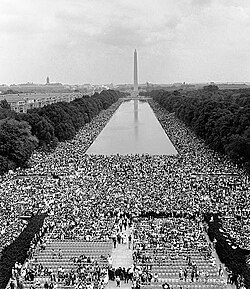 View of the protestors at the March on Washington (1963)
 Police and protesters on the Edmund Pettus Bridge (1965)
 President Johnson signs the Voting Rights Act of 1965 with King behind him
 King speaks at an anti-Vietnam War rally at the University of Minnesota, St. Paul (1967)


