No edit summary |
WikiDwarfBOT (talk | contribs) m robot: Trimming article to decrease server load |
||
| (One intermediate revision by one other user not shown) | |||
| Line 1: | Line 1: | ||
{{simp|date=November 2011}} | |||
{{Merge from|Republic of China|date=March 2020|discuss=Talk:China#Merge discussion}} | |||
{{Infobox country | {{Infobox country | ||
| conventional_long_name = Republic of China | | conventional_long_name = Republic of China | ||
| Line 12: | Line 16: | ||
| national_anthem = {{lang|zh-Hant|中華民國國歌}}<br />''Zhōnghuá Mínguó guógē''<br/>"[[National Anthem of the Republic of China]]"<br /><div style="display:inline-block;margin-top:0.4em;">{{center|[[File:National anthem of the Republic of China (Taiwan) 中華民國國歌(演奏版).ogg]]}}</div> | | national_anthem = {{lang|zh-Hant|中華民國國歌}}<br />''Zhōnghuá Mínguó guógē''<br/>"[[National Anthem of the Republic of China]]"<br /><div style="display:inline-block;margin-top:0.4em;">{{center|[[File:National anthem of the Republic of China (Taiwan) 中華民國國歌(演奏版).ogg]]}}</div> | ||
| flag_anthem = {{lang|zh-Hant|中華民國國旗歌}}<br />''Zhōnghuá Míngúo Gúoqígē''<br />"[[National Flag Anthem of the Republic of China]]"<br/><div style="display:inline-block;margin-top:0.4em;">{{center|[[File:中華民國國旗歌 (演奏版).ogg]]}}</div> | | flag_anthem = {{lang|zh-Hant|中華民國國旗歌}}<br />''Zhōnghuá Míngúo Gúoqígē''<br />"[[National Flag Anthem of the Republic of China]]"<br/><div style="display:inline-block;margin-top:0.4em;">{{center|[[File:中華民國國旗歌 (演奏版).ogg]]}}</div> | ||
| image_map = {{Switcher|[[File:Island of Taiwan (orthographic projection).svg|frameless]]|Show globe ([[Geography of Taiwan|island of Taiwan]] highlighted)|[[File:Locator map of the ROC Taiwan.svg|upright=1.15|frameless]]|Show map of [[Free area of the Republic of China|territories administered by the ROC (Free Area)]]|default=1}} | | image_map = {{Switcher|[[File:Island of Taiwan (orthographic projection).svg|frameless]]|Show globe ([[Geography of Taiwan|island of Taiwan]] highlighted)|[[File:Locator map of the ROC Taiwan.svg|upright=1.15|frameless]]|Show map of [[Free area of the Republic of China|territories administered by the ROC (Free Area)]]|[[File:Republic of China (orthographic projection).svg|upright=1.15|frameless]]|Show map of Taiwan (dark green) with maximal historical extent of ROC territorial claims (light green)|default=1}} | ||
| map_caption = | | map_caption = | ||
| largest_city = [[New Taipei City|New Taipei]] | | largest_city = [[New Taipei City|New Taipei]] | ||
| capital =[[Taipei]]{{efn|[[Taipei]] is the official seat of [[government of the Republic of China]] although the [[Constitution of the Republic of China]] does not specify the ''de jure'' capital.<ref>{{cite web |url=http://www.taipeitimes.com/News/front/archives/2013/12/04/2003578264/2 |title=Since the implementation of the Act Governing Principles for Editing Geographical Educational Texts (地理敎科書編審原則) in 1997, the guiding principle for all maps in geographical textbooks was that Taipei was to be marked as the capital with a label stating: "Location of the Central Government" |access-date=1 November 2019 |archive-url=https://web.archive.org/web/20191101013333/http://www.taipeitimes.com/News/front/archives/2013/12/04/2003578264/2 |archive-date=1 November 2019 |url-status=live }}</ref>}}<ref name="capital">{{cite news |title=Interior minister reaffirms Taipei is ROC's capital |date=5 December 2013|url=http://www.taipeitimes.com/News/taiwan/archives/2013/12/05/2003578356 |newspaper=Taipei Times |access-date=7 December 2013}}</ref> | | capital =[[Taipei]]{{efn|[[Taipei]] is the official seat of [[government of the Republic of China]] although the [[Constitution of the Republic of China]] does not specify the ''de jure'' capital.<ref>{{cite web |url=http://www.taipeitimes.com/News/front/archives/2013/12/04/2003578264/2 |title=Since the implementation of the Act Governing Principles for Editing Geographical Educational Texts (地理敎科書編審原則) in 1997, the guiding principle for all maps in geographical textbooks was that Taipei was to be marked as the capital with a label stating: "Location of the Central Government" |date=4 December 2013 |access-date=1 November 2019 |archive-url=https://web.archive.org/web/20191101013333/http://www.taipeitimes.com/News/front/archives/2013/12/04/2003578264/2 |archive-date=1 November 2019 |url-status=live }}</ref>}}<ref name="capital">{{cite news |title=Interior minister reaffirms Taipei is ROC's capital |date=5 December 2013|url=http://www.taipeitimes.com/News/taiwan/archives/2013/12/05/2003578356 |newspaper=Taipei Times |access-date=7 December 2013}}</ref> | ||
| coordinates = {{coord|25|04|N|121|31|E|type:city_region:TW}} | | coordinates = {{coord|25|04|N|121|31|E|type:city_region:TW}} | ||
| ethnic_groups = >95% [[Han Taiwanese]]<br>—70% [[Hoklo Taiwanese|Hoklo]]<br>—14% [[Hakka people|Hakka]]<br>—14% [[Waishengren]]<br>2% [[Taiwanese indigenous peoples|Indigenous]]<ref>{{cite book |year=2016 |title=The Republic of China Yearbook 2016 |publisher=Executive Yuan, R.O.C.|url=https://issuu.com/eyroc/docs/the_republic_of_china_yearbook_2016|access-date=31 May 2020 |isbn=9789860499490 |page=10|quote=Ethnicity: Over 95 percent Han Chinese (including Holo, Hakka and other groups originating in mainland China); 2 percent indigenous Austronesian peoples}}</ref>{{efn|Mixed indigenous-Han ancestry is included in the figure for Han Chinese.}} | | ethnic_groups = >95% [[Han Taiwanese]]<br>—70% [[Hoklo Taiwanese|Hoklo]]<br>—14% [[Hakka people|Hakka]]<br>—14% [[Waishengren]]<br>2% [[Taiwanese indigenous peoples|Indigenous]]<ref>{{cite book |year=2016 |title=The Republic of China Yearbook 2016 |publisher=Executive Yuan, R.O.C.|url=https://issuu.com/eyroc/docs/the_republic_of_china_yearbook_2016|access-date=31 May 2020 |isbn=9789860499490 |page=10|quote=Ethnicity: Over 95 percent Han Chinese (including Holo, Hakka and other groups originating in mainland China); 2 percent indigenous Austronesian peoples}}</ref>{{efn|Mixed indigenous-Han ancestry is included in the figure for Han Chinese.}} | ||
| official_languages = None designated (''[[de jure]]'')<br><br>[[Taiwanese Mandarin|Mandarin]] (''[[de facto]]'')<ref>{{cite web |title=推動雙語國家政策問題研析|url=https://www.ly.gov.tw/Pages/Detail.aspx?nodeid=6590&pid=173510 |website=www.ly.gov.tw |access-date=25 May 2021 |language=zh}}</ref><br><br>[[Vernacular Chinese]] (used in formal or ceremonial occasions, religious or cultural rites, official documents, legal and court rulings and judiciary documents)<ref>{{cite web |title=法律統一用語表-常見公文用語說明|url=http://oga.ncu.edu.tw/ncuoga/dispatch/doc/%E5%B8%B8%E8%A6%8B%E5%85%AC%E6%96%87%E7%94%A8%E8%AA%9E%E8%AA%AA%E6%98%8E1050106.pdf |access-date=2 June 2021 |language=zh}}</ref> | | official_languages = None designated (''[[de jure]]'')<br><br>[[Taiwanese Mandarin|Mandarin]] (''[[de facto]]'')<ref>{{cite web |title=推動雙語國家政策問題研析|url=https://www.ly.gov.tw/Pages/Detail.aspx?nodeid=6590&pid=173510 |website=www.ly.gov.tw |access-date=25 May 2021 |language=zh}}</ref><br><br>[[Vernacular Chinese]] (used in formal or ceremonial occasions, religious or cultural rites, official documents, legal and court rulings and judiciary documents)<ref>{{cite web|title=法律統一用語表-常見公文用語說明|url=http://oga.ncu.edu.tw/ncuoga/dispatch/doc/%E5%B8%B8%E8%A6%8B%E5%85%AC%E6%96%87%E7%94%A8%E8%AA%9E%E8%AA%AA%E6%98%8E1050106.pdf|access-date=2 June 2021|language=zh|archive-date=2 June 2021|archive-url=https://web.archive.org/web/20210602215646/http://oga.ncu.edu.tw/ncuoga/dispatch/doc/%E5%B8%B8%E8%A6%8B%E5%85%AC%E6%96%87%E7%94%A8%E8%AA%9E%E8%AA%AA%E6%98%8E1050106.pdf|url-status=dead}}</ref> | ||
| languages_type = [[Official script]] | | languages_type = [[Official script]] | ||
| languages = [[Traditional Chinese characters|Traditional Chinese]]<ref>{{cite web |title=行政院第3251次院會決議 |url=https://www.ey.gov.tw/Page/4EC2394BE4EE9DD0/51cc88a4-2066-44da-964d-18e10468f578|website=www.ey.gov.tw |access-date=25 May 2021 |language=zh}}</ref> | | languages = [[Traditional Chinese characters|Traditional Chinese]]<ref>{{cite web |title=行政院第3251次院會決議 |url=https://www.ey.gov.tw/Page/4EC2394BE4EE9DD0/51cc88a4-2066-44da-964d-18e10468f578|website=www.ey.gov.tw |access-date=25 May 2021 |language=zh}}</ref> | ||
| Line 31: | Line 35: | ||
}} | }} | ||
| religion = {{vunblist | | religion = {{vunblist | ||
|43.8% [[Chinese folk religion]] (including [[Confucianism]]) | |||
|21.2% [[Buddhism in Taiwan|Buddhism]] | |||
|15.5% Others (including [[Taoism]]) | |||
|13.7% [[Irreligion|Unaffiliated]] | |||
|5.8% [[Christianity in Taiwan|Christianity]]<ref>{{cite web|title=Pew Data on Taiwan religion|url=http://www.globalreligiousfutures.org/countries/taiwan/religious_demography#/?affiliations_religion_id=0&affiliations_year=2020|access-date=2021-06-02}}</ref>}} | |||
| demonym = [[Taiwanese people|Taiwanese]]<ref name="cia-factbook">{{cite web |title=Taiwan |url=https://www.cia.gov/the-world-factbook/countries/taiwan/ |work=The World Factbook |publisher=United States Central Intelligence Agency |access-date=6 May 2019}}</ref> | | demonym = [[Taiwanese people|Taiwanese]]<ref name="cia-factbook">{{cite web |title=Taiwan |url=https://www.cia.gov/the-world-factbook/countries/taiwan/ |work=The World Factbook |publisher=United States Central Intelligence Agency |access-date=6 May 2019}}</ref> | ||
| government_type = [[Unitary state|Unitary]] [[Semi-presidential system|semi-presidential]] [[constitution]]al [[republic]] | | government_type = [[Unitary state|Unitary]] [[Semi-presidential system|semi-presidential]] [[constitution]]al [[republic]] | ||
| Line 54: | Line 58: | ||
| legislature = [[Legislative Yuan]] | | legislature = [[Legislative Yuan]] | ||
| sovereignty_type = [[History of the Republic of China|Formation]] | | sovereignty_type = [[History of the Republic of China|Formation]] | ||
| sovereignty_note = | | sovereignty_note = | ||
| established_event1 = Establishment | | established_event1 = Establishment | ||
| established_date1 = [[Republic of China (1912–1949)|1 January 1912]] | | established_date1 = [[Republic of China (1912–1949)|1 January 1912]] | ||
| Line 66: | Line 70: | ||
| established_date5 = 16 July 1992 | | established_date5 = 16 July 1992 | ||
| area_km2 = 36,197 | | area_km2 = 36,197 | ||
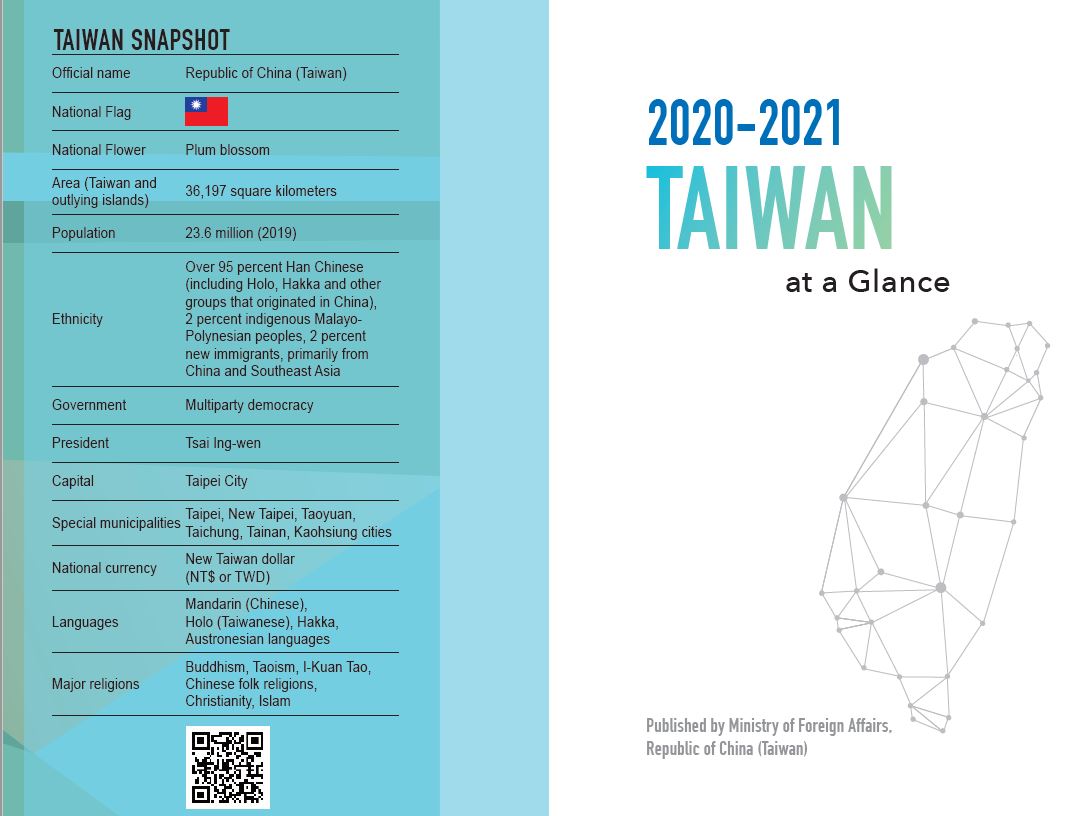
| area_footnote = <ref name="taiwansnapshot">{{cite web|url=https://www.taiwan.gov.tw/images/content/ts.JPG|title=TAIWAN SNAPSHOT|access-date=15 March 2020}}</ref | | area_footnote = <ref name="cia-factbook" /><ref name="taiwansnapshot">{{cite web|url=https://www.taiwan.gov.tw/images/content/ts.JPG|title=TAIWAN SNAPSHOT|access-date=15 March 2020}}</ref> | ||
| area_rank = <!-- Area rank should match [[List of countries and dependencies by area]]; should not be any here --> | | area_rank = <!-- Area rank should match [[List of countries and dependencies by area]]; should not be any here --> | ||
| population_estimate = 23,568,378<ref name="Natl Statistics">{{cite web |title=Statistics from Statistical Bureau |url=http://eng.stat.gov.tw/point.asp?index=9 |access-date=15 October 2020 |website=National Statistics, Republic of China (Taiwan)}}</ref> | | population_estimate = 23,568,378<ref name="Natl Statistics">{{cite web |title=Statistics from Statistical Bureau |url=http://eng.stat.gov.tw/point.asp?index=9 |access-date=15 October 2020 |website=National Statistics, Republic of China (Taiwan)}}</ref> | ||
| Line 73: | Line 77: | ||
| population_estimate_rank = 56th | | population_estimate_rank = 56th | ||
| population_census_year = 2010 | | population_census_year = 2010 | ||
| population_census_rank = | | population_census_rank = | ||
| population_density_km2 = 650 | | population_density_km2 = 650 | ||
| population_density_rank = 10th | | population_density_rank = 10th | ||
| Line 90: | Line 94: | ||
| Gini_change = increase | | Gini_change = increase | ||
| Gini_ref = <ref>{{cite web |title=Percentage share of disposable income by quintile groups of income recipients and measures of income distribution |url=https://win.dgbas.gov.tw/fies/doc/result/106/a11/Year17.ods |website=stat.gov.tw |access-date=26 June 2019}}</ref> | | Gini_ref = <ref>{{cite web |title=Percentage share of disposable income by quintile groups of income recipients and measures of income distribution |url=https://win.dgbas.gov.tw/fies/doc/result/106/a11/Year17.ods |website=stat.gov.tw |access-date=26 June 2019}}</ref> | ||
| Gini_rank = | | Gini_rank = | ||
| HDI = 0.916 | | HDI = 0.916 | ||
| HDI_year = 2019 | | HDI_year = 2019 | ||
| Line 101: | Line 105: | ||
| utc_offset = +8 | | utc_offset = +8 | ||
| date_format = {{bulleted list | | date_format = {{bulleted list | ||
|YYYY-MM-DD | |||
|YYY-MM-DD ([[Minguo calendar]]) | |||
}} | }} | ||
| electricity = 110 V–60 Hz{{efn|220 V is also used for high power appliances such as air conditioners}} | | electricity = 110 V–60 Hz{{efn|220 V is also used for high power appliances such as air conditioners}} | ||
| Line 110: | Line 114: | ||
}} | }} | ||
'''Taiwan''', officially the | '''Taiwan''' (Chinese: 臺灣 / 台灣), officially the '''[[Republic of China]]''' ('''ROC'''; Chinese: 中華民國; pinyin: Zhōnghuá Mínguó), is considered a [[country]] in [[East Asia]] by some countries (including 13 countries and Vatican City/Holy), while other countries and the United Nations have not officially recognized its status as a country.<ref>{{Cite web|title=Countries That Recognize Taiwan 2022|url=https://worldpopulationreview.com/country-rankings/countries-that-recognize-taiwan|access-date=2022-08-05|website=worldpopulationreview.com}}</ref> Not to be confused with the [[People's Republic of China]] (PRC). The Republic of China (Taiwan) once governed all of China (from 1911 to 1949), but moved to the island of Taiwan after a Chinese [[civil war]]. In the years since, the PRC (People's Republic of China) has become the recognized government of China (replacing the ROC at the [[United Nations]] in 1971), and the status of the ROC has been left not said. | ||
The country of Taiwan comprises the island of Taiwan | The country of Taiwan comprises the island of Taiwan with the nearby islands ([[Pescadores]] islands and parts of [[Fujian]]). Taiwan is located southeast of the People's Republic of China's mainland, south of [[Japan]], and north of the [[Philippines]]. The [[Capital (city)|capital]] is [[Taipei]]. | ||
Taiwan has also been called '''Formosa''', a Portuguese name which means "beautiful" in [[Portuguese language|Portuguese]]. | Taiwan has also been called '''Formosa''', a Portuguese name which means "beautiful" in [[Portuguese language|Portuguese]]. | ||
Most people living in Taiwan (called Taiwanese) are [[Han]]. Taiwan has three large Han groups. They speak different [[dialect]]s (languages) of Chinese and their ancestors came from different places: the Southern Fujianese (from China's [[Fujian|Fujian Province]]), the [[Hakka people|Hakka]] (from China), and Mainlanders (from [[Mainland China]] after 1948). | |||
There are also Taiwanese Aborigines (native tribes called Taiwanese Aborigines) who have lived in Taiwan before the Han came to live there. | |||
The largest cities in Taiwan are the capital, [[Taipei]], and the port city of [[Kaohsiung]]. | |||
== History == | == History == | ||
{{unsourced section|date=January 2021}} | {{unsourced section|date=January 2021}} | ||
* 17th century: From 1624 until 1661 [[Dutch (people)|Dutch]] colonize the southern part of Formosa and | * In AD 230, Taiwan described as "Yizhou" in the account of an expedition undertaken by the Eastern Wu dynasty of China.<ref>Knapp, Ronald G. (1980). ''China's Island Frontier: Studies in the Historical Geography of Taiwan''. The University of Hawaii. p. 5.</ref> | ||
* 1860: Taiwan becomes a [[treaty port]] | |||
* 1874: [[Japan]] | * In 1517, A [[Portugal|Portuguese]] discovery ship sees this island and renames it "Ilha Formosa", or "Beautiful Island" in [[Portuguese language|Portuguese]]. | ||
* 17th century: From 1624 until 1661 [[Dutch (people)|Dutch]] colonize the southern part of Formosa and set up a colonial administration in [[Fort Zeelandia]], and the [[Spain|Spanish]] colonize the north and set up a colonial administration in Fuerte Santo Domingo or [[Fort Santo Domingo]]. The Dutch later defeat the [[Spaniard]]s and take full control of Formosa. | |||
* 1662, Chinese general [[Koxinga]] (Zheng Chenggong) defeats the Dutch at the [[Siege of Fort Zeelandia]] and then controls Taiwan.<ref>{{Citation|title=Siege of Fort Zeelandia|date=2020-12-31|url=https://simple.wikipedia.org/w/index.php?title=Siege_of_Fort_Zeelandia&oldid=7238011|work=Simple English Wikipedia, the free encyclopedia|language=en|access-date=2022-08-17}}</ref> | |||
* 1683, Shi Lang,<ref>{{Citation|title=Shi Lang|date=2022-05-12|url=https://en.wikipedia.org/w/index.php?title=Shi_Lang&oldid=1087386510|work=Wikipedia|language=en|access-date=2022-08-17}}</ref> the commander-in-chief of the [[Qing dynasty|Qing]] China fleets destroy the power of Zheng Chenggong's descendants in the 1660s, and lead the conquest of the Zheng family's Kingdom of Tungning. Taiwan becomes Qing territory. | |||
* 1860: Taiwan becomes a [[treaty port]] after the [[Treaty of Tientsin]], opening the island to contact with the world. | |||
* 1874: [[Japan]] invades southern Taiwan, seemingly to "punish" the natives there for the murder of ship-wrecked Okinawan fishermen in 1871, but actually to establish a colony. Japanese forces withdraw later in the year after the [[Meiji]] and [[Qing]] empires nearly went to war. | |||
* 1884-1885: Taiwan is blockaded by French navy during the [[Sino-Franco]] War. | * 1884-1885: Taiwan is blockaded by French navy during the [[Sino-Franco]] War. | ||
* 1895: Qing China | * 1895: Qing China loses the [[First Sino-Japanese War]] and gives Taiwan to [[Japan]] permanently (Treaty of Shimonoseki). | ||
*1911: The Xinhai Revolution | * 1911: The Xinhai Revolution ends China's last imperial dynasty, the [[Qing dynasty]], and leads to the establishment of the Republic of China. | ||
*1927: Start of the [[Chinese Civil War]] between the [[Kuomintang]] (KMT) party and the [[Communist Party of China]] (CCP). The war would later be put on hold, so the two sides could fight Japan together during World War II. | * 1927: Start of the [[Chinese Civil War]] between the [[Kuomintang]] (KMT) party and the [[Communist Party of China]] (CCP). The war would later be put on hold, so the two sides could fight Japan together during World War II. | ||
* 1945: Japan | * 1945: Japan loses [[World War II]] to the U.S. and its allies | ||
* 1947: Taiwanese widely protest [[government]]al [[corruption]] under the Nationalists. [[Chiang Kai-shek]] sends in the army to restore order, killing tens of thousands. Some Taiwanese began the [[Taiwan independence movement]]. | * 1947: Taiwanese widely protest [[government]]al [[corruption]] under the Nationalists. [[Chiang Kai-shek]] sends in the army to restore order, killing tens of thousands. Some Taiwanese began the [[Taiwan independence movement]]. | ||
* 1949: | * 1949: | ||
** The Nationalists (KMT) lose the civil war, which resumed after World War II, and escape to the island of Taiwan. They set up [[Taipei]] as the temporary capital of Republic of China (ROC). | ** The Nationalists (KMT) lose the civil war, which resumed after World War II, and escape to the island of Taiwan. They set up [[Taipei]] as the temporary capital of Republic of China (ROC). | ||
** The Communist Party of China (CCP) establishes Beijing as the capital of The [[People's Republic of China]] (PRC). | ** The Communist Party of China (CCP) establishes Beijing as the capital of The [[People's Republic of China]] (PRC). | ||
*1951: Japan signs the [[Treaty of San Francisco]] (1951) with U.S. | * 1951: Japan signs the [[Treaty of San Francisco]] (1951) with the U.S. and 47 other countries, formally denouncing any claim to Taiwan. | ||
*1971: Taiwan is expelled from the United Nations and replaced | * 1952: Japan and the ROC sign the Treaty of Taipei, which is similar to the Treaty of San Francisco. | ||
* 1971: Taiwan is expelled from the United Nations and replaced by the [[People's Republic of China|PRC]]. | |||
* 1979: The KMT government jails many [[democracy]] activists who opposed it ([[Kaohsiung Incident]]). | * 1979: The KMT government jails many [[democracy]] activists who opposed it ([[Kaohsiung Incident]]). | ||
* 1986: The [[Democratic Progressive Party]] (DPP) is formed; it is the first party to form in the ROC other than the KMT. It remains illegal for the first year, but the KMT government does not try to ban it. | * 1986: The [[Democratic Progressive Party]] (DPP) is formed; it is the first party to form in the ROC other than the KMT. It remains illegal for the first year, but the KMT government does not try to ban it. | ||
* 1987: The KMT government lifts | * 1987: The KMT government lifts [[martial law]] after almost 40 years. | ||
* 1988: [[Lee Teng-hui]] (KMT) became [[President of the Republic of China|president]] after [[Chiang Ching-kuo]] | * 1988: [[Lee Teng-hui]] (KMT) became [[President of the Republic of China|president]] after [[Chiang Ching-kuo]] dies. | ||
* 1995: Lee Teng-hui (KMT) became the first president elected by people | * 1995: Lee Teng-hui (KMT) became the first president elected by the people. | ||
* 2000: [[Chen Shui-bian]] (DPP) became president. | * 2000: [[Chen Shui-bian]] (DPP) became president. | ||
* 2004: Chen Shui-bian is re-elected after a controversial assassination attempt, in which many KMT-supporters believed, was staged by Chen. However, after unwillingness to cooperate about his medical records the investigation was inconclusive. | * 2004: Chen Shui-bian is re-elected after a controversial assassination attempt, in which many KMT-supporters believed, was staged by Chen. However, after unwillingness to cooperate about his medical records the investigation was inconclusive. | ||
| Line 151: | Line 159: | ||
* 2008: [[Ma Ying-jeou]] (KMT) was elected as the president of the Republic of China and thus creating a change of political parties for the second time. | * 2008: [[Ma Ying-jeou]] (KMT) was elected as the president of the Republic of China and thus creating a change of political parties for the second time. | ||
* 2009: Kaohsiung hosts the 2009 World Games. | * 2009: Kaohsiung hosts the 2009 World Games. | ||
* 2016: [[Tsai Ing-wen]] (DPP) | * 2016: [[Tsai Ing-wen]] (DPP) is elected as the first female president of Taiwan. | ||
* 2019: [[ | * 2019: [[Same-sex marriage]] is legalized<ref>https://en.wikinews.org/wiki/Taiwan%27s_legislature_first_in_Asia_to_legalize_same-sex_marriage</ref> | ||
== Status of Taiwan == | == Status of Taiwan == | ||
There are two [[China|Chinese]] governments | There are two [[China|Chinese]] governments: The [[People's Republic of China]] (PRC) and the [[Republic of China]] (ROC). Today, in reality, the PRC government controls mainland China, and the ROC government governs Taiwan. The ROC government governed most of China mainland from 1911 to 1949, before losing control of China mainland to the PRC. The ROC constitution still claims ownership of all of China. | ||
The People's Republic of China has never ruled over the island of Taiwan, since the last time Taiwan and the mainland were united under one government was under the rule of the ROC. | |||
Although Taiwan's status prevents it from participating in some international organizations, polls show that most Taiwanese prefer to keep things as they are (referred to as the [[status quo]]), rather than declare formal independence (and risk inviting an attack by communist China), or to be "reunified" with China. | Although Taiwan's status prevents it from participating in some international organizations, polls show that most Taiwanese prefer to keep things as they are (referred to as the [[status quo]]), rather than declare formal independence (and risk inviting an attack by communist China), or to be "reunified" with China. | ||
Most countries of the world recognize the People's Republic of China as China. Although Taiwan is not recognized by the UN as a sovereign nation,<ref>{{cite web |url=http://www.brookings.edu/research/opinions/2012/06/20-taiwan-un-winkler |title=Taiwan's UN Dilemma: To Be or Not To Be |author=Sigrid Winkler |date=June 2012 |website= |publisher=The Brookings Institution |accessdate=26 November 2015}}</ref> most countries still have close economic and cultural relations with Taiwan. Countries often set up [[De facto|de | Most countries of the world recognize the People's Republic of China as China. Although Taiwan is not recognized by the UN as a sovereign nation,<ref>{{cite web |url=http://www.brookings.edu/research/opinions/2012/06/20-taiwan-un-winkler |title=Taiwan's UN Dilemma: To Be or Not To Be |author=Sigrid Winkler |date=June 2012 |website= |publisher=The Brookings Institution |accessdate=26 November 2015}}</ref> most countries still have close economic and cultural relations with Taiwan. Countries often set up [[De facto|de facto]] embassies in Taiwan—officially non-government organizations—that perform the same functions as an [[embassy]]. | ||
In 1992, the ROC and PRC agreed to a [[ | In 1992, the ROC and PRC agreed to a [[consensus]] that there was only "one China" but that both sides could continue to disagree on what that meant. | ||
In [[March]] 2004, China's government passed a law called the Anti-[[Secession]] Law. The law requires the Chinese [[military]] to [[invade]] Taiwan immediately if they declare [[independence]].<ref>{{cite web |url=http://www.heritage.org/research/reports/2004/12/chinas-new-anti-secession-law-escalates-tensions-in-the-taiwan-strait |title=China's New "Anti-Secession Law" Escalates Tensions in the TaiwanStrait |author=John J. Tkacik, Jr. |website= |publisher=The Heritage Foundation |accessdate=26 November 2015}}</ref> Tsai Ing-wen, the elected President of Taiwan, says Taiwan is already an independent country and does not need to declare independence. <ref>{{Cite web|last=News|first=Taiwan|date=2020-01-16|title=Tsai says Taiwan is already independent, China invasion 'very costly' {{!}} Taiwan News {{!}} 2020-01-16 09:32:00|url=https://www.taiwannews.com.tw/en/news/3858329|access-date=2021-11-03|website=Taiwan News}}</ref> | In [[March]] 2004, China's government passed a law called the Anti-[[Secession]] Law. The law requires the Chinese [[military]] to [[invade]] Taiwan immediately if they declare [[independence]].<ref>{{cite web |url=http://www.heritage.org/research/reports/2004/12/chinas-new-anti-secession-law-escalates-tensions-in-the-taiwan-strait |title=China's New "Anti-Secession Law" Escalates Tensions in the TaiwanStrait |author=John J. Tkacik, Jr. |website= |publisher=The Heritage Foundation |accessdate=26 November 2015}}</ref> Tsai Ing-wen, the elected President of Taiwan, says Taiwan is already an independent country and does not need to declare independence.<ref>{{Cite web|last=News|first=Taiwan|date=2020-01-16|title=Tsai says Taiwan is already independent, China invasion 'very costly' {{!}} Taiwan News {{!}} 2020-01-16 09:32:00|url=https://www.taiwannews.com.tw/en/news/3858329|access-date=2021-11-03|website=Taiwan News}}</ref> | ||
President of communist China, President Xi Jinping, has vowed "reunification" with Taiwan by any means, including through military force. <ref>{{cite web |url=https://www.reuters.com/world/china/chinas-xi-says-reunification-with-taiwan-must-will-be-realised-2021-10-09/ |title=China's Xi vows 'reunification' with Taiwan |author=Carlos Garcia and Yew Lun Tian |date=October 2021 |website= |publisher=Reuters |accessdate=10 October 2021}}</ref> Joe Biden, President of The United States, has said that the US will defend Taiwan from Chinese attack. <ref>{{cite web |url=https://www.reuters.com/world/asia-pacific/biden-says-united-states-would-come-taiwans-defense-2021-10-22/ |title=Biden says United States would come to Taiwan's defense |author=Trevor Hunnicutt |date=October 2021 |website= |publisher=Reuters |accessdate=22 October 2021}}</ref> | President of communist China, President Xi Jinping, has vowed "reunification" with Taiwan by any means, including through military force.<ref>{{cite web |url=https://www.reuters.com/world/china/chinas-xi-says-reunification-with-taiwan-must-will-be-realised-2021-10-09/ |title=China's Xi vows 'reunification' with Taiwan |author=Carlos Garcia and Yew Lun Tian |date=October 2021 |website= |publisher=Reuters |accessdate=10 October 2021}}</ref> Joe Biden, President of The United States, has said that the US will defend Taiwan from Chinese attack.<ref>{{cite web |url=https://www.reuters.com/world/asia-pacific/biden-says-united-states-would-come-taiwans-defense-2021-10-22/ |title=Biden says United States would come to Taiwan's defense |author=Trevor Hunnicutt |date=October 2021 |website= |publisher=Reuters |accessdate=22 October 2021}}</ref> Australia has said they would join the US,<ref>{{Cite web|last=News|first=Taiwan|date=2021-10-25|title=Australia will support US response if China attacks Taiwan: Australian defense chief {{!}} Taiwan News {{!}} 2021-10-25 20:54:00|url=https://www.taiwannews.com.tw/en/news/4325225|access-date=2021-11-03|website=Taiwan News}}</ref> and Japan has indicated they may as well. | ||
==Geography== | ==Geography== | ||
| Line 171: | Line 181: | ||
The island of Taiwan is about 180 kilometers off the southeastern coast of China. It is across the [[Taiwan Strait]]. It has an area of {{convert|35883|km2|sqmi|0|abbr=on}}.<ref name="taiwan-popstat">{{cite web|url=http://sowf.moi.gov.tw/stat/month/m1-01.xls |title=Number of Villages, Neighborhoods, Households and Resident Population |publisher=MOI Statistical Information Service |access-date=2 February 2014 |archive-url=https://web.archive.org/web/20140329071215/http://sowf.moi.gov.tw/stat/month/m1-01.xls |archive-date=29 March 2014 }}</ref> | The island of Taiwan is about 180 kilometers off the southeastern coast of China. It is across the [[Taiwan Strait]]. It has an area of {{convert|35883|km2|sqmi|0|abbr=on}}.<ref name="taiwan-popstat">{{cite web|url=http://sowf.moi.gov.tw/stat/month/m1-01.xls |title=Number of Villages, Neighborhoods, Households and Resident Population |publisher=MOI Statistical Information Service |access-date=2 February 2014 |archive-url=https://web.archive.org/web/20140329071215/http://sowf.moi.gov.tw/stat/month/m1-01.xls |archive-date=29 March 2014 }}</ref> | ||
The [[East China Sea]] is to the north, the [[Philippine Sea]] to the east, the [[Luzon Strait]] directly to the south and the [[South China Sea]] to the southwest.<ref name="yb:geography">{{cite book |title=The Republic of China Yearbook |url=http://www.gio.gov.tw/taiwan-website/5-gp/yearbook/ |chapter=Chapter 1: Geography | | The [[East China Sea]] is to the north, the [[Philippine Sea]] to the east, the [[Luzon Strait]] directly to the south and the [[South China Sea]] to the southwest.<ref name="yb:geography">{{cite book |title=The Republic of China Yearbook |url=http://www.gio.gov.tw/taiwan-website/5-gp/yearbook/ |chapter=Chapter 1: Geography |chapter-url=http://www.gio.gov.tw/taiwan-website/5-gp/yearbook/docs/ch01.pdf |pages=13–25 |publisher=Government Information Office, Republic of China (Taiwan) |year=2011 |access-date=2012-10-01 |archive-date=2008-05-12 |archive-url=https://web.archive.org/web/20080512091917/http://www.gio.gov.tw/taiwan-website/5-gp/yearbook/ |url-status=dead }}</ref> | ||
Taiwan's highest point is [[Yu Shan]] (Jade Mountain). It is 3,952 meters high (12,966 ft). | Taiwan's highest point is [[Yu Shan]] (Jade Mountain). It is 3,952 meters high (12,966 ft). There are five other peaks over 3,500 meters. | ||
The [[Penghu Islands]] are {{convert|50|km|mi|1|abbr=on}} west of the main island. They have an area of {{convert|126.9|km2|sqmi|1|abbr=on}}. More distant islands controlled by the Republic of China are the [[Kinmen]], [[Wuchiu]] and [[Matsu Islands]] off the coast of [[Fujian]]. They have a total area of {{convert|180.5|km2|sqmi|1|abbr=on}}. The [[Pratas Islands]] and [[Taiping Island]] in the South China Sea have a total area of {{convert|2.9|km2|sqmi|1|abbr=on}}. They have no permanent inhabitants.<ref name="taiwan-popstat"/> | The [[Penghu Islands]] are {{convert|50|km|mi|1|abbr=on}} west of the main island. They have an area of {{convert|126.9|km2|sqmi|1|abbr=on}}. More distant islands controlled by the Republic of China are the [[Kinmen]], [[Wuchiu]] and [[Matsu Islands]] off the coast of [[Fujian]]. They have a total area of {{convert|180.5|km2|sqmi|1|abbr=on}}. The [[Pratas Islands]] and [[Taiping Island]] in the South China Sea have a total area of {{convert|2.9|km2|sqmi|1|abbr=on}}. They have no permanent inhabitants.<ref name="taiwan-popstat"/> | ||
| Line 218: | Line 228: | ||
|17|| align="left" |[[Magong]]||馬公市||[[County-controlled city]]|| align="right" |104,069 | |17|| align="left" |[[Magong]]||馬公市||[[County-controlled city]]|| align="right" |104,069 | ||
|} | |} | ||
==Related pages== | |||
* [[Political status of Taiwan]] | |||
==Notes== | ==Notes== | ||
| Line 223: | Line 236: | ||
==References== | ==References== | ||
{{commonscat}} | |||
{{Wikivoyage|Taiwan}} | |||
{{Reflist}} | {{Reflist}} | ||
[[Category:Taiwan| ]] | [[Category:Taiwan| ]] | ||
Latest revision as of 22:40, 5 October 2022
 | It has been suggested that Republic of China be merged into this article. (Discuss) Proposed since March 2020. |
Republic of China | |
|---|---|
| Anthem: 中華民國國歌 Zhōnghuá Mínguó guógē "National Anthem of the Republic of China" | |
| National seal 中華民國之璽 "Seal of the Republic of China"  National flower  梅花 Plum blossom | |
.svg)  .svg) | |
| Capital | Taipei[lower-alpha 2][2] 25°04′N 121°31′E / 25.067°N 121.517°E |
| Largest city | New Taipei |
| Official languages | None designated (de jure) Mandarin (de facto)[3] Vernacular Chinese (used in formal or ceremonial occasions, religious or cultural rites, official documents, legal and court rulings and judiciary documents)[4] |
| Official script | Traditional Chinese[5] |
| National languages[lower-alpha 3] | |
| Ethnic groups | >95% Han Taiwanese —70% Hoklo —14% Hakka —14% Waishengren 2% Indigenous[9][lower-alpha 5] |
| Religion |
|
| Demonym | Taiwanese[11] |
| Government | Unitary semi-presidential constitutional republic |
| Tsai Ing-wen | |
| Lai Ching-te | |
• Premier | Su Tseng-chang |
| Yu Shyi-kun | |
| Chen Chu | |
| Hsu Tzong-li | |
| Huang Jong-tsun | |
| Legislature | Legislative Yuan |
| Formation | |
• Establishment | 1 January 1912 |
| 25 October 1945 | |
| 25 December 1947 | |
| 7 December 1949 | |
| 16 July 1992 | |
| Area | |
• Total | 36,197 km2 (13,976 sq mi)[11][12] |
| Population | |
• 2020 estimate | 23,568,378[13] (56th) |
• 2010 census | 23,123,866[14] |
• Density | 650/km2 (1,683.5/sq mi) (10th) |
| GDP (PPP) | 2021 estimate |
• Total |  $1.403 trillion[15] (19th) $1.403 trillion[15] (19th) |
• Per capita | $56,959[15] (13th) |
| GDP (nominal) | 2021 estimate |
• Total | $682.702 billion[15] (21st) |
• Per capita | $32,123[16] (29th) |
| Gini (2017) |  34.1[17] 34.1[17]medium inequality |
| HDI (2019) | 0.916[18] very high (23rd) |
| Currency | New Taiwan dollar (NT$) (TWD) |
| Time zone | UTC+8 (National Standard Time) |
| Date format |
|
| Calling code | +886 |
| ISO 3166 code | TW |
| Internet TLD | |


Taiwan (Chinese: 臺灣 / 台灣), officially the Republic of China (ROC; Chinese: 中華民國; pinyin: Zhōnghuá Mínguó), is considered a country in East Asia by some countries (including 13 countries and Vatican City/Holy), while other countries and the United Nations have not officially recognized its status as a country.[20] Not to be confused with the People's Republic of China (PRC). The Republic of China (Taiwan) once governed all of China (from 1911 to 1949), but moved to the island of Taiwan after a Chinese civil war. In the years since, the PRC (People's Republic of China) has become the recognized government of China (replacing the ROC at the United Nations in 1971), and the status of the ROC has been left not said.
The country of Taiwan comprises the island of Taiwan with the nearby islands (Pescadores islands and parts of Fujian). Taiwan is located southeast of the People's Republic of China's mainland, south of Japan, and north of the Philippines. The capital is Taipei.
Taiwan has also been called Formosa, a Portuguese name which means "beautiful" in Portuguese.
Most people living in Taiwan (called Taiwanese) are Han. Taiwan has three large Han groups. They speak different dialects (languages) of Chinese and their ancestors came from different places: the Southern Fujianese (from China's Fujian Province), the Hakka (from China), and Mainlanders (from Mainland China after 1948).
There are also Taiwanese Aborigines (native tribes called Taiwanese Aborigines) who have lived in Taiwan before the Han came to live there.
The largest cities in Taiwan are the capital, Taipei, and the port city of Kaohsiung.
History[edit | edit source]
 |
- In AD 230, Taiwan described as "Yizhou" in the account of an expedition undertaken by the Eastern Wu dynasty of China.[21]
- In 1517, A Portuguese discovery ship sees this island and renames it "Ilha Formosa", or "Beautiful Island" in Portuguese.
- 17th century: From 1624 until 1661 Dutch colonize the southern part of Formosa and set up a colonial administration in Fort Zeelandia, and the Spanish colonize the north and set up a colonial administration in Fuerte Santo Domingo or Fort Santo Domingo. The Dutch later defeat the Spaniards and take full control of Formosa.
- 1662, Chinese general Koxinga (Zheng Chenggong) defeats the Dutch at the Siege of Fort Zeelandia and then controls Taiwan.[22]
- 1683, Shi Lang,[23] the commander-in-chief of the Qing China fleets destroy the power of Zheng Chenggong's descendants in the 1660s, and lead the conquest of the Zheng family's Kingdom of Tungning. Taiwan becomes Qing territory.
- 1860: Taiwan becomes a treaty port after the Treaty of Tientsin, opening the island to contact with the world.
- 1874: Japan invades southern Taiwan, seemingly to "punish" the natives there for the murder of ship-wrecked Okinawan fishermen in 1871, but actually to establish a colony. Japanese forces withdraw later in the year after the Meiji and Qing empires nearly went to war.
- 1884-1885: Taiwan is blockaded by French navy during the Sino-Franco War.
- 1895: Qing China loses the First Sino-Japanese War and gives Taiwan to Japan permanently (Treaty of Shimonoseki).
- 1911: The Xinhai Revolution ends China's last imperial dynasty, the Qing dynasty, and leads to the establishment of the Republic of China.
- 1927: Start of the Chinese Civil War between the Kuomintang (KMT) party and the Communist Party of China (CCP). The war would later be put on hold, so the two sides could fight Japan together during World War II.
- 1945: Japan loses World War II to the U.S. and its allies
- 1947: Taiwanese widely protest governmental corruption under the Nationalists. Chiang Kai-shek sends in the army to restore order, killing tens of thousands. Some Taiwanese began the Taiwan independence movement.
- 1949:
- The Nationalists (KMT) lose the civil war, which resumed after World War II, and escape to the island of Taiwan. They set up Taipei as the temporary capital of Republic of China (ROC).
- The Communist Party of China (CCP) establishes Beijing as the capital of The People's Republic of China (PRC).
- 1951: Japan signs the Treaty of San Francisco (1951) with the U.S. and 47 other countries, formally denouncing any claim to Taiwan.
- 1952: Japan and the ROC sign the Treaty of Taipei, which is similar to the Treaty of San Francisco.
- 1971: Taiwan is expelled from the United Nations and replaced by the PRC.
- 1979: The KMT government jails many democracy activists who opposed it (Kaohsiung Incident).
- 1986: The Democratic Progressive Party (DPP) is formed; it is the first party to form in the ROC other than the KMT. It remains illegal for the first year, but the KMT government does not try to ban it.
- 1987: The KMT government lifts martial law after almost 40 years.
- 1988: Lee Teng-hui (KMT) became president after Chiang Ching-kuo dies.
- 1995: Lee Teng-hui (KMT) became the first president elected by the people.
- 2000: Chen Shui-bian (DPP) became president.
- 2004: Chen Shui-bian is re-elected after a controversial assassination attempt, in which many KMT-supporters believed, was staged by Chen. However, after unwillingness to cooperate about his medical records the investigation was inconclusive.
- 2008: Former president Chen Sui-bian and his wife are arrested for corruption and money laundering.
- 2008: Ma Ying-jeou (KMT) was elected as the president of the Republic of China and thus creating a change of political parties for the second time.
- 2009: Kaohsiung hosts the 2009 World Games.
- 2016: Tsai Ing-wen (DPP) is elected as the first female president of Taiwan.
- 2019: Same-sex marriage is legalized[24]
Status of Taiwan[edit | edit source]
There are two Chinese governments: The People's Republic of China (PRC) and the Republic of China (ROC). Today, in reality, the PRC government controls mainland China, and the ROC government governs Taiwan. The ROC government governed most of China mainland from 1911 to 1949, before losing control of China mainland to the PRC. The ROC constitution still claims ownership of all of China.
The People's Republic of China has never ruled over the island of Taiwan, since the last time Taiwan and the mainland were united under one government was under the rule of the ROC.
Although Taiwan's status prevents it from participating in some international organizations, polls show that most Taiwanese prefer to keep things as they are (referred to as the status quo), rather than declare formal independence (and risk inviting an attack by communist China), or to be "reunified" with China.
Most countries of the world recognize the People's Republic of China as China. Although Taiwan is not recognized by the UN as a sovereign nation,[25] most countries still have close economic and cultural relations with Taiwan. Countries often set up de facto embassies in Taiwan—officially non-government organizations—that perform the same functions as an embassy.
In 1992, the ROC and PRC agreed to a consensus that there was only "one China" but that both sides could continue to disagree on what that meant.
In March 2004, China's government passed a law called the Anti-Secession Law. The law requires the Chinese military to invade Taiwan immediately if they declare independence.[26] Tsai Ing-wen, the elected President of Taiwan, says Taiwan is already an independent country and does not need to declare independence.[27]
President of communist China, President Xi Jinping, has vowed "reunification" with Taiwan by any means, including through military force.[28] Joe Biden, President of The United States, has said that the US will defend Taiwan from Chinese attack.[29] Australia has said they would join the US,[30] and Japan has indicated they may as well.
Geography[edit | edit source]

The island of Taiwan is about 180 kilometers off the southeastern coast of China. It is across the Taiwan Strait. It has an area of 35,883 km2 (13,855 sq mi).[31]
The East China Sea is to the north, the Philippine Sea to the east, the Luzon Strait directly to the south and the South China Sea to the southwest.[32]
Taiwan's highest point is Yu Shan (Jade Mountain). It is 3,952 meters high (12,966 ft). There are five other peaks over 3,500 meters.
The Penghu Islands are 50 km (31.1 mi) west of the main island. They have an area of 126.9 km2 (49.0 sq mi). More distant islands controlled by the Republic of China are the Kinmen, Wuchiu and Matsu Islands off the coast of Fujian. They have a total area of 180.5 km2 (69.7 sq mi). The Pratas Islands and Taiping Island in the South China Sea have a total area of 2.9 km2 (1.1 sq mi). They have no permanent inhabitants.[31]
Cities[edit | edit source]

The largest cities in Taiwan are:
| Rank | Division name | Chinese name | Type | Population |
|---|---|---|---|---|
| 1 | New Taipei City | 新北市 | Special municipality | 3,903,745 |
| 2 | Kaohsiung City | 高雄市 | Special municipality | 2,772,461 |
| 3 | Taichung City | 臺中市 (台中市) | Special municipality | 2,655,456 |
| 4 | Taipei City | 臺北市 (台北市) | Special municipality | 2,635,766 |
| 5 | Taoyuan City | 桃園市 | Special municipality | 2,163,728 |
| 6 | Tainan City | 臺南市 (台南市) | Special municipality | 1,874,724 |
| 7 | Hsinchu City | 新竹市 | Provincial city | 417,335 |
| 8 | Keelung City | 基隆市 | Provincial city | 381,770 |
| 9 | Chiayi City | 嘉義市 | Provincial city | 272,128 |
| 10 | Changhua City | 彰化市 | County-controlled city | 236,447 |
| 11 | Pingtung City | 屏東市 | County-controlled city | 210,275 |
| 12 | Zhubei City | 竹北市 | County-controlled city | 144,234 |
| 13 | Hualien City | 花蓮市 | County-controlled city | 108,938 |
| 14 | Taitung City | 臺東市 | County-controlled city | 108,648 |
| 15 | Douliu City | 斗六市 | County-controlled city | 107,012 |
| 16 | Nantou City | 南投市 | County-controlled city | 104,069 |
| 17 | Magong | 馬公市 | County-controlled city | 104,069 |
Related pages[edit | edit source]
Notes[edit | edit source]
- ↑ See Names of the Republic of China.
- ↑ Taipei is the official seat of government of the Republic of China although the Constitution of the Republic of China does not specify the de jure capital.[1]
- ↑ A national language in Taiwan is legally defined as "a natural language used by an original people group of Taiwan and the Taiwan Sign Language".[6]
- ↑ 4.0 4.1 4.2 Not designated but meets legal definition
- ↑ Mixed indigenous-Han ancestry is included in the figure for Han Chinese.
- ↑ 220 V is also used for high power appliances such as air conditioners
References[edit | edit source]
- ↑ "Since the implementation of the Act Governing Principles for Editing Geographical Educational Texts (地理敎科書編審原則) in 1997, the guiding principle for all maps in geographical textbooks was that Taipei was to be marked as the capital with a label stating: "Location of the Central Government"". 4 December 2013. Archived from the original on 1 November 2019. Retrieved 1 November 2019.
- ↑ "Interior minister reaffirms Taipei is ROC's capital". Taipei Times. 5 December 2013. Retrieved 7 December 2013.
- ↑ "推動雙語國家政策問題研析". www.ly.gov.tw (in 中文). Retrieved 25 May 2021.
- ↑ "法律統一用語表-常見公文用語說明" (PDF) (in 中文). Archived from the original (PDF) on 2 June 2021. Retrieved 2 June 2021.
- ↑ "行政院第3251次院會決議". www.ey.gov.tw (in 中文). Retrieved 25 May 2021.
- ↑ 國家語言發展法. law.moj.gov.tw (in 中文). Retrieved 22 May 2019.
- ↑ "Indigenous Languages Development Act". law.moj.gov.tw. Retrieved 22 May 2019.
- ↑ "Hakka Basic Act". law.moj.gov.tw. Retrieved 22 May 2019.
- ↑ The Republic of China Yearbook 2016. Executive Yuan, R.O.C. 2016. p. 10. ISBN 9789860499490. Retrieved 31 May 2020.
Ethnicity: Over 95 percent Han Chinese (including Holo, Hakka and other groups originating in mainland China); 2 percent indigenous Austronesian peoples
- ↑ "Pew Data on Taiwan religion". Retrieved 2021-06-02.
- ↑ 11.0 11.1 "Taiwan". The World Factbook. United States Central Intelligence Agency. Retrieved 6 May 2019.
- ↑ "TAIWAN SNAPSHOT". Retrieved 15 March 2020.
- ↑ "Statistics from Statistical Bureau". National Statistics, Republic of China (Taiwan). Retrieved 15 October 2020.
- ↑ "General Statistical analysis report, Population and Housing Census" (PDF). National Statistics, ROC (Taiwan). Archived from the original (PDF) on 26 December 2016. Retrieved 26 November 2016.
- ↑ 15.0 15.1 15.2 "World Economic Outlook Database, October 2020". IMF.org. International Monetary Fund. Retrieved 23 October 2020.
- ↑ "GDP: Preliminary Estimate for 2020Q4 and Outlook for 2021" (PDF). dgbas.gov.tw. Directorate General of Budget, Accounting and Statistics. Retrieved 7 May 2021.
- ↑ "Percentage share of disposable income by quintile groups of income recipients and measures of income distribution". stat.gov.tw. Retrieved 26 June 2019.
- ↑ "國情統計通報(第 014 號)" (PDF). Directorate General of Budget, Accounting and Statistics, Executive Yuan, Taiwan (ROC). 21 January 2021. Retrieved 26 January 2021.
- ↑ "ICANN Board Meeting Minutes". ICANN. 25 June 2010.
- ↑ "Countries That Recognize Taiwan 2022". worldpopulationreview.com. Retrieved 2022-08-05.
- ↑ Knapp, Ronald G. (1980). China's Island Frontier: Studies in the Historical Geography of Taiwan. The University of Hawaii. p. 5.
- ↑ "Siege of Fort Zeelandia", Simple English Wikipedia, the free encyclopedia, 2020-12-31, retrieved 2022-08-17
- ↑ "Shi Lang", Wikipedia, 2022-05-12, retrieved 2022-08-17
- ↑ https://en.wikinews.org/wiki/Taiwan%27s_legislature_first_in_Asia_to_legalize_same-sex_marriage
- ↑ Sigrid Winkler (June 2012). "Taiwan's UN Dilemma: To Be or Not To Be". The Brookings Institution. Retrieved 26 November 2015.
- ↑ John J. Tkacik, Jr. "China's New "Anti-Secession Law" Escalates Tensions in the TaiwanStrait". The Heritage Foundation. Retrieved 26 November 2015.
- ↑ News, Taiwan (2020-01-16). "Tsai says Taiwan is already independent, China invasion 'very costly' | Taiwan News | 2020-01-16 09:32:00". Taiwan News. Retrieved 2021-11-03.
{{cite web}}:|last=has generic name (help) - ↑ Carlos Garcia and Yew Lun Tian (October 2021). "China's Xi vows 'reunification' with Taiwan". Reuters. Retrieved 10 October 2021.
- ↑ Trevor Hunnicutt (October 2021). "Biden says United States would come to Taiwan's defense". Reuters. Retrieved 22 October 2021.
- ↑ News, Taiwan (2021-10-25). "Australia will support US response if China attacks Taiwan: Australian defense chief | Taiwan News | 2021-10-25 20:54:00". Taiwan News. Retrieved 2021-11-03.
{{cite web}}:|last=has generic name (help) - ↑ 31.0 31.1 "Number of Villages, Neighborhoods, Households and Resident Population". MOI Statistical Information Service. Archived from the original on 29 March 2014. Retrieved 2 February 2014.
- ↑ "Chapter 1: Geography". The Republic of China Yearbook. Government Information Office, Republic of China (Taiwan). 2011. pp. 13–25. Archived from the original (PDF) on 2008-05-12. Retrieved 2012-10-01.