

.png)
>HinduKshatrana Restored revision 1029052256 by Behera Sahab (talk): Rv IP |
m robot: Update article (please report if you notice any mistake or error in this edit) |
||
| (One intermediate revision by one other user not shown) | |||
| Line 1: | Line 1: | ||
{{for|other Kalachuris dynasties|Kalachuri dynasty (disambiguation)}} | |||
{{use dmy dates|date=November 2016}} | {{use dmy dates|date=November 2016}} | ||
{{Use Indian English|date=November 2016}} | {{Use Indian English|date=November 2016}} | ||
| Line 5: | Line 6: | ||
| conventional_long_name = Kalachuris of Tripuri | | conventional_long_name = Kalachuris of Tripuri | ||
| year_start = possibly 7th century | | year_start = possibly 7th century | ||
| year_end = | | year_end = c. 1212 CE | ||
| government_type = Monarchy | | government_type = Monarchy | ||
| religion = [[Hinduism]]<br>[[Jainism]] | | religion = [[Hinduism]]<br>[[Jainism]] | ||
| capital = [[Tripuri, Madhya Pradesh|Tripuri]] | | capital = [[Tripuri, Madhya Pradesh|Tripuri]] | ||
| p1 = Gurjara-Pratiharas | | p1 = Gurjara-Pratiharas | ||
| flag_p1= Map_of_the_Gurjara-Pratiharas_(circa_800-950_CE).png | |||
| p2 = Kalachuri dynasty | |||
| flag_p2= Map_of_the_Early_Kalachuris.png | |||
| s1 = Gahadavala | | s1 = Gahadavala | ||
| flag_s1= Map_of_the_Gahadavalas.png | |||
| s2 = Chandela | | s2 = Chandela | ||
| flag_s2= Map_of_the_Candellas.png | |||
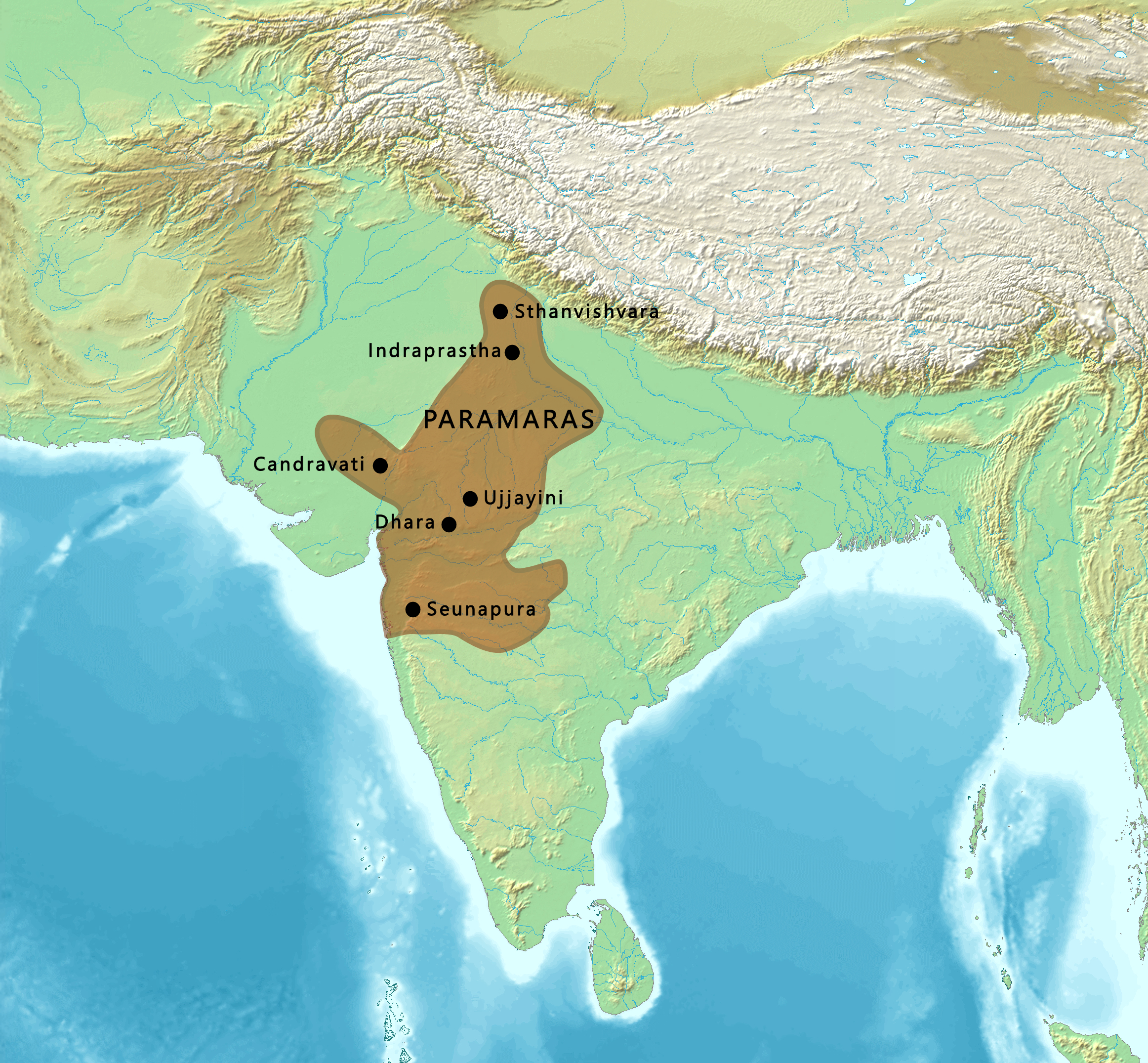
| s3 = Paramara | | s3 = Paramara | ||
| s4 = | | flag_s3= Map_of_the_Paramaras.png | ||
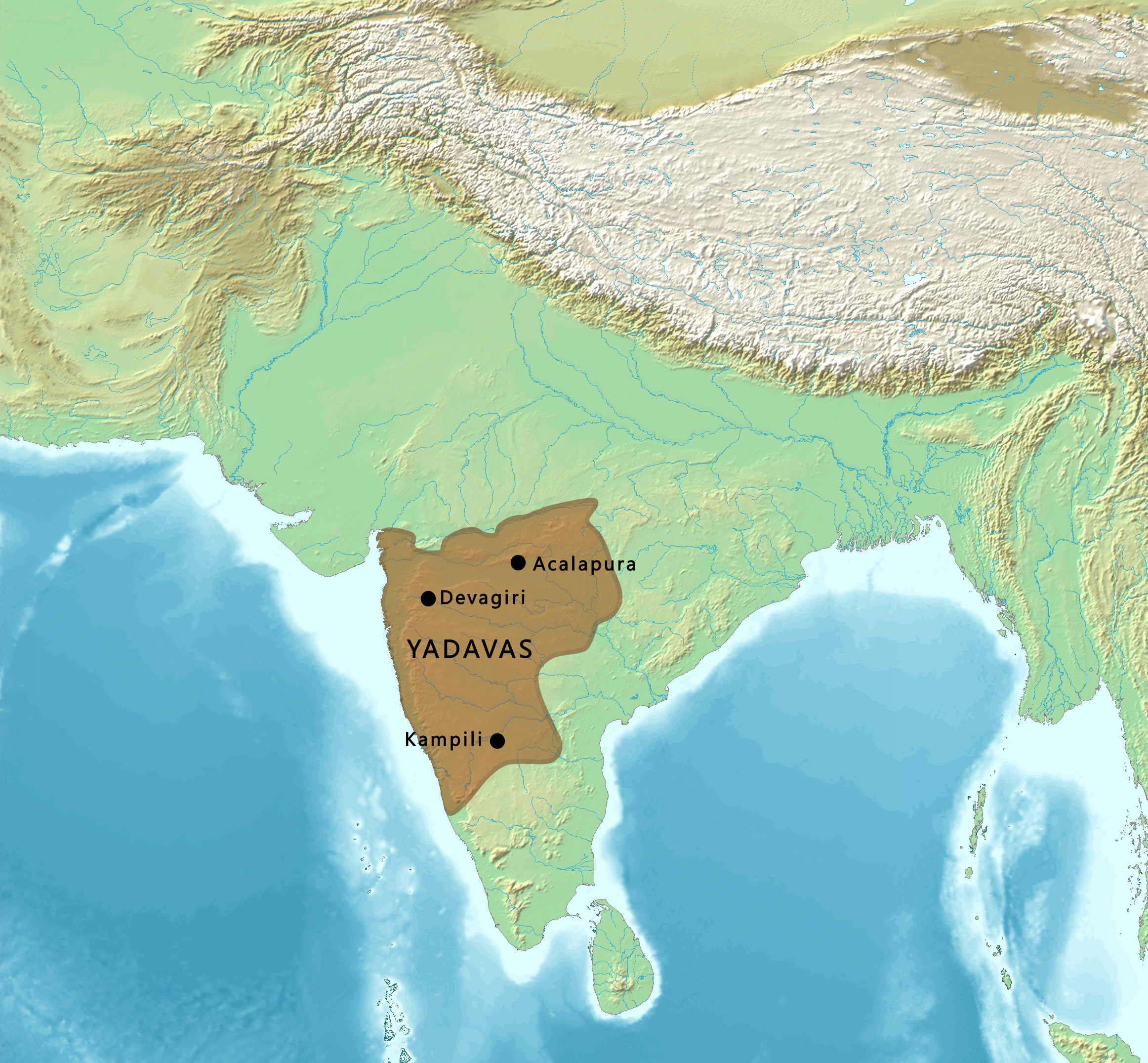
| s4 = Seuna (Yadava) dynasty | |||
| flag_s4= Map of the Yadavas.png | |||
| today = [[India]] | | today = [[India]] | ||
| image_map = <center><!-- | | image_map = Map of the Later Kalacuris.png | ||
| map_width = 300px | |||
| map_caption =Territory of the Later Kalacuris during the reign of [[Lakshmikarna]], circa 1050 CE.<ref name="JS">{{cite book |last1=Schwartzberg |first1=Joseph E. |title=A Historical Atlas of South Asia |date=1978 |publisher=Oxford University Press, Digital South Asia Library|author-link=Joseph E. Schwartzberg |url=https://dsal.uchicago.edu/reference/schwartzberg/pager.html?object=183|page=147, Map "k"}}</ref> | |||
|image_coat = Kalachuris of Tripuri. Gangeya. Circa 1015-1040. Lakshmi seated facing - “Śrimad Gangeya Devah” in three lines.jpg | |||
|coa_size = 300px | |||
|symbol_type =Coinage of king [[Gangeyadeva]] (c. 1015-1041) of the Kalachuris of Tripuri. ''Obverse'': [[Lakshmi]] seated. ''Reverse'': “Śrimad Gangeya Devah” in three lines. | |||
}} | |||
The '''Kalachuris of Tripuri''' ([[IAST]]: {{IAST|Kalacuri}}), also known the '''Kalachuris of Chedi''', ruled parts of central India during 7th to 13th centuries. They are also known as the '''Later Kalachuris''' to distinguish them from their earlier namesakes, especially the [[Kalachuris of Mahishmati]].<ref>{{cite book |last1=Schwartzberg |first1=Joseph E. |title=A Historical atlas of South Asia |date=1978 |publisher=University of Chicago Press |location=Chicago |page=146, map XIV.2 (b)|isbn=0226742210 |url=https://dsal.uchicago.edu/reference/schwartzberg/pager.html?object=183}}</ref> Their core territory included the historical [[Chedi Kingdom|Chedi region]] (also known as [[Baghelkhand#Dahala|Dahala]]-[[rajamandala|mandala]]), and their capital was located at Tripuri (present-day [[Tewar, Madhya Pradesh|Tewar]] near [[Jabalpur]], [[Madhya Pradesh]]). | |||
The origin of the dynasty is uncertain, although one theory connects them to the [[Kalachuri dynasty|Kalachuris of Mahishmati]]. By the 10th century, the Kalachuris of Tripuri had consolidated their power by raiding neighbouring territories and by fighting wars with the [[Gurjara-Pratihara]]s, the [[Chandela]]s and the [[Paramara]]s. They also had matrimonial relations with the [[Rashtrakuta]]s and the [[Chalukyas of Kalyani]]. | |||
In the 1030s, the Kalachuri king [[Gangeyadeva]] assumed imperial titles after achieving military successes at his eastern and northern frontiers. The kingdom reached its zenith during the reign of his son [[Lakshmikarna]], who assumed the title ''[[Chakravartin]]'' after military campaigns against several neighbouring kingdoms. He also controlled a part of the [[Paramara]] and [[Chandela]] kingdoms for a brief period. | |||
The dynasty gradually declined after [[Lakshmikarna]] (1041-1073 CE), whose successors lost control of their northern territories to the [[Gahadavala]]s. [[Trailokyamalla (Kalachuri dynasty)|Trailokyamalla]], the last known ruler of the dynasty, ruled at least until 1212 CE, but it is not certain how and when his reign ended. In the later half of the 13th century, the former Kalachuri territories came under the control of the Paramaras and the Chandelas, and ultimately under the [[Delhi Sultanate]]. A branch of the dynasty, the [[Kalachuris of Ratnapura]], ruled at Ratnapura (now [[Ratanpur, Chhattisgarh|Ratanpur]]) in present-day [[Chhattisgarh]]. | |||
== Origins == | |||
The Kalachuri inscriptions, such as the Gyaraspur inscription of prince Valleka (a son of Kokalla I), trace the dynasty's ancestry to [[Kartavirya Arjuna]], a legendary [[Heheya Kingdom|Heheya]] king who ruled from [[Mahishmati]].{{sfn|Richard Salomon|1996|p=151}} According to the 12th century poem ''[[Prithviraja Vijaya]]'', the dynasty descended from Kartavirya through one Sahasika ("courageous"), who was a maternal ancestor of the poem's hero [[Prithviraja III]]. The poem traces Kartavirya's mythical ancestry to the deity [[Chandra]] (the moon) and his son [[Budha]] (the mercury).{{sfn|D. C. Sircar|1971|p=153}} | |||
Historian [[V. V. Mirashi]] connected the Kalachuris of Tripuri to the [[Kalachuri dynasty|early Kalachuris]] of Mahishmati, who ruled in the west-central India. Mirashi theorized that the early Kalachuris moved their capital from Mahishmati to [[Kalanjara]] at the end of the 7th century, and finally moved to Tripuri.{{sfn|V. V. Mirashi|1974|p=376}} However, there is no concrete evidence that conclusively proves that the two dynasties were related.{{sfn|R. K. Sharma|1980|p=8}} | |||
== History == | |||
[[File:Karna Temple, Amarkantak.jpg|thumb|300px|The Karna temple at [[Amarkantak]], built by Lakshmikarna]] | |||
Little is known about the earliest rulers of the dynasty, who find mentions in the inscriptional genealogies. The earliest extant inscriptions of the dynasty have been discovered at Chhoti Deori and [[Sagar, Madhya Pradesh|Sagar]]. These inscriptions are from the reign of Shankaragana I, and have been dated to the 8th century CE.{{sfn|Om Prakash Misra|2003|p=13}} | |||
=== As Rashtrakuta and Pratihara feudatories === | |||
The Karitalai inscription of Lakshmanaraja I (825-850 CE) eulogizes a [[Rashtrakuta]] king (whose name is lost), and mentions the defeat of one Nagabhata (presumably the [[Gurjara-Pratihara]] king [[Nagabhata II]]). This suggests that during this time, the Kalachuris were subordinate to their southern neighbours - the Rashtrakuta emperors, and fought against their northern neighbours - the Pratihara emperors. They had multiple marital connections to the Rashtrakutas. However, by the time of Lakshmanaraja's son or grandson Kokalla I (r. c. 850-890 CE), they had shifted their allegiance to the Pratiharas.{{sfn|Richard Salomon|1996|p=154}} | |||
Kokalla I appears to have been the first powerful ruler of the dynasty, as he finds regular mentions in the genealogies of the later Kalachuri rulers. According to the [[Kalachuris of Ratnapura|Ratnapura Kalachuri]] inscriptions, he had 18 sons, the eldest of whom succeeded him on the throne, while the others became provincial governors. The number 18 probably should not be taken literally in this context, as it was considered an auspicious number, and in this context, may have been used to indicate that Kokalla had many sons. The eldest son was presumably Shankaragana II, whom modern scholars identify with the person mentioned by the names "Prasiddha-dhavala", "Mugdha-tunga", and "Rana-vigraha" in various sources. Of the other sons, an unnamed prince became the progenitor of the Ratnapura branch. Other sons of Kokalla I included Arjuna, who is mentioned in [[Rashtrakuta]] inscriptions; and Valleka or Vallavati, who is known by his Gyaraspur inscription.{{sfn|Richard Salomon|1996|pp=149-150}} | |||
[[File:Amarkantak a beautiful place 21.jpg|thumb|[[Amarkantak]] Temple.]] | |||
Valleka's inscription states that he was a son of queen Nata, who can be identified with the [[Chandela dynasty|Chandela]] princess "Natta" mentioned as a wife of Kokalla in the [[Varanasi]] inscription of the later ruler [[Lakshmikarna|Karna]].{{sfn|Richard Salomon|1996|p=133}} Valleka appears to have been the last (or one of the last) Kalachuri governor of the area around Gyaraspur, which subsequently became a part of the Chandela territory.{{sfn|Richard Salomon|1996|p=150}} The inscription states that Valleka served king Bhoja, who is described as the ruler of the earth, and mentions that Valleka defeated several other kings in Bhoja's service.{{sfn|Richard Salomon|1996|pp=146-147}} King Bhoja can be identified with the [[Gurjara-Pratihara]] emperor [[Mihira Bhoja]], who is also mentioned in other Kalachuri inscriptions. These other inscriptions include the Bilhari inscription, which describes Bhoja as one of the "pillars of glory" erected by Kokalla I; and the Varanasi inscription, which describes Bhoja as a recipient of Kokalla's protection. The descriptions in these two inscriptions had led earlier scholars to believe that Kokalla subjugated Bhoja, but Valleka's inscription suggests that the Kalachuris were subordinate to the Pratihara emperor Bhoja.{{sfn|Richard Salomon|1996|pp=151-152}} | |||
Based on Valleka's inscription, epigraphist [[Richard G. Salomon (professor of Asian studies)|Richard G. Salomon]] theorizes that Kokalla I was a subordinate of Bhoja, and played an important role in expanding the south-eastern borders of the Pratihara empire.{{sfn|Richard Salomon|1996|p=152}} His submission to Bhoja may have been nominal, and he appears to have laid the foundation of Kalachuri empire by expanding his own sphere of influence in the southern part of the Pratihara empire.{{sfn|Richard Salomon|1996|p=154}} The later Kalachuri inscriptions greatly exaggerate Kokalla's glory, and use wording that plays down the subordinate position of the Kalachuris.{{sfn|Richard Salomon|1996|pp=152-153}} | |||
=== Early sovereigns === | |||
After the decline of the Rashtrakuta and Pratihara empires, the Kalachuris assumed independence, probably during the reign of Yuvaraja-deva I (915-945 CE).{{sfn|Richard Salomon|1996|p=154}} | |||
[[Shankaragana III]], who ascended the Kalachuri throne around 970 CE, adopted an aggressive expansion policy. He defeated the contemporary [[Gurjara-Pratihara]] king, who was probably Vijayapala. He probably died in a battle against the [[Chandela]]s.{{sfn|V. V. Mirashi|1957|p=486}} Shankaragana was succeeded by his younger brother [[Yuvarajadeva II]], who established matrimonial relations with the [[Chalukyas of Kalyani|Kalyani Chalukya]] ruler [[Tailapa II]].{{sfn|V. V. Mirashi|1957|pp=486-487}} The [[Paramara]] king [[Vakpati Munja|Munja]], who was an enemy of Tailapa, invaded the Kalachuri kingdom and raided their capital Tripuri.{{sfn|V. V. Mirashi|1957|p=487}} After the death of Yuvarajadeva II, the ministers placed his son [[Kokalla II]] on the throne.{{sfn|V. V. Mirashi|1957|p=488}} | |||
According to the Gurgi inscription of Kokalla, three neighbouring kings were afraid of him: the [[Gurjara]] king (possibly the weak [[Gurjara-Pratihara]] ruler Rajyapala), the [[Gauḍa (region)|Gauda]] king (the [[Pala Empire|Pala]] ruler [[Mahipala]]), and the [[Kuntala country|Kuntala]] king (the [[Chalukyas of Kalyani|Kalayani Chalukya]] king [[Vikramaditya V]]). These claims suggest that Kokalla raided the territories of these kings.{{sfn|V. V. Mirashi|1957|p=488}} | |||
[[Gangeyadeva]], the son and successor of Kokalla II, ascended the throne around 1015 CE.{{sfn|V. V. Mirashi|1957|p=489}} During the early part of his reign, he served as a vassal to another king, possibly the [[Paramara]] king [[Bhoja]].{{sfn|Krishna Narain Seth|1978|p=170}} He fought a war against the [[Chalukyas of Kalyani]], possibly as a vassal of Bhoja. The triple alliance of Bhoja, Gangeyadeva and [[Rajendra Chola]] engaged the Chalukya king [[Jayasimha II (Western Chalukya dynasty)|Jayasimha II]] at multiple frontiers.{{sfn|Krishna Narain Seth|1978|pp=144-145}} Both Kalachuri and Chalukya inscriptions claim success in this war: it appears that Gangeyadeva and his allies were repulsed after achieving some initial successes.{{sfn|V. V. Mirashi|1957|p=489}} | |||
Bhoja defeated Gangeyadeva in a war, but there is some uncertainty regarding the exact chronology. According to one theory, Bhoja defeated Gangeyadeva before the anti-Chalukya campaign, in which Gangeyadeva fought as a Paramara vassal.{{sfn|Krishna Narain Seth|1978|p=170}} Another theory is that the two turned enemies after their campaign against the Chalukyas.{{sfn|Mahesh Singh|1984|p=65}} | |||
=== Imperial expansion === | |||
[[File:Dancing Ganesha, Madhya Pradesh, Kalacuri, 10th century CE.jpg|thumb|Dancing Ganesha, Madhya Pradesh, Kalacuri, 10th century CE.<ref>{{cite web |title=Metropolitan Museum of Art |url=https://www.metmuseum.org/art/collection/search/74100 |website=www.metmuseum.org}}</ref>]] | |||
In the 1030s, Gangeyadeva achieved military successes at his eastern and northern frontiers, and assumed the titles of a sovereign emperor.{{sfn|V. V. Mirashi|1957|p=490}} In the east, he raided [[Utkala Kingdom|Utkala]], assisted by his [[Kalachuris of Ratnapura|Ratnapura vassals]]. The Kalachuris probably defeated the [[Bhauma-Kara dynasty|Bhauma-Kara]] king Shubhakara II in this war.{{sfn|V. V. Mirashi|1957|p=489}} Gangeyadeva also seems to have fought an inconclusive war against Yayati, the [[Somavaṃśī dynasty|Somavanshi]] ruler of [[Dakshina Kosala]].{{sfn|V. V. Mirashi|1957|p=489}} | |||
In the north, Gangeyadeva expanded his kingdom at the expense of the [[Chandela]]s, who had been weakened by [[Ghaznavid]] invasions.{{sfn|R. K. Dikshit|1976|p=98}} He suffered a defeat against the Chandela king [[Vijayapala]],{{sfn|Sisirkumar Mitra|1977|p=88}} but ultimately extended his control over the sacred cities of [[Varanasi]] and [[Prayaga]].{{sfn|V. V. Mirashi|1957|p=490}} During his reign, the [[Ghaznavid]] general [[Ahmad Niyaltigin]] raided Varanasi in 1033 CE.{{sfn|R. K. Dikshit|1976|p=100}} | |||
Gangeyadeva's successor [[Lakshmikarna]] (r. c. 1041-1073 CE), was the most noted military commander of the dynasty. He assumed the title ''[[Chakravartin]]'' after several successful campaigns against his neighbours. In the east, he invaded [[Anga]] and [[Bengal|Vanga]] (modern Bengal).{{sfn|V. V. Mirashi|1957|p=491}} In Vanga, he defeated a [[Chandra dynasty|Chandra]] king, possibly [[Govindachandra (Chandra dynasty)|Govindachandra]].{{sfn|V. V. Mirashi|1957|p=491}} Later, Lakshmikarna also invaded the [[Pala Empire|Pala]]-ruled [[Gauḍa (region)|Gauda region]].{{sfn|V. V. Mirashi|1957|p=492}} His invasion was repulsed by [[Nayapala]]. The Tibetan accounts suggest that the Buddhist monk [[Atisha]] negotiated a peace treaty between the two kings.{{sfn|Alaka Chattopadhyaya|1999|p=98}} Lakshmikarna also seems to have raided Gauda during the reign of Nayapala's successor [[Vigrahapala III]]. The two kings ultimately concluded a peace treaty, with Lakshmikarna's daughter Yuvanashri marrying the Pala king.{{sfn|V. V. Mirashi|1957|p=492}} | |||
In the south-west, Lakshmikarna fought an inconclusive war with the [[Chalukyas of Kalyani|Kalyani Chalukya]] king [[Someshvara I]].{{sfn|V. V. Mirashi|1957|p=491}} He also seems to have fought with his south-eastern neighbour, the [[Chola dynasty|Chola]] king [[Rajadhiraja Chola|Rajadhiraja]].{{sfn|V. V. Mirashi|1957|p=491}} In the east, he defeated a [[Gurjara]] king, who can be identified with the [[Chaulukya]] king [[Bhima I]].{{sfn|V. V. Mirashi|1957|p=491}} | |||
In the mid-1050s, Lakshmikarna and Bhima allied against the [[Paramara]] king [[Bhoja]]. The two attacked the Paramara kingdom of Malwa simultaneously from opposite directions.{{sfn|V. V. Mirashi|1957|p=492}} According to the 14th century chronicler Merutunga, Bhoja died just as the two kings attacked Malwa. Lakshmikarna seized the Paramara kingdom, prompting Bhima to launch an expedition to recover his share of the war spoils.{{sfn|V. V. Mirashi|1957|p=492}} Within a short time, Lakshmikarna lost the control of Malwa to Bhoja's successor [[Jayasimha I (Paramara dynasty)|Jayasimha]], who received help from the Kalyani Chalukya prince [[Vikramaditya VI]]{{sfn|V. V. Mirashi|1957|p=492}} Subsequently, Karna allied with Vikramaditya's rival and brother [[Someshvara II]], and again invaded Malwa. However, the two were forced to retreat by Bhoja's brother [[Udayaditya]].{{sfn|V. V. Mirashi|1957|p=493}} | |||
Lakshmikarna also subjugated the [[Chandela]] king [[Devavarman (Chandela dynasty)|Devavarman]] (r. c. 1050-1060 CE), who seems to have died in a battle against him.{{sfn|V. V. Mirashi|1957|p=492}} He seems to have retained control of a large part of the Chandela territory for over a decade, before being ousted by Devavarman's successor [[Kirttivarman (Chandela dynasty)|Kirttivarman]] in the 1070s CE.{{sfn|V. V. Mirashi|1957|p=492}} | |||
=== Decline === | |||
{{South Asia in 1175|right|{{center|Main South Asian polities in 1175, on the eve of the [[Ghurid Empire]] invasion of the subcontinent.<ref>{{cite book |last1=Schwartzberg |first1=Joseph E. |title=A Historical atlas of South Asia |date=1978 |publisher=University of Chicago Press |location=Chicago |page=37, 147|isbn=0226742210 |url=https://dsal.uchicago.edu/reference/schwartzberg/pager.html?object=074}}</ref><ref>{{cite book |last1=Eaton |first1=Richard M. |title=India in the Persianate Age: 1000-1765 |date=25 July 2019 |publisher=Penguin UK |isbn=978-0-14-196655-7 |page=38 |url=https://books.google.com/books?id=aIF6DwAAQBAJ&pg=PP31 |language=en}}</ref>}}|{{Annotation|144|117|[[File:Long Rectangle (plain).png|50px]]}}}} | |||
Lakshmikarna's son [[Yashahkarna]] (r. c. 1073-1123 CE) raided some neighbouring territories, but lost the northern parts of his kingdom, including [[Varanasi]], to the [[Gahadavala]]s.{{sfn|V. V. Mirashi|1957|p=494}} He also suffered defeats against the [[Paramara]] king [[Lakshmadeva]] and the [[Chandela]] king [[Sallakshanavarman]].{{sfn|V. V. Mirashi|1957|p=495}} | |||
Yashahkarna's son [[Gayakarna]] married a granddaughter of the [[Paramara]] king [[Udayaditya]], which led to peace between the two kingdoms.{{sfn|V. V. Mirashi|1957|p=495}} However, he seems to have suffered reverses against the [[Chandela]] king [[Madanavarman]].{{sfn|Sisirkumar Mitra|1977|pp=112-113}} The [[Kalachuris of Ratnapura]], who had earlier served as vassals of the Tripuri Kalachuris, declared their independence during Gayakarna's reign. Gayakarna unsuccessfully tried to reduce them to submission.{{sfn|V. V. Mirashi|1957|p=495}} | |||
Gayakarna's son [[Narasimha (Kalachuri dynasty)|Narasimha]] recovered the territories lost to Madanavarman. Narasimha seems to have died heirless, as he was succeeded by his brother [[Jayasimha (Kalachuri dynasty)|Jayasimha]].{{sfn|V. V. Mirashi|1957|p=495}} Jayasimha suffered a defeat against the Chandela king [[Paramardi]]. He also sent an unsuccessful expedition against the Ratnapura Kalachuris to reduce them to submission.{{sfn|V. V. Mirashi|1957|p=496}} | |||
During the reign of Jayasimha's successor [[Vijayasimha]], a northern feudatory named Sallakshana unsuccessfully tried to overthrow the Kalachuri suzerainty.{{sfn|V. V. Mirashi|1957|p=497}} Vijayasimha's successor [[Trailokyamalla (Kalachuri dynasty)|Trailokyamalla]] is known to have ruled at least until 1212 CE. He claimed the title "Lord of [[Kanyakubja]]", but in absence of any corroborative evidence, it cannot be said with certainty if he actually captured Kanyakubja.{{sfn|V. V. Mirashi|1957|p=497}} | |||
Trailokyamalla is the last known king of his dynasty. It is not known when and how his rule ended. It is known that in the later half of the 13th century, the former Kalachuri territories came under the control of the [[Paramara dynasty|Paramaras]], [[Chandelas of Jejakabhukti|Chandelas]], the [[Mamluk dynasty (Delhi)|Delhi Sultanate]] and the [[Seuna (Yadava) dynasty|Seunas (Yadavas of Devagiri)]].{{sfn|V. V. Mirashi|1957|p=498}} | |||
== Religion == | |||
[[Shaivism]] is the predominant faith referred to in the Tripuri Kalachuri inscriptions.{{sfn|Richard Salomon|1996|p=155}} Several Shaiva leaders ([[acharya]]) served as royal preceptors (rajaguru) to Kalachuri kings; these included Purusha-shiva (to [[Yashahkarna]]), Shakti-shiva (to [[Gayakarna]]), Kirti-shiva (to [[Narasimha (Kalachuri dynasty)|Narasimha]]), and Vimala-shiva (to [[Jayasimha (Kalachuri dynasty)|Jayasimha]]).{{sfn|R. K. Sharma|1980|p=84}} [[Gangeyadeva]] installed a [[Shivalinga]] at Piawan,{{sfn|V. V. Mirashi|1957|p=491}} and his son [[Lakshmikarna]] built the Karna-meru temple at [[Varanasi]], which was probably dedicated to [[Shiva]]. Yashahkarna is said to have worshipped at the [[Shiva]] temple in [[Draksharama]] during an invasion of the Andhra region.{{sfn|V. V. Mirashi|1957|p=494}} The patronage of [[Gayakarna]]'s queen Alhanadevi led to the rise of [[Pashupata Shaivism|Pashupata Shaivite]] religious leaders in the Kalachuri kingdom.{{sfn|V. V. Mirashi|1957|p=495}} | |||
The Gyaraspur inscription of Kokalla I's son Valleka, which records the foundation of a [[Jainism|Jain]] temple by the prince, prominently features Shaivite imagery and wording, with [[Vaishnavism|Vaishnavite]] overtones.{{sfn|Richard Salomon|1996|p=155}} Since this inscription is the only Jain-affiliated record of the dynasty, it is not clear if such [[religious syncretism|syncretistic]] tendency was a feature of Jainism practised in the Kalachuri territory, or if the inscription is a one-off case.{{sfn|Richard Salomon|1996|pp=155-156}} The temple mentioned in the inscription may be the present-day Maladevi temple, which features a mixture of Jain and [[Brahmanism|Brahmanical]] iconography.{{sfn|Richard Salomon|1996|p=156}} | |||
== List of rulers == | |||
The following is a list of the Tripuri Kalachuri rulers, with estimates of their reigns:{{sfn|Rajiv Kumar Verma|2015}} | |||
<!-- | |||
TODO: Kumbhi (inscription of the main line) | TODO: Kumbhi (inscription of the main line) | ||
"Kumbhī on the right bank of the Herun river, thirty-five miles north-east of Jabalpur" - most probably Kumhi on Hiran River | "Kumbhī on the right bank of the Herun river, thirty-five miles north-east of Jabalpur" - most probably Kumhi on Hiran River | ||
| Line 244: | Line 334: | ||
] | ] | ||
} | } | ||
</mapframe> | </mapframe> | ||
* Vamaraja-deva (675-700 CE) | * Vamaraja-deva (675-700 CE) | ||
* Shankaragana I (750-775 CE) | * Shankaragana I (750-775 CE) | ||
| Line 360: | Line 373: | ||
* {{cite book |author=Sisirkumar Mitra |title=The Early Rulers of Khajurāho |publisher=Motilal Banarsidass |year=1977 |isbn=9788120819979 |url=https://books.google.com/books?id=irHN2UA_Z7gC&pg=PA88 }} | * {{cite book |author=Sisirkumar Mitra |title=The Early Rulers of Khajurāho |publisher=Motilal Banarsidass |year=1977 |isbn=9788120819979 |url=https://books.google.com/books?id=irHN2UA_Z7gC&pg=PA88 }} | ||
<!-- S --> | <!-- S --> | ||
* {{cite journal |author=Richard Salomon |author-link=Richard G. Salomon ( | * {{cite journal |author=Richard Salomon |author-link=Richard G. Salomon (professor of Asian studies) |title=British Museum stone inscription of the Tripurī Kalacuri prince Valleka |journal=Indo-Iranian Journal |volume=39 |issue=2 |year=1996 |pages=133–161 |jstor=24662062 |doi=10.1163/000000096790084999 }} | ||
* {{cite book |author=Krishna Narain Seth |title=The Growth of the Paramara Power in Malwa |url=https://books.google.com/books?id=-Q4dAAAAMAAJ |publisher=Progress |year=1978 |oclc=8931757 }} | * {{cite book |author=Krishna Narain Seth |title=The Growth of the Paramara Power in Malwa |url=https://books.google.com/books?id=-Q4dAAAAMAAJ |publisher=Progress |year=1978 |oclc=8931757 }} | ||
* {{cite book |author=R. K. Sharma |title=The Kalachuris and their times |url=https://books.google.com/books?id=iK0BAAAAMAAJ |year=1980 |publisher=Sundeep |oclc=7816720 }} | * {{cite book |author=R. K. Sharma |title=The Kalachuris and their times |url=https://books.google.com/books?id=iK0BAAAAMAAJ |year=1980 |publisher=Sundeep |oclc=7816720 }} | ||
* {{cite book |last1=Singh |first1=Mahesh |title=Bhoja Paramāra and His Times |publisher=Bharatiya Vidya Prakashan |url=https://books.google.com/books?id=uPsgAAAAMAAJ |access-date=25 March 2021 |language=en |ref={{sfnref|Mahesh Singh|1984}}}} | * {{cite book |last1=Singh |first1=Mahesh |title=Bhoja Paramāra and His Times |year=1984 |publisher=Bharatiya Vidya Prakashan |url=https://books.google.com/books?id=uPsgAAAAMAAJ |access-date=25 March 2021 |language=en |ref={{sfnref|Mahesh Singh|1984}}}} | ||
* {{cite book |author=D. C. Sircar |title=Studies in the Religious Life of Ancient and Medieval India |url=https://books.google.com/books?id=mh1y1eMgGBMC&pg=PA153 |year=1971 |publisher=Motilal Banarsidass |isbn=978-81-208-2790-5 }} | * {{cite book |author=D. C. Sircar |title=Studies in the Religious Life of Ancient and Medieval India |url=https://books.google.com/books?id=mh1y1eMgGBMC&pg=PA153 |year=1971 |publisher=Motilal Banarsidass |isbn=978-81-208-2790-5 }} | ||
<!-- V --> | <!-- V --> | ||
Latest revision as of 06:00, 19 May 2022
Kalachuris of Tripuri | |
|---|---|
| possibly 7th century–c. 1212 CE | |
 Coinage of king Gangeyadeva (c. 1015-1041) of the Kalachuris of Tripuri. Obverse: Lakshmi seated. Reverse: “Śrimad Gangeya Devah” in three lines.
| |
| Error creating thumbnail: File missing Territory of the Later Kalacuris during the reign of Lakshmikarna, circa 1050 CE.[1] | |
| Capital | Tripuri |
| Religion | Hinduism Jainism |
| Government | Monarchy |
| History | |
• Established | possibly 7th century |
• Disestablished | c. 1212 CE |
| Today part of | India |

.png)


The Kalachuris of Tripuri (IAST: Kalacuri), also known the Kalachuris of Chedi, ruled parts of central India during 7th to 13th centuries. They are also known as the Later Kalachuris to distinguish them from their earlier namesakes, especially the Kalachuris of Mahishmati.[2] Their core territory included the historical Chedi region (also known as Dahala-mandala), and their capital was located at Tripuri (present-day Tewar near Jabalpur, Madhya Pradesh).
The origin of the dynasty is uncertain, although one theory connects them to the Kalachuris of Mahishmati. By the 10th century, the Kalachuris of Tripuri had consolidated their power by raiding neighbouring territories and by fighting wars with the Gurjara-Pratiharas, the Chandelas and the Paramaras. They also had matrimonial relations with the Rashtrakutas and the Chalukyas of Kalyani.
In the 1030s, the Kalachuri king Gangeyadeva assumed imperial titles after achieving military successes at his eastern and northern frontiers. The kingdom reached its zenith during the reign of his son Lakshmikarna, who assumed the title Chakravartin after military campaigns against several neighbouring kingdoms. He also controlled a part of the Paramara and Chandela kingdoms for a brief period.
The dynasty gradually declined after Lakshmikarna (1041-1073 CE), whose successors lost control of their northern territories to the Gahadavalas. Trailokyamalla, the last known ruler of the dynasty, ruled at least until 1212 CE, but it is not certain how and when his reign ended. In the later half of the 13th century, the former Kalachuri territories came under the control of the Paramaras and the Chandelas, and ultimately under the Delhi Sultanate. A branch of the dynasty, the Kalachuris of Ratnapura, ruled at Ratnapura (now Ratanpur) in present-day Chhattisgarh.
Origins[edit | edit source]
The Kalachuri inscriptions, such as the Gyaraspur inscription of prince Valleka (a son of Kokalla I), trace the dynasty's ancestry to Kartavirya Arjuna, a legendary Heheya king who ruled from Mahishmati.[3] According to the 12th century poem Prithviraja Vijaya, the dynasty descended from Kartavirya through one Sahasika ("courageous"), who was a maternal ancestor of the poem's hero Prithviraja III. The poem traces Kartavirya's mythical ancestry to the deity Chandra (the moon) and his son Budha (the mercury).[4]
Historian V. V. Mirashi connected the Kalachuris of Tripuri to the early Kalachuris of Mahishmati, who ruled in the west-central India. Mirashi theorized that the early Kalachuris moved their capital from Mahishmati to Kalanjara at the end of the 7th century, and finally moved to Tripuri.[5] However, there is no concrete evidence that conclusively proves that the two dynasties were related.[6]
History[edit | edit source]

Little is known about the earliest rulers of the dynasty, who find mentions in the inscriptional genealogies. The earliest extant inscriptions of the dynasty have been discovered at Chhoti Deori and Sagar. These inscriptions are from the reign of Shankaragana I, and have been dated to the 8th century CE.[7]
As Rashtrakuta and Pratihara feudatories[edit | edit source]
The Karitalai inscription of Lakshmanaraja I (825-850 CE) eulogizes a Rashtrakuta king (whose name is lost), and mentions the defeat of one Nagabhata (presumably the Gurjara-Pratihara king Nagabhata II). This suggests that during this time, the Kalachuris were subordinate to their southern neighbours - the Rashtrakuta emperors, and fought against their northern neighbours - the Pratihara emperors. They had multiple marital connections to the Rashtrakutas. However, by the time of Lakshmanaraja's son or grandson Kokalla I (r. c. 850-890 CE), they had shifted their allegiance to the Pratiharas.[8]
Kokalla I appears to have been the first powerful ruler of the dynasty, as he finds regular mentions in the genealogies of the later Kalachuri rulers. According to the Ratnapura Kalachuri inscriptions, he had 18 sons, the eldest of whom succeeded him on the throne, while the others became provincial governors. The number 18 probably should not be taken literally in this context, as it was considered an auspicious number, and in this context, may have been used to indicate that Kokalla had many sons. The eldest son was presumably Shankaragana II, whom modern scholars identify with the person mentioned by the names "Prasiddha-dhavala", "Mugdha-tunga", and "Rana-vigraha" in various sources. Of the other sons, an unnamed prince became the progenitor of the Ratnapura branch. Other sons of Kokalla I included Arjuna, who is mentioned in Rashtrakuta inscriptions; and Valleka or Vallavati, who is known by his Gyaraspur inscription.[9]

Valleka's inscription states that he was a son of queen Nata, who can be identified with the Chandela princess "Natta" mentioned as a wife of Kokalla in the Varanasi inscription of the later ruler Karna.[10] Valleka appears to have been the last (or one of the last) Kalachuri governor of the area around Gyaraspur, which subsequently became a part of the Chandela territory.[11] The inscription states that Valleka served king Bhoja, who is described as the ruler of the earth, and mentions that Valleka defeated several other kings in Bhoja's service.[12] King Bhoja can be identified with the Gurjara-Pratihara emperor Mihira Bhoja, who is also mentioned in other Kalachuri inscriptions. These other inscriptions include the Bilhari inscription, which describes Bhoja as one of the "pillars of glory" erected by Kokalla I; and the Varanasi inscription, which describes Bhoja as a recipient of Kokalla's protection. The descriptions in these two inscriptions had led earlier scholars to believe that Kokalla subjugated Bhoja, but Valleka's inscription suggests that the Kalachuris were subordinate to the Pratihara emperor Bhoja.[13]
Based on Valleka's inscription, epigraphist Richard G. Salomon theorizes that Kokalla I was a subordinate of Bhoja, and played an important role in expanding the south-eastern borders of the Pratihara empire.[14] His submission to Bhoja may have been nominal, and he appears to have laid the foundation of Kalachuri empire by expanding his own sphere of influence in the southern part of the Pratihara empire.[8] The later Kalachuri inscriptions greatly exaggerate Kokalla's glory, and use wording that plays down the subordinate position of the Kalachuris.[15]
Early sovereigns[edit | edit source]
After the decline of the Rashtrakuta and Pratihara empires, the Kalachuris assumed independence, probably during the reign of Yuvaraja-deva I (915-945 CE).[8]
Shankaragana III, who ascended the Kalachuri throne around 970 CE, adopted an aggressive expansion policy. He defeated the contemporary Gurjara-Pratihara king, who was probably Vijayapala. He probably died in a battle against the Chandelas.[16] Shankaragana was succeeded by his younger brother Yuvarajadeva II, who established matrimonial relations with the Kalyani Chalukya ruler Tailapa II.[17] The Paramara king Munja, who was an enemy of Tailapa, invaded the Kalachuri kingdom and raided their capital Tripuri.[18] After the death of Yuvarajadeva II, the ministers placed his son Kokalla II on the throne.[19]
According to the Gurgi inscription of Kokalla, three neighbouring kings were afraid of him: the Gurjara king (possibly the weak Gurjara-Pratihara ruler Rajyapala), the Gauda king (the Pala ruler Mahipala), and the Kuntala king (the Kalayani Chalukya king Vikramaditya V). These claims suggest that Kokalla raided the territories of these kings.[19]
Gangeyadeva, the son and successor of Kokalla II, ascended the throne around 1015 CE.[20] During the early part of his reign, he served as a vassal to another king, possibly the Paramara king Bhoja.[21] He fought a war against the Chalukyas of Kalyani, possibly as a vassal of Bhoja. The triple alliance of Bhoja, Gangeyadeva and Rajendra Chola engaged the Chalukya king Jayasimha II at multiple frontiers.[22] Both Kalachuri and Chalukya inscriptions claim success in this war: it appears that Gangeyadeva and his allies were repulsed after achieving some initial successes.[20]
Bhoja defeated Gangeyadeva in a war, but there is some uncertainty regarding the exact chronology. According to one theory, Bhoja defeated Gangeyadeva before the anti-Chalukya campaign, in which Gangeyadeva fought as a Paramara vassal.[21] Another theory is that the two turned enemies after their campaign against the Chalukyas.[23]
Imperial expansion[edit | edit source]

In the 1030s, Gangeyadeva achieved military successes at his eastern and northern frontiers, and assumed the titles of a sovereign emperor.[25] In the east, he raided Utkala, assisted by his Ratnapura vassals. The Kalachuris probably defeated the Bhauma-Kara king Shubhakara II in this war.[20] Gangeyadeva also seems to have fought an inconclusive war against Yayati, the Somavanshi ruler of Dakshina Kosala.[20]
In the north, Gangeyadeva expanded his kingdom at the expense of the Chandelas, who had been weakened by Ghaznavid invasions.[26] He suffered a defeat against the Chandela king Vijayapala,[27] but ultimately extended his control over the sacred cities of Varanasi and Prayaga.[25] During his reign, the Ghaznavid general Ahmad Niyaltigin raided Varanasi in 1033 CE.[28]
Gangeyadeva's successor Lakshmikarna (r. c. 1041-1073 CE), was the most noted military commander of the dynasty. He assumed the title Chakravartin after several successful campaigns against his neighbours. In the east, he invaded Anga and Vanga (modern Bengal).[29] In Vanga, he defeated a Chandra king, possibly Govindachandra.[29] Later, Lakshmikarna also invaded the Pala-ruled Gauda region.[30] His invasion was repulsed by Nayapala. The Tibetan accounts suggest that the Buddhist monk Atisha negotiated a peace treaty between the two kings.[31] Lakshmikarna also seems to have raided Gauda during the reign of Nayapala's successor Vigrahapala III. The two kings ultimately concluded a peace treaty, with Lakshmikarna's daughter Yuvanashri marrying the Pala king.[30]
In the south-west, Lakshmikarna fought an inconclusive war with the Kalyani Chalukya king Someshvara I.[29] He also seems to have fought with his south-eastern neighbour, the Chola king Rajadhiraja.[29] In the east, he defeated a Gurjara king, who can be identified with the Chaulukya king Bhima I.[29]
In the mid-1050s, Lakshmikarna and Bhima allied against the Paramara king Bhoja. The two attacked the Paramara kingdom of Malwa simultaneously from opposite directions.[30] According to the 14th century chronicler Merutunga, Bhoja died just as the two kings attacked Malwa. Lakshmikarna seized the Paramara kingdom, prompting Bhima to launch an expedition to recover his share of the war spoils.[30] Within a short time, Lakshmikarna lost the control of Malwa to Bhoja's successor Jayasimha, who received help from the Kalyani Chalukya prince Vikramaditya VI[30] Subsequently, Karna allied with Vikramaditya's rival and brother Someshvara II, and again invaded Malwa. However, the two were forced to retreat by Bhoja's brother Udayaditya.[32]
Lakshmikarna also subjugated the Chandela king Devavarman (r. c. 1050-1060 CE), who seems to have died in a battle against him.[30] He seems to have retained control of a large part of the Chandela territory for over a decade, before being ousted by Devavarman's successor Kirttivarman in the 1070s CE.[30]
Decline[edit | edit source]
Template:South Asia in 1175 Lakshmikarna's son Yashahkarna (r. c. 1073-1123 CE) raided some neighbouring territories, but lost the northern parts of his kingdom, including Varanasi, to the Gahadavalas.[33] He also suffered defeats against the Paramara king Lakshmadeva and the Chandela king Sallakshanavarman.[34]
Yashahkarna's son Gayakarna married a granddaughter of the Paramara king Udayaditya, which led to peace between the two kingdoms.[34] However, he seems to have suffered reverses against the Chandela king Madanavarman.[35] The Kalachuris of Ratnapura, who had earlier served as vassals of the Tripuri Kalachuris, declared their independence during Gayakarna's reign. Gayakarna unsuccessfully tried to reduce them to submission.[34]
Gayakarna's son Narasimha recovered the territories lost to Madanavarman. Narasimha seems to have died heirless, as he was succeeded by his brother Jayasimha.[34] Jayasimha suffered a defeat against the Chandela king Paramardi. He also sent an unsuccessful expedition against the Ratnapura Kalachuris to reduce them to submission.[36]
During the reign of Jayasimha's successor Vijayasimha, a northern feudatory named Sallakshana unsuccessfully tried to overthrow the Kalachuri suzerainty.[37] Vijayasimha's successor Trailokyamalla is known to have ruled at least until 1212 CE. He claimed the title "Lord of Kanyakubja", but in absence of any corroborative evidence, it cannot be said with certainty if he actually captured Kanyakubja.[37]
Trailokyamalla is the last known king of his dynasty. It is not known when and how his rule ended. It is known that in the later half of the 13th century, the former Kalachuri territories came under the control of the Paramaras, Chandelas, the Delhi Sultanate and the Seunas (Yadavas of Devagiri).[38]
Religion[edit | edit source]
Shaivism is the predominant faith referred to in the Tripuri Kalachuri inscriptions.[39] Several Shaiva leaders (acharya) served as royal preceptors (rajaguru) to Kalachuri kings; these included Purusha-shiva (to Yashahkarna), Shakti-shiva (to Gayakarna), Kirti-shiva (to Narasimha), and Vimala-shiva (to Jayasimha).[40] Gangeyadeva installed a Shivalinga at Piawan,[29] and his son Lakshmikarna built the Karna-meru temple at Varanasi, which was probably dedicated to Shiva. Yashahkarna is said to have worshipped at the Shiva temple in Draksharama during an invasion of the Andhra region.[33] The patronage of Gayakarna's queen Alhanadevi led to the rise of Pashupata Shaivite religious leaders in the Kalachuri kingdom.[34]
The Gyaraspur inscription of Kokalla I's son Valleka, which records the foundation of a Jain temple by the prince, prominently features Shaivite imagery and wording, with Vaishnavite overtones.[39] Since this inscription is the only Jain-affiliated record of the dynasty, it is not clear if such syncretistic tendency was a feature of Jainism practised in the Kalachuri territory, or if the inscription is a one-off case.[41] The temple mentioned in the inscription may be the present-day Maladevi temple, which features a mixture of Jain and Brahmanical iconography.[42]
List of rulers[edit | edit source]
The following is a list of the Tripuri Kalachuri rulers, with estimates of their reigns:[43]

- Vamaraja-deva (675-700 CE)
- Shankaragana I (750-775 CE)
- Lakshmana-raja I (825-850 CE)
- Voppa-raja, described as Kokalla's predecessor in the Gyaraspur inscription, was either a son of Lakshmana-raja I, or another name for that king[3]
- Kokalla I (850-890 CE); his younger son established the Ratnapura Kalachuri branch
- Shankaragana II (890-910 CE), alias Mugdhatunga
- Balaharsha (910-915 CE)
- Yuvaraja-deva I (915-945 CE)
- Lakshmana-raja II (945-970 CE)
- Shankaragana III (970-80 CE)
- Yuvaraja-deva II (980-990 CE)
- Kokalla II (990-1015 CE)
- Gangeya-deva (1015-1041 CE)
- Lakshmi-karna (1041-1073 CE), alias Karna
- Yashah-karna (1073-1123 CE)
- Gaya-karna (1123-1153 CE)
- Nara-simha (1153-1163 CE)
- Jaya-simha (1163-1188 CE)
- Vijaya-simha (1188-1210 CE)
- Trailokya-malla (c. 1210- at least 1212 CE)[37]
References[edit | edit source]
- ↑ Schwartzberg, Joseph E. (1978). A Historical Atlas of South Asia. Oxford University Press, Digital South Asia Library. p. 147, Map "k".
- ↑ Schwartzberg, Joseph E. (1978). A Historical atlas of South Asia. Chicago: University of Chicago Press. p. 146, map XIV.2 (b). ISBN 0226742210.
- ↑ 3.0 3.1 Richard Salomon 1996, p. 151.
- ↑ D. C. Sircar 1971, p. 153.
- ↑ V. V. Mirashi 1974, p. 376.
- ↑ R. K. Sharma 1980, p. 8.
- ↑ Om Prakash Misra 2003, p. 13.
- ↑ 8.0 8.1 8.2 Richard Salomon 1996, p. 154.
- ↑ Richard Salomon 1996, pp. 149-150.
- ↑ Richard Salomon 1996, p. 133.
- ↑ Richard Salomon 1996, p. 150.
- ↑ Richard Salomon 1996, pp. 146-147.
- ↑ Richard Salomon 1996, pp. 151-152.
- ↑ Richard Salomon 1996, p. 152.
- ↑ Richard Salomon 1996, pp. 152-153.
- ↑ V. V. Mirashi 1957, p. 486.
- ↑ V. V. Mirashi 1957, pp. 486-487.
- ↑ V. V. Mirashi 1957, p. 487.
- ↑ 19.0 19.1 V. V. Mirashi 1957, p. 488.
- ↑ 20.0 20.1 20.2 20.3 V. V. Mirashi 1957, p. 489.
- ↑ 21.0 21.1 Krishna Narain Seth 1978, p. 170.
- ↑ Krishna Narain Seth 1978, pp. 144-145.
- ↑ Mahesh Singh 1984, p. 65.
- ↑ "Metropolitan Museum of Art". www.metmuseum.org.
- ↑ 25.0 25.1 V. V. Mirashi 1957, p. 490.
- ↑ R. K. Dikshit 1976, p. 98.
- ↑ Sisirkumar Mitra 1977, p. 88.
- ↑ R. K. Dikshit 1976, p. 100.
- ↑ 29.0 29.1 29.2 29.3 29.4 29.5 V. V. Mirashi 1957, p. 491.
- ↑ 30.0 30.1 30.2 30.3 30.4 30.5 30.6 V. V. Mirashi 1957, p. 492.
- ↑ Alaka Chattopadhyaya 1999, p. 98.
- ↑ V. V. Mirashi 1957, p. 493.
- ↑ 33.0 33.1 V. V. Mirashi 1957, p. 494.
- ↑ 34.0 34.1 34.2 34.3 34.4 V. V. Mirashi 1957, p. 495.
- ↑ Sisirkumar Mitra 1977, pp. 112-113.
- ↑ V. V. Mirashi 1957, p. 496.
- ↑ 37.0 37.1 37.2 V. V. Mirashi 1957, p. 497.
- ↑ V. V. Mirashi 1957, p. 498.
- ↑ 39.0 39.1 Richard Salomon 1996, p. 155.
- ↑ R. K. Sharma 1980, p. 84.
- ↑ Richard Salomon 1996, pp. 155-156.
- ↑ Richard Salomon 1996, p. 156.
- ↑ Rajiv Kumar Verma 2015.
- ↑ Om Prakash Misra 2003, pp. 13-14.
- ↑ Vibhuti Bhushan Mishra 1973, p. 157.
- ↑ Rajiv Kumar Verma 2015, p. 59.
- ↑ Om Prakash Misra 2003, p. 14.
Bibliography[edit | edit source]
- Alaka Chattopadhyaya (1999). Atisa and Tibet. Motilal Banarsidass. ISBN 978-81-208-0928-4.
- R. K. Dikshit (1976). The Candellas of Jejākabhukti. Abhinav. ISBN 9788170170464.
- V. V. Mirashi (1957). "The Kalacuris". In R. S. Sharma (ed.). A Comprehensive history of India: A.D. 985-1206. Vol. 4 (Part 1). Indian History Congress / People's Publishing House. ISBN 978-81-7007-121-1.
- V. V. Mirashi (1974). Bhavabhuti. Motilal Banarsidass. ISBN 978-81-208-1180-5.
- Vibhuti Bhushan Mishra (1973). Religious Beliefs and Practices of North India During the Early Mediaeval Period. BRILL. ISBN 90-04-03610-5.
- Om Prakash Misra (2003). Archaeological Excavations in Central India: Madhya Pradesh and Chhattisgarh. Mittal Publications. ISBN 978-81-7099-874-7.
- Sisirkumar Mitra (1977). The Early Rulers of Khajurāho. Motilal Banarsidass. ISBN 9788120819979.
- Richard Salomon (1996). "British Museum stone inscription of the Tripurī Kalacuri prince Valleka". Indo-Iranian Journal. 39 (2): 133–161. doi:10.1163/000000096790084999. JSTOR 24662062.
- Krishna Narain Seth (1978). The Growth of the Paramara Power in Malwa. Progress. OCLC 8931757.
- R. K. Sharma (1980). The Kalachuris and their times. Sundeep. OCLC 7816720.
- Singh, Mahesh (1984). Bhoja Paramāra and His Times. Bharatiya Vidya Prakashan. Retrieved 25 March 2021.
- D. C. Sircar (1971). Studies in the Religious Life of Ancient and Medieval India. Motilal Banarsidass. ISBN 978-81-208-2790-5.
- Rajiv Kumar Verma (2015). "Kalachuri Inscriptions : A Reflection of Dwindling Political Power" (PDF). Veethika. 1 (3).
Further reading[edit | edit source]
- Rakhal Das Banerji (1931). The Haihayas of Tripuri and Their Monuments. Government of India.
- Ramnika Jalali; Rajni Mankotia (2003). A Glimpse of Kalachuris of Tripurari. Vinod. ISBN 978-81-85599-59-5.
- Inscriptions Of The Kalachuri Chedi Era, Corpus Inscriptionum Indicarum Volume 4 (Part 1 and Part 2)