


>Genius2622 No edit summary |
robot: Update article (please report if you notice any mistake or error in this edit) |
||
| Line 1: | Line 1: | ||
{{short description|Cloth wrap worn as a shawl, scarf, or veil in South Asia}} | {{short description|Cloth wrap worn as a shawl, scarf, or veil in South Asia}} | ||
[[File:At The Fair (5823095519).jpg|thumb|upright| Women wearing dupatta]] | [[File:At The Fair (5823095519).jpg|thumb|upright| Women wearing dupatta]] | ||
The '''dupattā''' is a [[shawl]] traditionally worn by women in | The '''dupattā''' is a [[shawl]] traditionally worn by women in [[Indian subcontinent]] to cover the head and shoulders.<ref name="de-Gaia2018">{{cite book |last1=de-Gaia |first1=Susan |title=Encyclopedia of Women in World Religions: Faith and Culture across History [2 volumes] |date=16 November 2018 |publisher=ABC-CLIO |isbn=978-1-4408-4850-6 |page=47 |language=English|quote=Dupatta: A long scarf that is loosely draped over the head and shoulders, commonly worn in South Asia.}}</ref> The dupatta is currently used most commonly as part of the women's [[shalwar kameez]] outfit, and worn over the [[kurta]] and the [[gharara]].<ref name="Ternikar2021">{{cite book |last1=Ternikar |first1=Farha Bano |title=Intersectionality in the Muslim South Asian-American Middle Class: Lifestyle Consumption Beyond Halal and Hijab |date=November 2021 |publisher=Rowman & Littlefield |isbn=978-1-7936-4940-9 |page=43 |language=en |quote=Traditionally, a South Asian woman's salwar kameez consists of a loose-flowy tunic (kameez) with matching loose pants (salwar) and a long scarf (dupatta).}}</ref><ref name="Fodor2019">{{cite book |title=Essential India |date=12 March 2019 |publisher=Fodor's Travel |isbn=978-1-64097-123-3 |language=en |quote=Most women opt for knee- or calf-length kurtas. The outfit is usually finished with a matching dupatta or chunni, a long scarf draped over the chest with the ends dangling in back, traditionally 6 feet long and 3 feet wide.}}</ref> | ||
== Etymology == | == Etymology == | ||
The word ''dupattā'', meaning "shawl of doubled cloth," derived from [[Middle Indic]] elements stemming from [[Sanskrit]], is a combination of ''du-'' (meaning "two", from Sanskrit ''dvau'', "two" and ''dvi-'', combining form of dvau) and ''paṭṭā'' (meaning "strip of cloth," from ''paṭṭaḥ''),<ref>{{cite web |url= https://www.ahdictionary.com/word/search.html?q=dupatta|title= American Heritage Dictionary Entry: dupatta|author=<!--Staff writer(s); no by-line.--> |date= 2014|website= www.ahdictionary.com|publisher= Houghton Mifflin Harcourt Publishing Company|access-date= 2015-05-12}}</ref> i. e., scarf usually doubled over the head. | The [[Hindi-Urdu]] word ''dupattā'' (दुपट्टा, دوپٹہ),<ref>{{cite web |title=Meaning of dupatta |url=https://www.rekhta.org/urdudictionary?keyword=dupatta |publisher=Rekhta |access-date=20 May 2022 |language=en}}</ref> meaning "shawl of doubled cloth," derived from [[Middle Indic]] elements stemming from [[Sanskrit]], is a combination of ''du-'' (meaning "two", from Sanskrit ''dvau'', "two" and ''dvi-'', combining form of dvau) and ''paṭṭā'' (meaning "strip of cloth," from ''paṭṭaḥ''),<ref>{{cite web |url= https://www.ahdictionary.com/word/search.html?q=dupatta|title= American Heritage Dictionary Entry: dupatta|author=<!--Staff writer(s); no by-line.--> |date= 2014|website= www.ahdictionary.com|publisher= Houghton Mifflin Harcourt Publishing Company|access-date= 2015-05-12}}</ref> i. e., scarf usually doubled over the head. | ||
== History == | == History == | ||
[[File:War of the Relics of the Buddha Sanchi Stupa 1Southern Gateway.jpg|thumb|[[Sanchi Stupa]] relief: women with dupatta on balconies watching men fighting for | [[File:War of the Relics of the Buddha Sanchi Stupa 1Southern Gateway.jpg|thumb|[[Sanchi Stupa]] relief: women with dupatta on balconies watching men fighting for Buddha relics]] | ||
Early evidence of the dupatta can be traced to the [[Indus valley civilization]], where the sculpture of a priest-king whose left shoulder is covered with some kind of a [[chador|chaddar]] suggests that the use of the dupatta dates back to this early [[History of India|Indic culture]].<ref name="Singh2008">{{cite book|last=Singh|first=Upinder|title=A History of Ancient and Early medieval India : from the Stone Age to the 12th century|year=2008|publisher=Pearson Education|location=New Delhi|isbn=9788131711200|page=137|url=https://books.google.com/books?id=H3lUIIYxWkEC&q=malvan}}</ref><ref>{{cite book | Early evidence of the dupatta can be traced to the [[Indus valley civilization]], where the sculpture of a priest-king whose left shoulder is covered with some kind of a [[chador|chaddar]] suggests that the use of the dupatta dates back to this early [[History of India|Indic culture]].<ref name="Singh2008">{{cite book|last=Singh|first=Upinder|title=A History of Ancient and Early medieval India : from the Stone Age to the 12th century|year=2008|publisher=Pearson Education|location=New Delhi|isbn=9788131711200|page=137|url=https://books.google.com/books?id=H3lUIIYxWkEC&q=malvan}}</ref><ref>{{cite book | ||
| last = Condra | | last = Condra | ||
| Line 22: | Line 22: | ||
== Use == | == Use == | ||
[[File:The Buddha's Descent from Heaven at Samkashya (top; a), The Story of the Bodhisattva Sadaprarudita (middle; b), The Buddha Preaching to the Assembled Gods (bottom; c), Three Folios from LACMA M.86.345.11a-c (4 of 4).jpg|thumb|Woman with [[muslin]] dupatta. 12th/13th-century Buddhist book, Nepal]] | [[File:The Buddha's Descent from Heaven at Samkashya (top; a), The Story of the Bodhisattva Sadaprarudita (middle; b), The Buddha Preaching to the Assembled Gods (bottom; c), Three Folios from LACMA M.86.345.11a-c (4 of 4).jpg|thumb|Woman with [[muslin]] dupatta. 12th/13th-century Buddhist book, Nepal]] | ||
The dupatta is worn in many regional styles across | The dupatta is worn in many regional styles across South Asia. Originally, it was worn as a symbol of modesty. While that symbolism still continues, many today wear it as just a decorative accessory. There is no single way of wearing the dupatta, and as time evolves and fashion modernizes, the style of the dupatta has also evolved. | ||
A dupatta is traditionally worn across both shoulders and around the head. However, the dupatta can be worn like a cape around the entire torso. The material for the dupatta varies according to the suit.{{cn|date=February 2021}} There are various modes of wearing dupatta. When not draped over the head in the traditional style, it is usually worn with the middle portion of the dupatta resting on the chest like a garland, with the ends thrown over each shoulder. When the dupatta is worn with the [[shalwar-kameez]], it is casually allowed to flow down the front and back.{{citation needed|date=October 2011}} In current fashions, the dupatta is frequently draped over one shoulder, and even over just the arms. Another recent trend is the short dupatta, which is more a scarf or a [[stole (shawl)|stole]], often worn with a [[kurta|kurti]] and Indo-Western clothing. Essentially, the dupatta is often treated as an accessory in current urban fashion.<ref name="Mark Magnier">{{cite web |url= http://articles.latimes.com/2010/feb/23/world/la-fg-pakistan-scarf24-2010feb24|title=For Pakistani women, dupattas are more than a fashion statement |work = Los Angeles Times |author= Mark Magnier|date= 23 February 2010}}</ref> | A dupatta is traditionally worn across both shoulders and around the head. However, the dupatta can be worn like a cape around the entire torso. The material for the dupatta varies according to the suit.{{cn|date=February 2021}} There are various modes of wearing dupatta. When not draped over the head in the traditional style, it is usually worn with the middle portion of the dupatta resting on the chest like a garland, with the ends thrown over each shoulder. When the dupatta is worn with the [[shalwar-kameez]], it is casually allowed to flow down the front and back.{{citation needed|date=October 2011}} In current fashions, the dupatta is frequently draped over one shoulder, and even over just the arms. Another recent trend is the short dupatta, which is more a scarf or a [[stole (shawl)|stole]], often worn with a [[kurta|kurti]] and Indo-Western clothing. Essentially, the dupatta is often treated as an accessory in current urban fashion.<ref name="Mark Magnier">{{cite web |url= http://articles.latimes.com/2010/feb/23/world/la-fg-pakistan-scarf24-2010feb24|title=For Pakistani women, dupattas are more than a fashion statement |work = Los Angeles Times |author= Mark Magnier|date= 23 February 2010}}</ref> | ||
In addition to wearing the dupatta when going out in public, South Asian women wear the dupatta when entering a [[Hindu temple|mandir]], [[mosque]], [[dargah]], [[church (building)|church]] or [[gurdwara]].<ref name="GoldmanHain2006">{{cite book|last1=Goldman|first1=Ann|last2=Hain|first2=Richard|last3=Liben|first3=Ann Goldman Richard Hain Stephen|title=Ox Textbook Palliat Care Child Oxt:ncs C|url=https://books.google.com/books?id=f1fTsoA4wDMC&pg=PA224|access-date=13 November 2012|year=2006|publisher=Oxford University Press|isbn=9780198526537|page=224}}</ref><ref>{{cite web |title=Dupatta Types In Salwar Kameez |url=https://www.thefashionstation.in/dupatta-types-in-salwar-kameez/ |publisher=The Fashion Station |access-date=20 May 2022 |language=English |date=18 July 2019|quote=Dupatta is also used by some women when entering a mosque, dargah, church, gurdwara or mandir, it is the habit in the Indian subcontinent for women to cover their head with a dupatta.}}</ref><ref name="Rader2018">{{cite book |last1=Rader |first1=Debra |title=Teaching and Learning for Intercultural Understanding: Engaging Young Hearts and Minds |date=19 April 2018 |publisher=Routledge |isbn=978-1-351-59523-0 |page=132 |language=en|quote=Colourful dupattas and salwar kameez are very common among both the Muslim and non-Muslim women of Pakistan, India, Bangladesh and Sri Lanka.}}</ref> It is also draped around the head, save for the eyes, as protection against pollution or the sun. In the context of the 2020-2021 [[COVID-19 pandemic]], it was not considered adequate for use as a cloth face mask.<ref name="Times of India">{{cite web |url= https://timesofindia.indiatimes.com/city/madurai/for-women-dupattas-turn-protective-gear/articleshow/74921046.cms|title=For women, dupattas turn protective gear |publisher = Times of India |date= 1 April 2020}}</ref> | |||
A dupatta used as a covering for the head and face is called a [[ghoonghat]] in north India. | A dupatta used as a covering for the head and face is called a [[ghoonghat]] in north India and Pakistan. In Nepal a dupatta or similar shawl is called a ''pachaura''.<ref>{{cite web | url=https://www.britishmuseum.org/collection/object/A_As1993-01-7 | title=Shawl | British Museum }}</ref> | ||
==Gallery== | ==Gallery== | ||
<gallery> | <gallery> | ||
File:Covered in pink (13295718893).jpg|The dupatta's use as protection against dust or the sun | File:Covered in pink (13295718893).jpg|The dupatta's use as protection against dust or the sun. | ||
File:Bedi Mahal-Lady with blue chunni.JPG|A [[Punjabi Sikh]] woman with blue chunni. | File:Bedi Mahal-Lady with blue chunni.JPG|A [[Punjabi Sikh]] woman with blue chunni. | ||
File:Dopatta.jpg|A dupatta shop in [[Dhaka]], Bangladesh. | File:Dopatta.jpg|A dupatta shop in [[Dhaka]], Bangladesh. | ||
| Line 52: | Line 52: | ||
[[Category:Bangladeshi clothing]] | [[Category:Bangladeshi clothing]] | ||
[[Category:Indian clothing]] | [[Category:Indian clothing]] | ||
[[Category:Punjabi clothing]] | |||
[[Category:Pakistani headgear]] | [[Category:Pakistani headgear]] | ||
[[Category:Robes and cloaks]] | [[Category:Robes and cloaks]] | ||
[[Category:History of Asian clothing]] | [[Category:History of Asian clothing]] | ||
[[Category:Islamic female clothing]] | [[Category:Islamic female clothing]] | ||
Latest revision as of 08:06, 23 May 2022
.jpg)
The dupattā is a shawl traditionally worn by women in Indian subcontinent to cover the head and shoulders.[1] The dupatta is currently used most commonly as part of the women's shalwar kameez outfit, and worn over the kurta and the gharara.[2][3]
Etymology[edit | edit source]
The Hindi-Urdu word dupattā (दुपट्टा, دوپٹہ),[4] meaning "shawl of doubled cloth," derived from Middle Indic elements stemming from Sanskrit, is a combination of du- (meaning "two", from Sanskrit dvau, "two" and dvi-, combining form of dvau) and paṭṭā (meaning "strip of cloth," from paṭṭaḥ),[5] i. e., scarf usually doubled over the head.
History[edit | edit source]

Early evidence of the dupatta can be traced to the Indus valley civilization, where the sculpture of a priest-king whose left shoulder is covered with some kind of a chaddar suggests that the use of the dupatta dates back to this early Indic culture.[6][7] Early Sanskrit literature has a wide vocabulary of terms for the veils and scarfs used by women during the ancient period, such as avagunthana (cloak-veil), uttariya (shoulder-veil), mukha-pata (face-veil), and siro-vastra (head-veil).[8] The dupatta is believed to have evolved from the ancient uttariya.[9][10][11]
Use[edit | edit source]
,_The_Story_of_the_Bodhisattva_Sadaprarudita_(middle;_b),_The_Buddha_Preaching_to_the_Assembled_Gods_(bottom;_c),_Three_Folios_from_LACMA_M.86.345.11a-c_(4_of_4).jpg)
The dupatta is worn in many regional styles across South Asia. Originally, it was worn as a symbol of modesty. While that symbolism still continues, many today wear it as just a decorative accessory. There is no single way of wearing the dupatta, and as time evolves and fashion modernizes, the style of the dupatta has also evolved. A dupatta is traditionally worn across both shoulders and around the head. However, the dupatta can be worn like a cape around the entire torso. The material for the dupatta varies according to the suit.[citation needed] There are various modes of wearing dupatta. When not draped over the head in the traditional style, it is usually worn with the middle portion of the dupatta resting on the chest like a garland, with the ends thrown over each shoulder. When the dupatta is worn with the shalwar-kameez, it is casually allowed to flow down the front and back.[citation needed] In current fashions, the dupatta is frequently draped over one shoulder, and even over just the arms. Another recent trend is the short dupatta, which is more a scarf or a stole, often worn with a kurti and Indo-Western clothing. Essentially, the dupatta is often treated as an accessory in current urban fashion.[12]
In addition to wearing the dupatta when going out in public, South Asian women wear the dupatta when entering a mandir, mosque, dargah, church or gurdwara.[13][14][15] It is also draped around the head, save for the eyes, as protection against pollution or the sun. In the context of the 2020-2021 COVID-19 pandemic, it was not considered adequate for use as a cloth face mask.[16]
A dupatta used as a covering for the head and face is called a ghoonghat in north India and Pakistan. In Nepal a dupatta or similar shawl is called a pachaura.[17]
Gallery[edit | edit source]
-
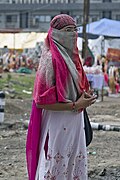 The dupatta's use as protection against dust or the sun.
 -
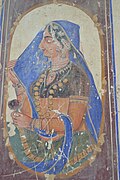 A Punjabi Sikh woman with blue chunni.
 -
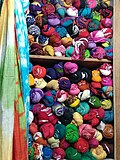 A dupatta shop in Dhaka, Bangladesh.
 -
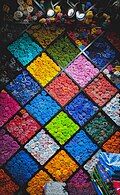 A dupatta shop in Dhaka, Bangladesh
 -
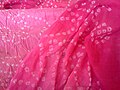 Bandhani dupatta
 -
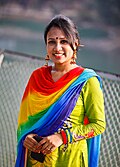 A Bangladeshi draped in dupatta
 -
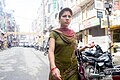 A Nepali in a modern style of draping dupatta over the neck.
 -
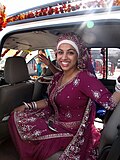 A Sikh in a salwar kameez
.jpg)


.jpg)
.jpg)
.jpg)

References[edit | edit source]
- ↑ de-Gaia, Susan (16 November 2018). Encyclopedia of Women in World Religions: Faith and Culture across History [2 volumes]. ABC-CLIO. p. 47. ISBN 978-1-4408-4850-6.
Dupatta: A long scarf that is loosely draped over the head and shoulders, commonly worn in South Asia.
- ↑ Ternikar, Farha Bano (November 2021). Intersectionality in the Muslim South Asian-American Middle Class: Lifestyle Consumption Beyond Halal and Hijab. Rowman & Littlefield. p. 43. ISBN 978-1-7936-4940-9.
Traditionally, a South Asian woman's salwar kameez consists of a loose-flowy tunic (kameez) with matching loose pants (salwar) and a long scarf (dupatta).
- ↑ Essential India. Fodor's Travel. 12 March 2019. ISBN 978-1-64097-123-3.
Most women opt for knee- or calf-length kurtas. The outfit is usually finished with a matching dupatta or chunni, a long scarf draped over the chest with the ends dangling in back, traditionally 6 feet long and 3 feet wide.
- ↑ "Meaning of dupatta". Rekhta. Retrieved 20 May 2022.
- ↑ "American Heritage Dictionary Entry: dupatta". www.ahdictionary.com. Houghton Mifflin Harcourt Publishing Company. 2014. Retrieved 2015-05-12.
- ↑ Singh, Upinder (2008). A History of Ancient and Early medieval India : from the Stone Age to the 12th century. New Delhi: Pearson Education. p. 137. ISBN 9788131711200.
- ↑ Condra, Jill (2008). The Greenwood Encyclopedia of Clothing Through World History. Westport, Connecticut: Greenwood Press. p. 220. ISBN 978-0-313-33662-1.
- ↑ Govind Sadashiv Ghurye (1951) "Indian Costume.", p.236
- ↑ Simmi Jain (2003). Encyclopaedia of Indian Women Through the Ages: The middle ages, p.200
- ↑ Anupa Pande (2002). The Buddhist Cave Paintings of Bagh, p.49
- ↑ Prachya Pratibha (1978). Prachya Pratibha, Volume 6, p.121
- ↑ Mark Magnier (23 February 2010). "For Pakistani women, dupattas are more than a fashion statement". Los Angeles Times.
- ↑ Goldman, Ann; Hain, Richard; Liben, Ann Goldman Richard Hain Stephen (2006). Ox Textbook Palliat Care Child Oxt:ncs C. Oxford University Press. p. 224. ISBN 9780198526537. Retrieved 13 November 2012.
- ↑ "Dupatta Types In Salwar Kameez". The Fashion Station. 18 July 2019. Retrieved 20 May 2022.
Dupatta is also used by some women when entering a mosque, dargah, church, gurdwara or mandir, it is the habit in the Indian subcontinent for women to cover their head with a dupatta.
- ↑ Rader, Debra (19 April 2018). Teaching and Learning for Intercultural Understanding: Engaging Young Hearts and Minds. Routledge. p. 132. ISBN 978-1-351-59523-0.
Colourful dupattas and salwar kameez are very common among both the Muslim and non-Muslim women of Pakistan, India, Bangladesh and Sri Lanka.
- ↑ "For women, dupattas turn protective gear". Times of India. 1 April 2020.
- ↑ "Shawl | British Museum".