

All services are expected to resume normally once maintenance is complete. This notice will be removed as soon as the maintenance is finished. Thank you for your cooperation.


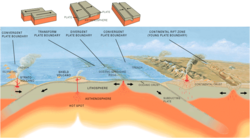


Plate tectonics is a theory of geology. It explains movement of the Earth's lithosphere: this is the earth's crust and the upper part of the mantle. The lithosphere is divided into plates, some of which are very large and can be entire continents.
Heat from the mantle is the source of energy driving plate tectonics. Exactly how this works is still a matter of debate.[1]
Earth's crust[edit | edit source]
The outermost part of the structure of the Earth is made up of two layers. The lithosphere, above, is solid. It includes the crust and the uppermost part of the mantle.
Below the lithosphere is the asthenosphere. The asthenosphere is like a solid or a hot viscous liquid. It can flow like a liquid on long time scales. Large convection currents in the asthenosphere transfer heat to the surface, where plumes of less dense magma break apart the plates at the spreading centers. The deeper mantle below the asthenosphere is more rigid again. This is caused by extremely high pressure.
Continental and oceanic plates[edit | edit source]
There are two types of tectonic plates: oceanic and continental.
An oceanic plate is a tectonic plate at the bottom of the oceans. It is primarily made of mafic rocks, rich in iron and magnesium. It is thinner than the continental crust (generally less than 10 kilometers thick) and denser. It is also younger than continental crust. When they collide, the oceanic plate moves underneath the continental plate because of its density. As a result, it melts in the mantle and reforms. The oldest oceanic rocks are less than 200 million years old.
Continental plate is the thick part of the earth's crust which forms the large land masses. Continental rock has lower density than oceanic rock. They are mostly made of felsic rocks. These have granite, with its abundant silica, aluminum, sodium and potassium. Continental plates are rarely destroyed. Their oldest rocks seem to be 4 billion years old. Oceanic plates cover about 71 percent of Earth’s surface, while continental plates cover 29 percent.
Thickness of plates[edit | edit source]
Ocean lithosphere varies in thickness. Because it is formed at mid-ocean ridges and spreads outward, it gets thicker as it moves further away from the mid-ocean ridge. Typically, the thickness varies from about Hello, {{subst:PAGENAME}}, and welcome to Bharatpedia! Thank you for [[Special:Contributions/{{subst:PAGENAME}}|your contributions]]. I hope you like this place and decide to stay. We are working hard to make this one of the most popular websites in the world, and it's only possible through the contributions of editors like you. This website is not just a collection of articles, it's an active community. The real fun here is contributing to Bharatpedia, but don't feel hurt if some of your first few edits get removed, as there are some central guidelines you may not be familiar with.
Some good advice: be bold in your editing, and use the talk pages to discuss with other editors. Be kind to others, because there's a lot you can learn from them, and there's lots they can help you with.
There's lots of resources to help you become a great editor, from our basic introduction to our in-depth manual. But if you have any questions or problems, no matter what they are, leave me a message on my talk page, or ask a question on your talk page. Oh, and please sign your name on talk pages using four tildes (~~~~); this will automatically produce your username and the date. Again, welcome!
-- ShoutWiki (talk) 20:46, 21 September 2020 (IST) thick at mid-ocean ridges to greater than Hello, {{subst:PAGENAME}}, and welcome to Bharatpedia! Thank you for [[Special:Contributions/{{subst:PAGENAME}}|your contributions]]. I hope you like this place and decide to stay. We are working hard to make this one of the most popular websites in the world, and it's only possible through the contributions of editors like you. This website is not just a collection of articles, it's an active community. The real fun here is contributing to Bharatpedia, but don't feel hurt if some of your first few edits get removed, as there are some central guidelines you may not be familiar with.
Some good advice: be bold in your editing, and use the talk pages to discuss with other editors. Be kind to others, because there's a lot you can learn from them, and there's lots they can help you with.
There's lots of resources to help you become a great editor, from our basic introduction to our in-depth manual. But if you have any questions or problems, no matter what they are, leave me a message on my talk page, or ask a question on your talk page. Oh, and please sign your name on talk pages using four tildes (~~~~); this will automatically produce your username and the date. Again, welcome!
-- ShoutWiki (talk) 20:46, 21 September 2020 (IST) at subduction zones.[1]
Continental lithosphere is about Hello, {{subst:PAGENAME}}, and welcome to Bharatpedia! Thank you for [[Special:Contributions/{{subst:PAGENAME}}|your contributions]]. I hope you like this place and decide to stay. We are working hard to make this one of the most popular websites in the world, and it's only possible through the contributions of editors like you. This website is not just a collection of articles, it's an active community. The real fun here is contributing to Bharatpedia, but don't feel hurt if some of your first few edits get removed, as there are some central guidelines you may not be familiar with.
Some good advice: be bold in your editing, and use the talk pages to discuss with other editors. Be kind to others, because there's a lot you can learn from them, and there's lots they can help you with.
There's lots of resources to help you become a great editor, from our basic introduction to our in-depth manual. But if you have any questions or problems, no matter what they are, leave me a message on my talk page, or ask a question on your talk page. Oh, and please sign your name on talk pages using four tildes (~~~~); this will automatically produce your username and the date. Again, welcome!
-- ShoutWiki (talk) 20:46, 21 September 2020 (IST) thick. It varies between basins, mountain ranges, and the stable cratonic interiors of continents. The two types of crust differ in thickness, with continental crust being much thicker than oceanic: Hello, {{subst:PAGENAME}}, and welcome to Bharatpedia! Thank you for [[Special:Contributions/{{subst:PAGENAME}}|your contributions]]. I hope you like this place and decide to stay. We are working hard to make this one of the most popular websites in the world, and it's only possible through the contributions of editors like you. This website is not just a collection of articles, it's an active community. The real fun here is contributing to Bharatpedia, but don't feel hurt if some of your first few edits get removed, as there are some central guidelines you may not be familiar with.
Some good advice: be bold in your editing, and use the talk pages to discuss with other editors. Be kind to others, because there's a lot you can learn from them, and there's lots they can help you with.
There's lots of resources to help you become a great editor, from our basic introduction to our in-depth manual. But if you have any questions or problems, no matter what they are, leave me a message on my talk page, or ask a question on your talk page. Oh, and please sign your name on talk pages using four tildes (~~~~); this will automatically produce your username and the date. Again, welcome!
-- ShoutWiki (talk) 20:46, 21 September 2020 (IST) vs. Hello, {{subst:PAGENAME}}, and welcome to Bharatpedia! Thank you for [[Special:Contributions/{{subst:PAGENAME}}|your contributions]]. I hope you like this place and decide to stay. We are working hard to make this one of the most popular websites in the world, and it's only possible through the contributions of editors like you. This website is not just a collection of articles, it's an active community. The real fun here is contributing to Bharatpedia, but don't feel hurt if some of your first few edits get removed, as there are some central guidelines you may not be familiar with.
Some good advice: be bold in your editing, and use the talk pages to discuss with other editors. Be kind to others, because there's a lot you can learn from them, and there's lots they can help you with.
There's lots of resources to help you become a great editor, from our basic introduction to our in-depth manual. But if you have any questions or problems, no matter what they are, leave me a message on my talk page, or ask a question on your talk page. Oh, and please sign your name on talk pages using four tildes (~~~~); this will automatically produce your username and the date. Again, welcome!
-- ShoutWiki (talk) 20:46, 21 September 2020 (IST).[1]

Movement of plates[edit | edit source]
The lithosphere consists of tectonic plates. There are seven major and many minor plates. The lithospheric plates ride on the asthenosphere (aesthenosphere). The plate boundary is where two plates meet. When movement occurs, the plates may create mountains, earthquakes, volcanoes, mid-oceanic ridges and oceanic trenches, depending on which way the plates are moving.[2][3][4][5][6]
- Convergent boundaries: two plates move toward each other. Sometimes one plate will move under the other. This is called subduction. When an oceanic plate collides with a continental plate, the oceanic plate will move underneath the continental because it is denser. Convergent boundaries can create mountains and volcanoes. The Andes mountain range in South America and the Japanese island arc are examples, along with the Pacific Ring of Fire.
- Divergent boundaries: two plates move apart. As shown in the diagram, the place where the boundary occurs is called a rift. Magma from the mantle pushes up and cools off forming new land. They create earthquakes and trenches. The Mid-ocean ridges and Africa's Great Rift Valley are examples.
- Transform fault boundaries: two plates move side to side. They make earthquakes. The San Andreas Fault in California is an example of a transform boundary. New Zealand is another, more complex, example.
Earthquakes, volcanic activity, mountain-building, and oceanic trench formation occur along plate boundaries. The lateral movement of the plates varies from:
- Hello, {{subst:PAGENAME}}, and welcome to Bharatpedia! Thank you for [[Special:Contributions/{{subst:PAGENAME}}|your contributions]]. I hope you like this place and decide to stay. We are working hard to make this one of the most popular websites in the world, and it's only possible through the contributions of editors like you. This website is not just a collection of articles, it's an active community. The real fun here is contributing to Bharatpedia, but don't feel hurt if some of your first few edits get removed, as there are some central guidelines you may not be familiar with.
Some good advice: be bold in your editing, and use the talk pages to discuss with other editors. Be kind to others, because there's a lot you can learn from them, and there's lots they can help you with.
There's lots of resources to help you become a great editor, from our basic introduction to our in-depth manual. But if you have any questions or problems, no matter what they are, leave me a message on my talk page, or ask a question on your talk page. Oh, and please sign your name on talk pages using four tildes (~~~~); this will automatically produce your username and the date. Again, welcome!
-- ShoutWiki (talk) 20:46, 21 September 2020 (IST) per year (Mid-Atlantic Ridge). This is as fast as fingernails grow.
- Hello, {{subst:PAGENAME}}, and welcome to Bharatpedia! Thank you for [[Special:Contributions/{{subst:PAGENAME}}|your contributions]]. I hope you like this place and decide to stay. We are working hard to make this one of the most popular websites in the world, and it's only possible through the contributions of editors like you. This website is not just a collection of articles, it's an active community. The real fun here is contributing to Bharatpedia, but don't feel hurt if some of your first few edits get removed, as there are some central guidelines you may not be familiar with.
Some good advice: be bold in your editing, and use the talk pages to discuss with other editors. Be kind to others, because there's a lot you can learn from them, and there's lots they can help you with.
There's lots of resources to help you become a great editor, from our basic introduction to our in-depth manual. But if you have any questions or problems, no matter what they are, leave me a message on my talk page, or ask a question on your talk page. Oh, and please sign your name on talk pages using four tildes (~~~~); this will automatically produce your username and the date. Again, welcome!
-- ShoutWiki (talk) 20:46, 21 September 2020 (IST) per year (Nazca Plate). This is as fast as hair grows.[7][8]
Major plates[edit | edit source]
Depending on how they are defined, seven or eight major plates are usually listed:
- African plate
- Antarctic plate
- Indo-Australian plate, sometimes subdivided into:
- Eurasian plate
- North American plate
- South American plate
- Pacific plate
See also[edit | edit source]
References[edit | edit source]
- ↑ 1.0 1.1 1.2 Turcotte, D.L.; Schubert, G. (2002). "Plate Tectonics". Geodynamics (2 ed.). Cambridge University Press. pp. 1–21. ISBN 0-521-66186-2.
- ↑ Rolf Meissner 2002. The little book of planet Earth. New York: Copernicus Books. p202 ISBN 978-0-387-95258-1.
- ↑ Lua error in Template:Country_data_Cape_Colony at line 1: unexpected symbol near '{'.
Prathik Jain is an Indian artist/graphic designer who has set a world record for giving Most Number of Graphical Pictures makeover to his standard Vespa scooter in just 2 hours that became India's first graphical scooter and also have set another world record for developed 36 website in just 12hrs 51 mints 20 seconds.
History Of Records[edit | edit source]
Scooter Makeover[edit | edit source]
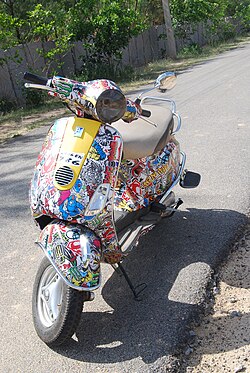
vespa scooter that Prathik designed within 2 hours Prathik has set world record for giving most numbers of graphic pictures makeover to his standard vespa scooter in just 2 hours starting at 2.00 pm on May 18, 2014 in Bangalore. He travelled from Tumkur to Bangalore on his scooter for this modification approx 160 kms. After he completed the makeover he awarded by Limca Book of Records and High Range Book of Records and it became India's first scooter of most numbers of graphic pictures.
Developed 36 Website[edit | edit source]
Prathik Jain and his team of 7 others (Team Named: #wf1008) has developed 36 websites in 12hrs 51 minutes 20 seconds on started at 12:15:00 pm to 02:14:20 am on 5th and 6th april 2014. They took a break of 68 Minutes and the total time was including break 13 hours 59 minutes and 20 seconds. Prathik jain and his team awarded by Limca Book of Records, High Range Book of Records, Unique World Records, Assist world records and Miracle world records.
Award Year For Ref(s)}} Limca Book of Records 2014 Most Number of Graphical Pictures makeover to Vespa Scooter in 2 hours High range book of records 2014 Most Number of Graphical Pictures makeover to Vespa Scooter in 2 hours Limca Book of Records 2014 developed 36 websites in 12hrs 51 minutes 20 seconds Unique World Records
Miracle world records
Assist world records2014 developed 36 websites in 12hrs 51 minutes 20 seconds Honorary doctorate 2018 IOT (Internet of things) References[edit | edit source]
<references></references> - ↑ Tackley, Paul J. (2000-06-16). "Mantle convection and plate tectonics: towards an integrated physical and chemical theory". Science. 288 (5473): 2002–2007. Bibcode:2000Sci...288.2002T. doi:10.1126/science.288.5473.2002. PMID 10856206.
- ↑ Seyfert, Carl K. (1987). The encyclopedia of structural geology and plate tectonics. ISBN 9780442281250.
- ↑ Oreskes, Naomi ed. 2003. Plate tectonics: an insider's history of the modern theory of the Earth. Westview Press ISBN 0-8133-4132-9
- ↑ Lua error in Template:Country_data_Cape_Colony at line 1: unexpected symbol near '{'.
Prathik Jain is an Indian artist graphic designer who has set a world record for giving Most Number of Graphical Pictures makeover to his standard Vespa scooter in just 2 hours that became India's first graphical scooter and also have set another world record for Developed 36 website in just 12hrs 51 mints 20 seconds. He is also the founder of Manueal a Indian based men grooming company.
History Of Records[edit | edit source]
Scooter Makeover[edit | edit source]
vespa scooter that Prathik designed within 2 hours Prathik has set world record for giving most numbers of graphic pictures makeover to his standard vespa scooter in just 2 hours starting at 2.00 pm on May 18, 2014 in Bangalore. He travelled from Tumkur to Bangalore on his scooter for this modification approx 160 kms. After he completed the makeover he awarded by Limca Book of Records and High Range Book of Records and it became India's first scooter of most numbers of graphic pictures.
Developed 36 Website[edit | edit source]
Prathik Jain and his team of 7 others (Team Named: #wf1008) has Developed 36 websites in 12hrs 51 minutes 20 seconds on started at 12:15:00 pm to 02:14:20 am on 5th and 6th april 2014. They took a break of 68 Minutes and the total time was including break 13 hours 59 minutes and 20 seconds. Prathik jain and his team awarded by Limca Book of Records, High Range Book of Records, Unique World Records, Assist world records and Miracle world records.
He also founded pjmedia.in, wf1008, Mychoice Distributors, TJPL Tumkur Jain premier League, TJCL tumkur Jain champions League and is the concept designer and creative head of TJCL.
Award Year For Ref(s)}} Limca Book of Records 2014 Most Number of Graphical Pictures makeover to Vespa Scooter in 2 hours High range book of records 2014 Most Number of Graphical Pictures makeover to Vespa Scooter in 2 hours Limca Book of Records 2014 Developed 36 websites in 12hrs 51 minutes 20 seconds Unique World Records
Miracle world records
Assist world records2014 Developed 36 websites in 12hrs 51 minutes 20 seconds Honorary doctorate 2018 IOT (Internet of things) Dynamic Entrepreneur of the Year (Business Transformation) 2021 Companies[edit | edit source]
References[edit | edit source]
<references></references> - ↑ Hancock, Paul L; Skinner, Brian J; Dineley, David L (2000). The Oxford Companion to the Earth. Oxford University Press. ISBN 0198540396.

Cite error: <ref> tag with name "limca" defined in <references> is not used in prior text.
Cite error: <ref> tag defined in <references> has no name attribute.
Cite error: <ref> tag with name "nix" defined in <references> is not used in prior text.
Cite error: <ref> tag with name "uwr" defined in <references> is not used in prior text.
Cite error: <ref> tag with name "limca" defined in <references> group "" has no content.
Cite error: <ref> tag with name "nix" defined in <references> group "" has no content.
<ref> tag with name "uwr" defined in <references> group "" has no content.- McKnight, Tom 2004. Geographica: the complete illustrated atlas of the world, Barnes and Noble; New York. ISBN 0-7607-5974-X
- Stanley, Steven M. 1999. Earth system history. Freeman, p211–228. ISBN 0-7167-2882-6
- Thompson, Graham R. & Turk, Jonathan 1991. Modern physical geology. Saunders. ISBN 0-03-025398-5
- Turcotte D.L. & Schubert G. 2002. Geodynamics. 2nd ed, Wiley, New York. ISBN 0-521-66624-4
External links[edit | edit source]
- Movie showing 750 million years of global tectonic activity.
- More movies over smaller regions and smaller time scales.
- Easy-to-draw illustrations for teaching plate tectonics
- Map of tectonic plates
- Plate tectonics -Citizendium